

 English
 français
 Deutsch
 español
 العربية
 中文
中文
SVG: Power Electronics for Daily Life Quality
When you turn on a light, charge your phone, take the subway, watch videos, or run factory machines, you use electricity. Few people wonder why the power remains stable, clean, and reliable. Behind stable power supplies, smooth subways and efficient wind farms lies key power electronics: SVG (Static Var Generator).
SVG is little known outside power engineering. It never appears in consumer products or ads. Yet it runs 24/7 in power grids, industrial parks, new energy stations, transit systems and urban buildings worldwide.
This blog explains SVG’s working principles, applications, dvantages and unique value. It shows how this invisible device powers your daily life in unexpected ways.
In power systems, SVG is a core member of the FACTS (Flexible AC Transmission Systems) family. A fully controlled reactive power compensation device with fast response. It adopts Voltage Source Converter (VSC) architecture.
Traditional reactive power devices use motors or fixed parts.SVG has no such components. With real-time PWM control, SVG quickly adjusts reactive power. It stabilizes voltage, reduces harmonics, improves power factor and stabilizes the power system.
Its core working mechanism:
l Connects to the grid via a coupling reactor or transformer;
l Converts DC-side voltage into an AC voltage vector with controllable amplitude and phase;
l Bi-directionally controls reactive power flow by adjusting amplitude/phase difference relative to grid voltage;
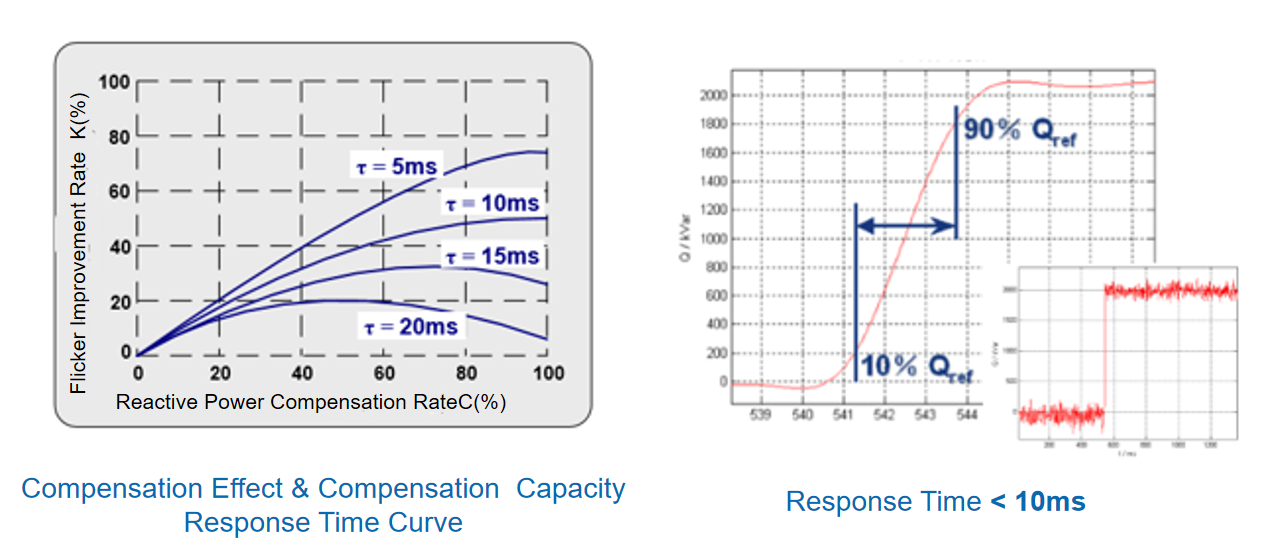
l Completes dynamic compensation in 5–10 milliseconds, far outpacing traditional devices.
l In short, SVG acts as a precise “reactive power regulator” and “power quality bodyguard” for modern power systems.
To understand SVG’s mainstream adoption, below is a professional indicator comparison with traditional reactive power devices:
|
Technical Indicators |
SVG (Static Var Generator) |
SVC (Thyristor Controlled Reactor) |
Fixed Capacitor/Reactor Banks |
|
Response Speed |
5–10 ms (millisecond level) |
20–30 ms |
100 ms–several seconds |
|
Reactive Power Regulation |
Bi-directional, continuous stepless |
Capacitive step-less, inductive step |
Unidirectional, stepped only |
|
Harmonic Suppression Capacity |
Strong (filters characteristic harmonics) |
Limited, may amplify harmonics |
Almost none |
|
Operation Loss |
Low (high conversion efficiency) |
Medium |
High |
|
Floor Area |
Small (modular design) |
Large |
Very large |
|
Grid Resonance Risk |
Extremely low |
High |
Extremely high |
|
Service Life & Maintenance |
Long, low maintenance |
Medium |
Short, frequent replacement |
|
Applicable Working Conditions |
Impact load, new energy, weak grid |
Stable industrial load |
Simple, low-demand scenarios |
This data shows why SVG can replace older equipment in high-speed rail, data centers, and power grids. Solar farms and wind farms also use it.
Though installed in power distribution rooms, converter stations, and industrial substations, SVG’s influence permeates daily life:
Urban Residential & Commercial Power Grids
Cities rely on stable grid voltage to support households, offices, malls, and hospitals. Modern city loads, like elevators, variable-speed air conditioners, LED lights, servers, and chargers, create reactive power loss.
They also create harmonic interference.
This can cause voltage flicker, equipment overheating, or outages.
In urban power substations, SVG adjusts reactive power often. It keeps voltage within ±5% of 380V/10kV.
It lowers energy loss and keeps lights bright. It helps appliances run safely and office equipment work well. Without SVG, urban power quality would degrade sharply.
New Energy Grid Integration (Wind & Solar Power)
Wind and solar power are intermittent. Wind speed changes, cloud cover shifts, and output can vary quickly. This can cause reactive power imbalance and voltage oscillations. These issues can threaten grid safety.
SVG is mandatory for large-scale wind and solar stations. It stabilizes voltage during rapid power changes, suppresses low-frequency oscillations, and enables smooth grid connection of clean energy. SVG supports every kilowatt-hour of green electricity you use behind the scenes.
Rail Transit (Subways & High-Speed Rail)
High-speed railways and subways use high-power traction converters. These can create strong impact loads and harmonic interference during startup and growth. Unadjusted
Reactive power causes voltage drops, endangering train safety and station equipment.
SVG used in rail transit traction systems reduces reactive power spikes within milliseconds. It stabilizes catenary voltage and supports smooth growth and on-time service. Your daily commute and intercity trips depend on SVG’s role in maintaining traction grid stability.
Industrial Manufacturing & Data Centers
Steel plants, aluminum factories, semiconductor fabs, and large data centers have strict power quality requirements. Low power factor leads to grid penalties; harmonics damage precision equipment; voltage fluctuations cause production interruptions.
SVG boosts system power factor to over 0.99, reducing energy waste, filtering harmonics, and protecting equipment. For data centers that support cloud computing, online payments, and social media, SVG ensures continuous power. It keeps your online activities stable.
Contemporary SVG products are highly integrated, digital, and modular power electronic devices with key technical features:
Full-Speed Bi-Directional Compensation: Switches between capacitive/inductive reactive power in milliseconds, adapting to impact loads like cranes and traction systems.
Modular Design: Standardized power modules support parallel expansion, easy installation, and quick maintenance, reducing on-site construction difficulty.
Harmonic Governance & Voltage Support: Compensates reactive power while suppressing 5th, 7th, 11th, and other characteristic harmonics.
Low Working Loss: Advanced IGBT and topology design cut self-loss to below 1%, outperforming SVC and capacitor banks.
Digital & Intelligent Control: Uses fast DSP+FPGA control systems. It supports remote monitoring, adaptive grid adjustment, and smart grid connection.
With new energy-dominated power systems, SVG evolves beyond standalone compensation toward energy storage integration, virtual grid stability, and multi-device coordination. Key trends:
SVG + Energy Storage Hybrid Systems: Combine reactive power support with active power regulation to enhance grid flexibility.
Medium-Voltage Compact SVG: Smaller, more integrated designs for distributed scenarios like residential districts and charging stations.
AI-Enhanced SVG Control: Machine learning predicts load fluctuations for pre-compensation, further improving stability.
As global power use grows rapidly, SVG remains essential to power system infrastructure.
SVG (Static Var Generator) is one of modern society’s most unknown yet influential technologies. It has no consumer brand or daily ads.But each time you turn on a light, ride the subway, use the internet, or use clean energy, SVG works quietly.It keep voltage stable, reduces harmonics, compensates reactive power, and supports a reliable grid.
You may never see an SVG device in person, but it truly powers your life every day. To engineers, SVG is key to ensuring power quality. To the public, it silently keeps electricity safe, stable and efficient. As smart grids and carbon neutrality develop, SVG will become even more important. It shows that the most vital technologies are often the ones we never see.



 IPv6 network supported