
 English
 français
 Deutsch
 español
 العربية
 中文
中文
STATCOM Solutions for Renewable Energy Grid Stability
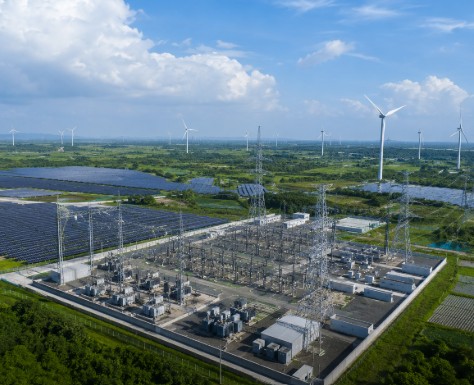
As renewable energy generation continues to expand worldwide, maintaining grid stability has become a critical challenge for utilities, power system operators, and industrial users. Solar farms, wind power plants, and other renewable energy sources introduce variability and intermittency into the electrical grid, creating voltage fluctuations, reactive power imbalances, and power quality issues. To address these challenges, STATCOM (Static Synchronous Compensator) technology has emerged as one of the most effective solutions for enhancing renewable energy grid stability.
This article explores how STATCOM systems support renewable energy integration, improve power quality, and ensure reliable grid operation.
A STATCOM is a power electronics-based device used in Flexible AC Transmission Systems (FACTS). It provides fast and dynamic reactive power compensation to regulate voltage levels and improve grid stability.
Unlike conventional capacitor banks or Static Var Compensators (SVCs), a STATCOM utilizes voltage source converters (VSCs) to inject or absorb reactive power almost instantaneously. This rapid response makes it particularly suitable for renewable energy applications where power output can change quickly due to weather conditions.
Dynamic reactive power compensation
Voltage regulation and stabilization
Power factor correction
Flicker mitigation
Harmonic reduction support
Fault ride-through enhancement
Grid code compliance assistance
Renewable energy resources such as solar and wind power are inherently variable. Cloud cover, wind speed fluctuations, and changing environmental conditions can cause rapid changes in power generation.
These variations may result in:
| Grid Challenge | Impact on Power System |
|---|---|
| Voltage fluctuations | Equipment stress and instability |
| Reactive power deficiency | Poor voltage regulation |
| Power factor issues | Reduced transmission efficiency |
| Grid disturbances | Increased risk of outages |
| Weak grid connections | Reduced reliability |
| Renewable intermittency | Unstable power flow |
As renewable penetration increases, grid operators require advanced compensation systems capable of maintaining stable voltage and reactive power support under dynamic operating conditions.
This is where STATCOM solutions for renewable energy grid stability become essential.
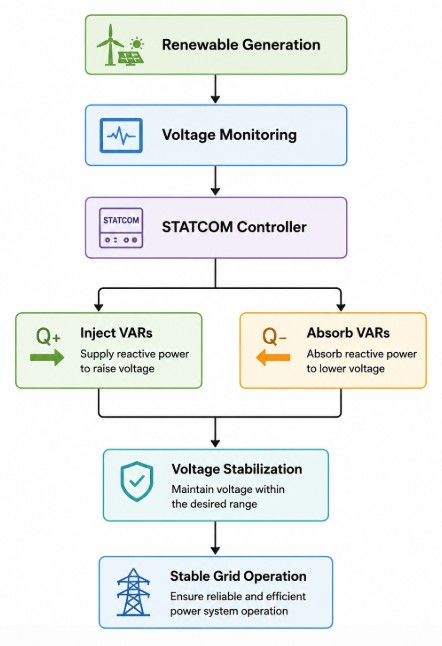
A STATCOM continuously monitors grid voltage and adjusts reactive power output accordingly.
When grid voltage decreases:
STATCOM supplies reactive power.
Voltage levels rise toward the desired range.
When grid voltage increases:
STATCOM absorbs reactive power.
Voltage levels return to normal.
The process occurs within milliseconds, allowing the grid to respond quickly to sudden renewable generation changes.
Wind and solar power output can change rapidly. STATCOM systems provide near-instantaneous voltage regulation, preventing voltage collapse and maintaining network stability.
Compared with traditional capacitor banks, STATCOM response times are significantly faster, often within one electrical cycle.
Modern grid codes require renewable power plants to provide reactive power support and maintain operation during voltage disturbances.
STATCOM systems help renewable facilities meet requirements such as:
Low Voltage Ride Through (LVRT)
High Voltage Ride Through (HVRT)
Reactive power capability
Voltage control performance
This improves project approval rates and grid acceptance.
Power quality issues can negatively affect both utilities and end users.
STATCOM technology helps reduce:
Voltage flicker
Voltage sag
Voltage swell
Reactive power fluctuations
As a result, renewable power plants can deliver cleaner and more reliable electricity.
By maintaining proper voltage levels, STATCOM devices enable transmission lines to operate more efficiently.
Benefits include:
Higher power transfer capability
Reduced transmission losses
Better utilization of existing infrastructure
Deferred investment in new transmission assets
Many renewable energy projects are located in remote regions where grid strength is limited.
Examples include:
Desert solar farms
Offshore wind projects
Rural renewable installations
STATCOM systems provide critical voltage support in these weak-grid environments, improving operational reliability and reducing instability risks.
Large photovoltaic (PV) installations experience rapid output changes due to cloud movement and irradiance variations.
STATCOM helps by:
Stabilizing voltage
Providing reactive power support
Improving inverter performance
Meeting utility interconnection requirements
Wind turbines generate fluctuating power due to changing wind conditions.
STATCOM systems assist with:
Voltage stabilization
Flicker reduction
Dynamic reactive power compensation
Fault ride-through capability
Many modern projects combine:
Solar power
Wind power
Battery energy storage systems (BESS)
STATCOM solutions coordinate reactive power management across multiple energy resources, creating a more stable and resilient power system.
| Feature | STATCOM | Capacitor Bank | SVC |
|---|---|---|---|
| Response Speed | Very Fast | Slow | Fast |
| Dynamic Control | Excellent | Limited | Good |
| Performance in Weak Grids | Excellent | Poor | Moderate |
| Voltage Regulation | Superior | Basic | Good |
| Renewable Integration | Ideal | Limited | Suitable |
The table illustrates why STATCOM has become the preferred technology for modern renewable energy installations.
As renewable penetration continues to grow, STATCOM technology is evolving to support more advanced grid requirements.
Emerging trends include:
Digital monitoring and diagnostics
AI-assisted voltage control
Integration with battery energy storage systems
Smart grid communication capabilities
Higher-capacity converter technology
These innovations will further improve the reliability and flexibility of renewable energy networks.
The global transition toward renewable energy demands advanced technologies capable of maintaining grid reliability and power quality. As solar and wind generation continue to expand, traditional reactive power compensation methods often struggle to meet modern grid requirements.
STATCOM solutions for renewable energy grid stability provide fast reactive power compensation, dynamic voltage regulation, improved power quality, and enhanced grid code compliance. Their ability to support weak grids and respond rapidly to changing renewable energy conditions makes them an essential component of today's power infrastructure.
For utilities, renewable energy developers, and industrial power users, investing in STATCOM technology represents a practical and future-ready approach to ensuring stable, efficient, and reliable grid operation.



 IPv6 network supported