

 English
 français
 Deutsch
 español
 العربية
 中文
中文
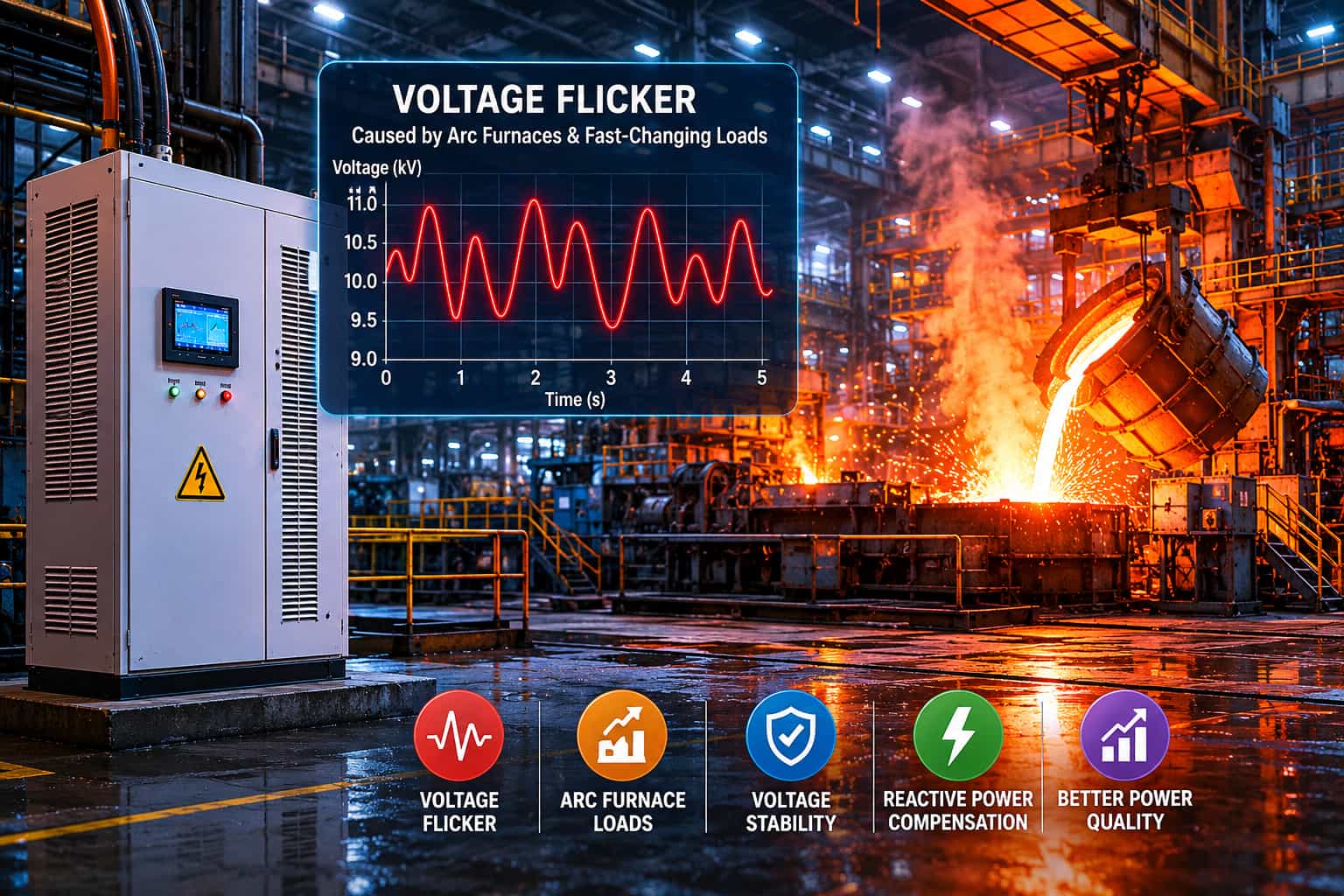
Voltage flicker is a serious power quality problem in steel plants. It is often caused by loads that change quickly. These loads include electric arc furnaces, rolling mills, ladle furnaces, large motors, and heavy equipment.
These loads do not draw power smoothly. Their demand changes quickly during melting, rolling, lifting, cutting, and cooling operations. When this happens, voltage can rise and drop repeatedly.
This creates visible flicker, unstable equipment operation, poor power factor, and stress across the medium voltage power system.
For steel plants, voltage flicker is not only a technical issue. It can affect production stability, equipment life, and power grid compliance.
A medium voltage STATCOM, also known as static var generator or medium voltage SVG, can help reduce voltage flicker through fast reactive power compensation.
Voltage flicker is a repeated voltage fluctuation in the electrical system.
When voltage changes quickly, lighting may appear to flicker. Sensitive equipment may also become unstable. In large industrial systems, voltage flicker can spread beyond one machine and affect the wider power network.
In steel plants, voltage flicker is usually caused by large loads that change rapidly. The most common example is the electric arc furnace.
During furnace operation, the arc is unstable. Current demand changes quickly. This creates rapid reactive power changes and voltage fluctuation.
If the electrical system cannot respond fast enough, flicker becomes worse.
Steel plants are among the most demanding industrial power users.
Many steel processes require high power in short and changing cycles. This makes the power system harder to control.
Common causes of voltage flicker in steel plants include:
These loads create sudden changes in active and reactive power demand. When the grid is weak or the transformer capacity is limited, voltage stability becomes harder to maintain.
This is why steel plant power quality needs dynamic compensation, not only basic power factor correction.
An electric arc furnace is one of the strongest sources of voltage flicker.
During melting, the arc changes constantly. The furnace current is not stable. This causes fast changes in reactive power demand.
When reactive power demand changes suddenly, voltage also changes. If these changes happen repeatedly, the result is voltage flicker.
Arc furnace power quality problems may include:
A standard capacitor bank may not respond fast enough to this type of load. Steel plants often need a faster solution.
Capacitor banks are commonly used for power factor correction. They can work in stable systems where the reactive power demand changes slowly.
Steel plants are different.
The load changes quickly. Reactive power demand can rise and fall within a short time. A capacitor bank works in steps, so it cannot follow these changes smoothly.
In some systems, capacitor switching may also create additional stress. If harmonics are present, capacitor banks may face resonance risk.
For voltage flicker, the main problem is response speed. The compensation device must react quickly enough to stabilize voltage during fast load changes.
This is where a medium voltage STATCOM becomes more suitable.
A medium voltage STATCOM provides dynamic reactive power compensation.
It monitors voltage and current in real time. When the steel plant load demands reactive power, the STATCOM supplies it. When the system has excess reactive power, the STATCOM absorbs it.
This fast response helps reduce voltage fluctuation and improve voltage stability.
In simple terms:
This makes STATCOM useful for steel plants, especially where electric arc furnaces and rolling mills create unstable power conditions.
A static var generator performs the same core function as STATCOM in many industrial power quality applications.
It provides fast reactive power compensation and helps keep power factor and voltage more stable.
For steel plants, SVG or STATCOM can help:
The main value is speed. Steel plant loads change too quickly for slow compensation systems. A static var generator follows the real load condition more accurately.
Check out out solution here https://www.ytelect.com/medium-voltage-statcom_c17
Voltage flicker can become a grid compliance issue.
If a steel plant causes excessive voltage fluctuation, the disturbance may affect nearby users or the utility network. Utilities may require the plant to reduce flicker before expansion or continued operation.
This is especially important for steel plants connected to medium voltage or high voltage networks.
A proper flicker control system can help reduce grid disturbance and improve the plant’s relationship with the utility.
In many cases, voltage flicker control is not optional. It becomes part of responsible industrial power system design.
Before selecting a STATCOM or SVG for voltage flicker control, engineers should review the actual site condition.
Important points include:
Correct sizing is important. The solution should be based on measured voltage fluctuation and reactive power demand, not only on equipment nameplate power.
Voltage flicker should be checked as part of the full power quality condition. Some steel plants also have harmonic distortion, poor power factor, and transformer heating. If reactive power fluctuation is the main issue, STATCOM or SVG is the key solution. If harmonics are also high, an active harmonic filter may be needed.
Steel plants should not treat voltage flicker as an isolated issue.
Flicker is usually part of a wider power quality problem. The same site may also have poor power factor, harmonic distortion, transformer heating, and unstable voltage.
A stronger strategy is to measure the system first. Then select the right solution based on the real problem.
If the main issue is fast reactive power fluctuation, STATCOM or SVG is the key solution. If harmonic distortion is also high, an active harmonic filter may be needed as part of the full power quality system.
The goal is not only to reduce flicker. The goal is to create a more stable steel plant power system.
Voltage flicker is common in steel plants because arc furnaces, rolling mills, and large industrial loads change quickly during operation.
These changes create reactive power fluctuation and voltage instability. If the system cannot respond fast enough, the plant may face flicker, poor power factor, equipment stress, grid complaints, and unstable production.
A medium voltage STATCOM or static var generator helps solve this problem with fast reactive power compensation. It improves voltage stability, reduces flicker, and supports better steel plant power quality.
For steel plants with arc furnaces or other fast-changing loads, dynamic compensation is often the stronger long-term solution.



 IPv6 network supported