Applicationof High-Voltage Dynamic Reactive Power Compensation Device (SVG) in Photovoltaic Power Stations
March 06 , 2026
Applicationof High-Voltage Dynamic Reactive Power Compensation Device (SVG) in Photovoltaic Power Stations
1 Introduction
Driven by the "dual carbon" goals, the new energy industry has become a core driver for China's energy structure transformation. Photovoltaic power generation has achieved large-scale development due to its clean and renewable characteristics. However, affected by changes in light intensity, the output of photovoltaic power generation systems is volatile and intermittent, which is prone to causing problems such as low power factor of the power grid, voltage fluctuation and flicker, and harmonic pollution, seriously affecting the power supply quality of the power grid and the grid-connection stability of photovoltaic power stations. As a new generation of reactive power compensation equipment, the High-Voltage Dynamic Reactive Power Compensation Device (SVG) has become the core solution for photovoltaic power stations to solve power quality problems due to its technical advantages of fast response and precise compensation. A large-scale photovoltaic power station has effectively improved the grid-connection power quality of the station and ensured the stable operation of the system by installing high-voltageSVG, providing practical reference for the design and application of reactive power compensation in large-scale photovoltaic power stations.
2 Site Overview
The photovoltaic power station is located in a photovoltaic industrial park, with a total project area of about 720,000 square meters, a total installed capacity of 30MW, , divided into 30 independent power generation units; it is equipped with 60 500kW grid-connected inverters, After the renovation, the annual reduction in assessment fees exceeded 3.5 million yuan, and the power generation efficiency of the photovoltaic power station increased by 1.2%.
3 Core Characteristics and Principle of High-Voltage Dynamic Reactive Power Compensation Device (SVG)
The photovoltaic power station selects the high-voltage dynamic reactive power compensation device (SVG) as the core power quality management equipment. The device is designed for the grid-connection needs of new energy power stations, and can realize multiple functions such as dynamic reactive power compensation, harmonic treatment, and voltage stabilization, adapting to the operating characteristics of volatile output of photovoltaic power stations.
3.1 Core Characteristics of SVG
The high-voltage SVG is designed with high adaptability, high reliability and high-precision compensation as the core, fully meeting the grid management needs of photovoltaic power stations. Its core characteristics are as follows:
Simplified installation, commissioning and parameter setting processes, and modular design adapts to the rapid construction needs of the power station site;
Fast dynamic response speed, with a response time of less than 1ms, which can real-time track the instantaneous changes of photovoltaic output;
When the compensation capacity is sufficient, the output current total harmonic distortion (THD) of the device is ≤3%, without harmonic pollution;
It can continuously and smoothly compensate inductive/capacitive reactive power, real-time treat grid harmonics, compensate negative sequence current, and effectively improve the grid-connection power factor;
It has excellent voltage support capability, which can suppress grid voltage flicker and sag, and stabilize the grid-connection point voltage of the photovoltaic power station;
The main circuit adopts a chain series structure of H-bridge power units composed of IGBT power devices, and the output step wave approximates a sine wave, with excellent waveform quality after filtering by the output reactor;
Adopting redundant design and modular architecture, the failure of a single power unit will not affect the operation of the entire system, ensuring high reliability of the equipment;
The switching process has no transient impact, no inrush current, no arc reignition, and the equipment can be put into operation again without discharge, with high operational safety;
Complete protection functions, integrating multiple protections such as overvoltage, undervoltage, overcurrent, overheating, phase loss, and power unit failure, with strong operational stability;
Reserved interface for cooperation with FC (Fixed Capacitor Compensation), which can realize the combination of fixed compensation and dynamic compensation, adapting to the compensation needs of different load conditions;
Equipped with a human-machine interaction touch screen, with comprehensive status display and convenient parameter setting, supporting on-site operation and remote monitoring;
Integrated with RS485, Ethernet and other communication interfaces, supporting Modbus standard communication protocol, which can be seamlessly connected to the power station monitoring system;
No need to consider the phase sequence of the AC system when connecting to the power grid, and the wiring method is simple, reducing the difficulty of on-site construction;
The control power supply is independently powered by 220VAC through UPS, and the device can still maintain normal operation even if the control power supply is cut off;
Supports parallel installation of multiple units, which can flexibly expand the compensation capacity, adapting to the expansion needs of the second and third phases of the photovoltaic power station.
3.2 Working Principle of SVG
The core working principle of the high-voltage SVG is: connect the self-commutated bridge circuit to the 35kV grid-connection point of the photovoltaic power station in parallel through a reactor, calculate the reactive current component required by the system by real-time detecting the grid voltage and current signals, and appropriately adjust the amplitude and phase of the output voltage on the AC side of the bridge circuit through the control strategy, or directly control the output current on its AC side, so that the device can accurately send or absorb the reactive current meeting the grid requirements, thereby realizing the purpose of dynamic reactive power compensation.
The device is divided into three modes according to the operating conditions: in the no-load operation mode, the output voltage of the device is consistent with the amplitude and phase of the grid voltage, no compensation current is output, and no compensation effect is produced; in the inductive operation mode, the output voltage amplitude of the device is lower than the grid voltage, and the lagging reactive current is output, which is equivalent to a continuously adjustable inductor, absorbing the capacitive reactive power of the grid; in the capacitive operation mode, the output voltage amplitude of the device is higher than the grid voltage, and the leading reactive current is output, which is equivalent to a continuously adjustable capacitor, sending capacitive reactive power to make up for the inductive reactive power deficit of the grid.
3.3 SVG System Structure
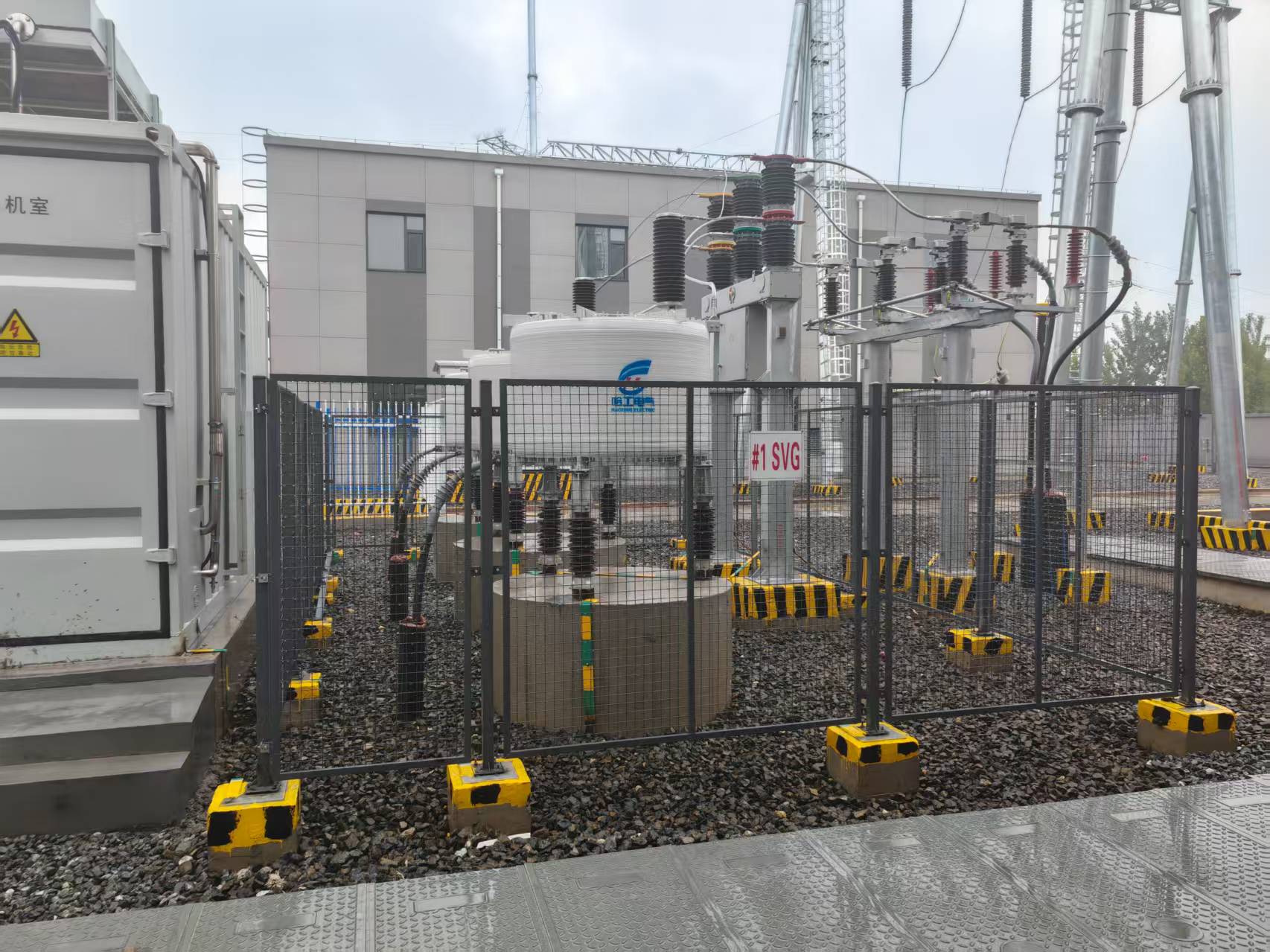
The main circuit of the high-voltage SVG adopts a chain inverter topology, with three phases connected in Y-type. The 35kV grade device is connected to the grid through a step-up transformer, and each phase is composed of 15 power units connected in series, adopting the N+1 redundancy operation mode. When a single unit fails, it is automatically bypassed to ensure the continuous operation of the system. The device is generally divided into two parts: power cabinet and control cabinet. The power cabinet includes core components such as IGBT power units, reactors, and cooling systems, responsible for power conversion and reactive power output; the control cabinet integrates analog quantity collection, switching quantity processing, fault protection, logic control, communication modules, etc., to realize real-time monitoring, operation control and remote interaction of the device. The cabinet adopts optical fiber communication interface, which has strong anti-interference ability and ensures stable transmission of control signals.
3.4 Comparative Advantages of SVG and Traditional Reactive Power Compensation Devices
Compared with traditional capacitive reactive power compensation devices (FC) and static var compensators (SVC), high-voltage SVG has significant technical advantages in the application of photovoltaic power stations, and the specific comparisons are as follows:
Higher compensation accuracy: The power factor after traditional capacitor compensation is generally between 0.85-0.92, while the power factor after SVG compensation can be stably above 0.98, meeting the high-standard grid-connection requirements of photovoltaic power stations;
Faster response speed: The single compensation response time of traditional reactive power compensation devices is ≥200ms, which cannot adapt to the instantaneous fluctuation of photovoltaic output. The SVG compensation response time is only 5-20ms, which can realize instantaneous and precise compensation of reactive power;
More flexible compensation method: Traditional devices are mostly 3-12 level stepped compensation, with step differences in increasing or decreasing compensation capacity, which is prone to over-compensation or under-compensation. SVG supports stepless continuous compensation starting from 0.1kvar, realizing precise matching of reactive power;
Stronger harmonic treatment capability: Traditional capacitive compensation devices will amplify grid harmonics and have no harmonic filtering function. SVG itself does not generate harmonics, does not amplify grid harmonics, and can filter out more than 50% of grid characteristic harmonics, effectively improving power quality;
Better voltage adaptability: The compensation capacity of traditional devices drops significantly when the grid voltage sags. When the grid voltage drops to 50% of the rated voltage, SVG can still maintain the output of rated compensation capacity, with excellent voltage support capability.
4 Analysis of SVG Operation in Photovoltaic Power Station
The 6Mvar high-voltage SVG of the photovoltaic power station is connected to the 35kV bus of the power station, operating in parallel with the photovoltaic inverter step-up unit. The device detects the real-time voltage and current data of the grid-connection point and automatically completes reactive power compensation and harmonic treatment. Through actual operation monitoring, the SVG device is fully adapted to the environmental conditions and operating conditions of the power station site, and various operating indicators meet the design requirements. The core operation effects are as follows:
(1) Convenient Installation and Commissioning, Adapting to On-site Conditions
SVG adopts a modular integral design. On-site, only cabinet fixing, cable connection and parameter commissioning are required, with less wiring and low construction difficulty. It takes only 7 days from equipment positioning to commissioning, which greatly shortens the power station commissioning cycle; the modular structure is also convenient for later maintenance, and a single power unit can be quickly replaced, reducing equipment operation and maintenance costs.
(2) Convenient Operation and Realizable Intelligent Monitoring
SVG is equipped with a high-definition human-machine interaction interface, which can real-time display key parameters such as compensation capacity, power factor, harmonic content, and equipment operation status, with simple on-site operation; at the same time, it is connected to the power station central monitoring system through RS485 interface, realizing functions such as remote start-stop, parameter modification, fault alarm, and data upload, meeting the intelligent operation needs of the power station. Operation and maintenance personnel can complete the full monitoring of the device in the central control room.
(3) Stable Power Factor, Meeting Grid-connection Standards
The grid-connection requirement of photovoltaic power stations requires the power factor of the grid-connection point to be maintained between 0.95~0.99. Before SVG is put into use, due to the fluctuation of photovoltaic output, the power factor of the power station fluctuates greatly between 0.88~1.0, which cannot meet the grid-connection requirements; after SVG is put into use, the device real-time tracks the reactive power demand and automatically adjusts the compensation capacity, so that the power factor of the power station's grid-connection point is stably maintained between 0.98~0.99, which not only avoids grid fines caused by low power factor, but also ensures the full grid-connection consumption of photovoltaic power.
(4) Effective Harmonic Treatment, Improving Power Quality
Before SVG is put into use, due to the operation of power electronic equipment such as inverters at the grid-connection point of the power station, the current harmonic distortion rate reaches 8%~12%, with obvious harmonic pollution; after SVG is put into use, the device effectively filters grid harmonics, and the current harmonic distortion rate at the grid-connection point is stably below 2%, which is far lower than the national standard requirements, greatly improving the power supply quality of the power grid, and at the same time reducing the damage of harmonics to power station equipment such as transformers and switchgear, extending the service life of the equipment.
(5) Suppressing Voltage Fluctuation, Stabilizing Grid Operation
The load on the power grid side in the area where the power station is located fluctuates greatly, and the output of the photovoltaic power station has instantaneous changes due to the influence of light, which is prone to causing voltage flicker and sag at the grid-connection point; relying on its fast dynamic response capability and voltage support capability, SVG effectively suppresses voltage fluctuation, making the 35kV bus voltage of the power station stable within ±2% of the rated voltage, avoiding the disconnection of photovoltaic inverters caused by voltage abnormalities, and ensuring the continuous and stable operation of the power station.
(6) Extremely Low Energy Consumption and Excellent Operation Efficiency
The SVG device adopts high-efficiency IGBT power devices and optimized control strategies, with an operation efficiency of up to 99.96% and extremely low power consumption. The annual self-power consumption of a single device is only about 2,000 kWh, which is far lower than that of traditional compensation devices, greatly reducing the self-power consumption of the power station and improving the overall power generation efficiency of the power station.
(7) Strong Environmental Adaptability, Adapting to Severe Working Conditions
The power station site has cold winters, high temperatures in summer, many strong wind days, and certain sand and dust pollution, which puts high requirements on the insulation, heat dissipation and anti-interference capabilities of the equipment. The SVG device is specially designed for plateau, cold and dusty environments, optimizing the insulation structure and cooling system, and configuring dust-proof sealing devices. Through actual operation verification, the device can operate stably under extreme temperature and humidity and sand and dust weather, with no fault shutdown records, and excellent environmental adaptability.


 English
 français
 Deutsch
 español
 العربية
 中文
中文



 IPv6 network supported