
 English
 français
 Deutsch
 español
 العربية
 中文
中文
Improving Medical Center Power Quality with STATCOM

Modern medical centers rely heavily on advanced electrical systems to support life-saving equipment, digital healthcare infrastructure, and uninterrupted patient care. From MRI scanners and CT imaging systems to intensive care units and laboratory automation, every department depends on stable and reliable power. Even a brief voltage fluctuation can disrupt operations, damage sensitive equipment, or compromise patient safety.
As healthcare facilities expand and integrate more electronic systems, power quality issues have become increasingly common. One effective solution gaining attention in healthcare infrastructure projects is the Static Synchronous Compensator (STATCOM). This advanced power electronics device helps maintain voltage stability, improve power factor, and reduce harmonic distortion in complex electrical networks.
This article explores how STATCOM technology improves power quality in medical centers through a practical case study and technical analysis.
Hospitals and healthcare campuses operate around the clock. Unlike commercial buildings, medical centers cannot tolerate power interruptions or unstable voltage conditions.
Common power quality challenges in healthcare facilities include:
Voltage sags during large equipment startup
Reactive power imbalance
Harmonic distortion from nonlinear medical devices
Flicker caused by rapidly changing loads
Overheating of transformers and cables
Reduced lifespan of sensitive equipment
These problems often originate from high-power medical devices such as:
| Equipment Type | Typical Electrical Impact |
|---|---|
| MRI Systems | High reactive power demand |
| CT Scanners | Rapid load fluctuations |
| HVAC Systems | Inductive load instability |
| Laboratory Equipment | Harmonic generation |
| UPS Systems | Nonlinear current distortion |
Poor power quality can lead to operational downtime, equipment malfunction, and increased maintenance costs.
A Static Synchronous Compensator (STATCOM) is a flexible AC transmission system (FACTS) device designed to regulate voltage and reactive power dynamically.
Unlike traditional capacitor banks, STATCOM systems use power electronic converters to provide fast and continuous reactive power compensation.
Voltage stabilization
Reactive power compensation
Power factor correction
Harmonic mitigation
Flicker reduction
Grid stability enhancement
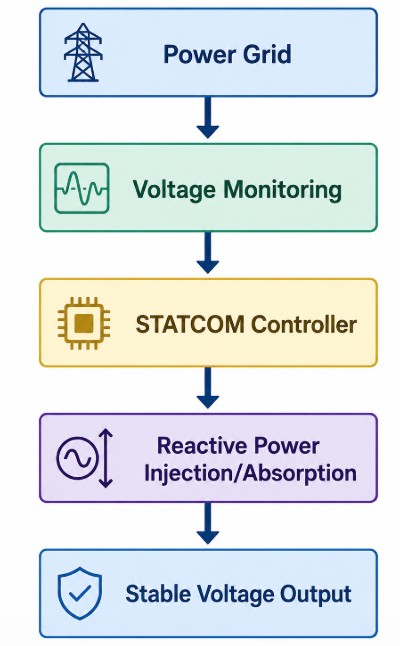
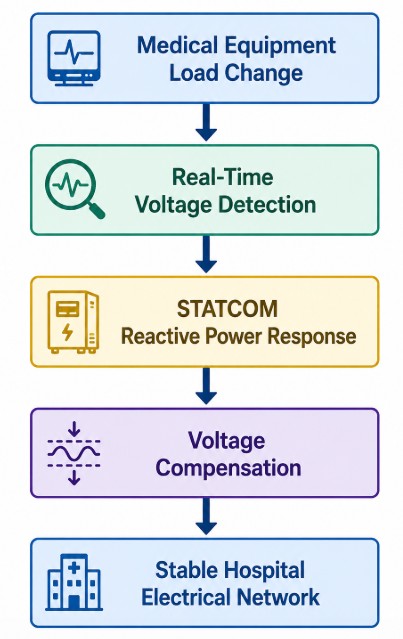
The operating principle of STATCOM can be summarized as follows:
Because STATCOM reacts within milliseconds, it is particularly effective in environments with rapidly changing electrical loads, such as hospitals.
A large regional medical center experienced recurring voltage instability issues after expanding its imaging department and surgical facilities.
| Parameter | Value |
|---|---|
| Facility Type | Regional Medical Center |
| Total Capacity | 18 MW |
| Main Loads | MRI, CT, HVAC, ICU |
| Existing Power Factor | 0.82 |
| Voltage Fluctuation | ±9% |
| Harmonic Distortion | 7.5% THD |
The hospital management identified several operational concerns:
MRI systems occasionally shut down during peak demand
Backup generators experienced synchronization issues
High utility penalties due to poor power factor
Increased overheating in transformers
An electrical audit revealed that the facility's rapidly changing reactive power demand exceeded the capability of existing capacitor banks.
Traditional compensation systems could not respond fast enough to dynamic load changes caused by imaging equipment startup cycles.
The engineering team selected a ±8 MVAR STATCOM solution for dynamic reactive power support.
The installed STATCOM system included:
| Component | Function |
|---|---|
| Voltage Source Converter | Dynamic reactive compensation |
| DSP-Based Controller | Real-time monitoring |
| Harmonic Filter | THD reduction |
| Air Cooling System | Thermal management |
| SCADA Integration | Remote supervision |
The STATCOM unit was connected to the hospital’s 11 kV distribution network near the imaging department.
The system continuously monitored voltage conditions and injected or absorbed reactive power depending on network requirements.
After six months of operation, the hospital reported substantial improvements in electrical performance.
| Performance Indicator | Before STATCOM | After STATCOM |
|---|---|---|
| Power Factor | 0.82 | 0.98 |
| Voltage Fluctuation | ±9% | ±2% |
| Harmonic Distortion | 7.5% THD | 3.1% THD |
| Transformer Temperature | High | Normal |
| Utility Penalties | Frequent | Eliminated |
The facility also observed:
Stable MRI operation during peak demand
Improved generator synchronization
Reduced maintenance incidents
Lower energy losses
Better operational reliability
The hospital engineering department estimated annual energy savings of approximately 12%.
Medical loads can change within milliseconds. STATCOM systems respond almost instantly compared to conventional capacitor banks.
Sensitive imaging and diagnostic equipment require stable voltage conditions. STATCOM minimizes damaging fluctuations.
Improved power factor reduces utility penalties and lowers overall energy consumption.
Hospitals rely heavily on emergency generators and UPS systems. STATCOM improves synchronization and transient stability during power transitions.
STATCOM systems can be expanded as healthcare campuses grow and add new electrical loads.
When implementing STATCOM in a medical center, engineers should evaluate:
Load profile characteristics
Harmonic levels
Existing power factor
Generator interaction
Space limitations
Cooling requirements
SCADA compatibility
Accurate power quality analysis is essential before system sizing and deployment.
As hospitals continue digitizing operations and adopting advanced medical technologies, electrical infrastructure requirements will become more demanding.
Future healthcare power systems are expected to include:
Smart grid integration
AI-based energy management
Renewable energy support
Battery energy storage systems
Advanced STATCOM control platforms
STATCOM technology will play an increasingly important role in ensuring resilient and intelligent healthcare energy networks.
Reliable electrical infrastructure is critical for modern healthcare operations. Voltage instability, harmonic distortion, and poor reactive power management can negatively affect patient care and equipment reliability.
The case study presented here demonstrates how STATCOM technology significantly improved power quality in a regional medical center. By stabilizing voltage, correcting power factor, and reducing harmonics, the hospital achieved greater operational reliability and lower energy costs.
As healthcare facilities continue expanding their electrical demands, STATCOM systems provide a practical and highly effective solution for maintaining stable and efficient power networks.



 IPv6 network supported