

 English
 français
 Deutsch
 español
 العربية
 中文
中文
AHF and SVG for Water Treatment Plants
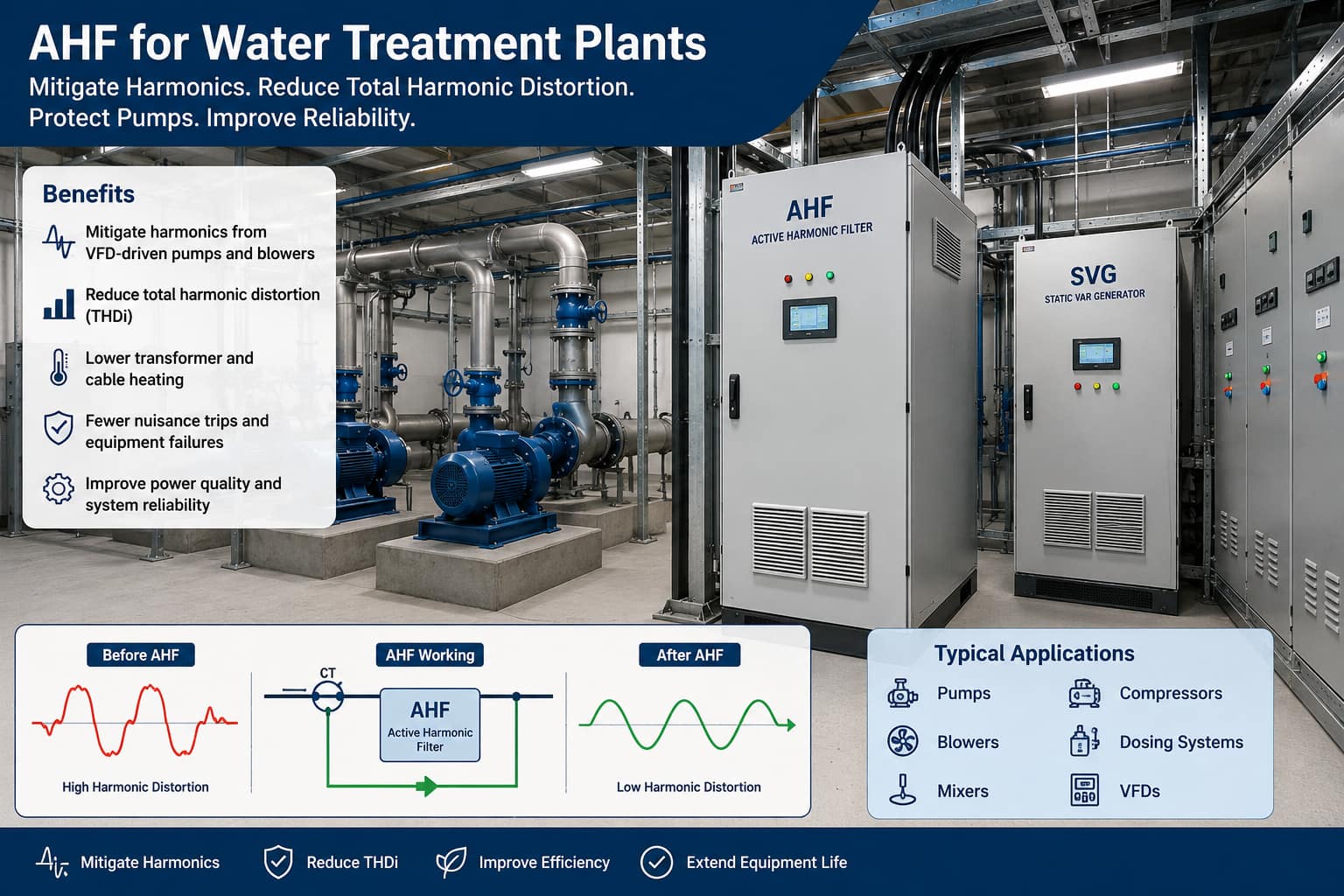
Water treatment plants depend on a stable power supply. Pumps, blowers, mixers, compressors, dosing systems, and control panels must operate continuously. If the electrical system becomes unstable, the treatment process can face equipment trips, overheating, poor efficiency, and higher maintenance costs.
Many water treatment plants now use variable frequency drives, UPS systems, soft starters, and automation equipment. These devices improve process control and energy efficiency. However, they can also create harmonic distortion, poor power factor, voltage fluctuation, and electrical stress.
This is why AHF and SVG for water treatment plants are becoming important power quality solutions. An Active Harmonic Filter helps mitigate harmonics, while a Static Var Generator improves power factor correction and voltage stability.
A water treatment plant is not a fixed electrical load. Pump speed changes during the day. Blower demand changes according to the treatment process. Some motors start and stop often. Other equipment runs continuously for long hours.
This changing load pattern puts pressure on the electrical system.
Common problems include:
harmonic distortion from VFDs
poor power factor from motor loads
voltage fluctuation during load changes
transformer and cable heating
nuisance breaker trips
reduced motor efficiency
stress on capacitor banks
unstable control system performance
For a water treatment plant, electrical reliability is process reliability. If pumps or blowers stop unexpectedly, the treatment system can be affected.
Variable frequency drives are widely used in water treatment plants. They control pump and blower speed, reduce energy waste, and improve process flexibility.
The problem is that VFDs are nonlinear loads. They do not draw current in a smooth sine wave. Instead, they draw current in pulses. This creates harmonic current and increases total harmonic distortion in the electrical system.
When total harmonic distortion becomes too high, the effect spreads through transformers, cables, switchgear, protection devices, and control panels. The plant may still operate, but the system runs hotter and less efficiently.
This is where an Active Harmonic Filter becomes useful. It helps mitigate harmonics in real time and keeps the current waveform cleaner.
An Active Harmonic Filter detects harmonic current and injects opposite compensation current into the system. This reduces harmonic distortion before it spreads through the electrical network.
For water treatment plants, an AHF can help:
mitigate harmonics from VFD-controlled pumps
reduce total harmonic distortion
lower transformer heating
protect cables and switchgear
reduce nuisance tripping
improve current waveform quality
support a more stable power supply
Unlike passive filters, an Active Harmonic Filter responds dynamically. This matters because water treatment plant loads change throughout the day. A fixed filter may not match every operating condition, but an AHF can adjust according to the real harmonic current.
Large pumps, blowers, and motor systems require reactive power. If reactive power is not controlled, the plant’s power factor drops.
Poor power factor causes higher current in the electrical system. This increases losses in transformers, cables, and switchgear. It also reduces available system capacity. In some regions, poor power factor can lead to utility penalties.
This is why power factor correction is important in water treatment plants. Better power factor helps the plant use electrical capacity more efficiently and reduces unnecessary stress on the power supply system.
A Static Var Generator provides dynamic reactive power compensation. It improves power factor correction and supports voltage stability when motor loads change.
Traditional capacitor banks can work in stable systems. However, water treatment plants often have changing loads and harmonic distortion. In this condition, capacitor banks may respond too slowly or face harmonic stress.
An SVG is faster and more flexible. It can inject or absorb reactive power in real time. This helps maintain a stable power factor and reduces voltage fluctuation during pump and blower operation.
For water treatment plants, SVG can help:
improve power factor correction
stabilize voltage
reduce reactive power losses
lower transformer stress
improve system efficiency
support changing motor loads
strengthen the plant power supply
Some water treatment plants have both harmonic distortion and poor power factor. In this case, using only one solution may not solve the full problem.
An Active Harmonic Filter helps mitigate harmonics and reduce total harmonic distortion.
A Static Var Generator improves power factor correction and voltage stability.
Together, AHF and SVG provide a stronger power quality solution for water treatment plants.
This combined solution is useful when a plant has:
many VFD-controlled pumps
large blower systems
poor power factor
high harmonic distortion
transformer overheating
capacitor bank failures
unstable voltage
repeated electrical trips
future expansion plans
The goal is not only to improve one electrical reading. The goal is to protect the full electrical system and keep the treatment process running reliably.
AHF and SVG can be installed in different parts of a water treatment plant depending on the system design.
Common locations include:
main low-voltage distribution panel
motor control center
VFD cabinet
pump control room
blower control panel
transformer secondary side
main incomer panel
The correct installation point should be based on measurement. Engineers should check harmonic current, power factor trend, transformer loading, and voltage stability before final selection.
Before choosing AHF or SVG, engineers should review the actual electrical condition of the plant.
Important points include:
system voltage
transformer capacity
number of VFDs
pump and blower motor ratings
measured total harmonic distortion
main harmonic orders
power factor trend
load variation during operation
existing capacitor banks
cable and transformer temperature
target compensation level
The right solution should be based on real measurement, not only the total motor power. This helps avoid undersizing, oversizing, or placing the device in the wrong part of the system.
Improving power quality helps water treatment plants reduce hidden electrical stress.
The main benefits include:
more stable power supply
lower harmonic distortion
better power factor correction
less transformer and cable heating
fewer nuisance trips
longer equipment life
lower maintenance risk
better use of electrical capacity
stronger support for future expansion
For water treatment plants, power quality is not only an electrical issue. It affects reliability, maintenance, and process stability.
Water treatment plants rely on VFD-controlled pumps, blowers, motors, and control systems. These loads improve efficiency, but they can also create harmonic distortion, poor power factor, voltage fluctuation, and overheating.
AHF and SVG for water treatment plants provide a practical solution. An Active Harmonic Filter helps mitigate harmonics and reduce total harmonic distortion. A Static Var Generator improves power factor correction and supports voltage stability.
For plants facing unstable power supply, transformer heating, electrical trips, or poor power factor, AHF and SVG can improve long-term reliability and reduce system stress.
For realible solutions, please check our product catalog.



 IPv6 network supported