Electricity is generated by generating stations and transmitted to load centers from where it is distributed to end consumers. These load centers are controlled by distribution utilities, and there is an inter-change of energy between different utilities connected to the grid. Consumers connected to the distribution utilities, though consuming active energy may or may not consume reactive energy. ...
Night-Time Reactive Power Management and Ferranti Effect Voltage Control in Long Solar PV Feeder Networks Quick Engineering Answer: In large-scale solar PV farms with extensive medium-voltage (MV 33kV/35kV) underground collector networks (often exceeding 50 km in cumulative length), zero-generation night-time conditions trigger the Ferranti Effect. The distributed shunt capacitance of lightly load...
YT ELECTRIC has been offering a comprehensive range of key components for Automatic Power factor correction (APFC) and power quality solutions for many years. The rapid development of industry and infrastructure resulted in the increased usage of power electronic loads which demands a highly dynamic response time for reactive power compensation. Conventional reactive power compensation only with p...
Power factor is a measurement of electrical system efficiency. Many utilities have a power factor penalty built into their rate structure to penalize users with a low power factor reading in their electrical system. To improve the power factor, the most common solution is to install a capacitor banks, But Static Var Generator is the best power factor correction product. There are 3 kinds of...
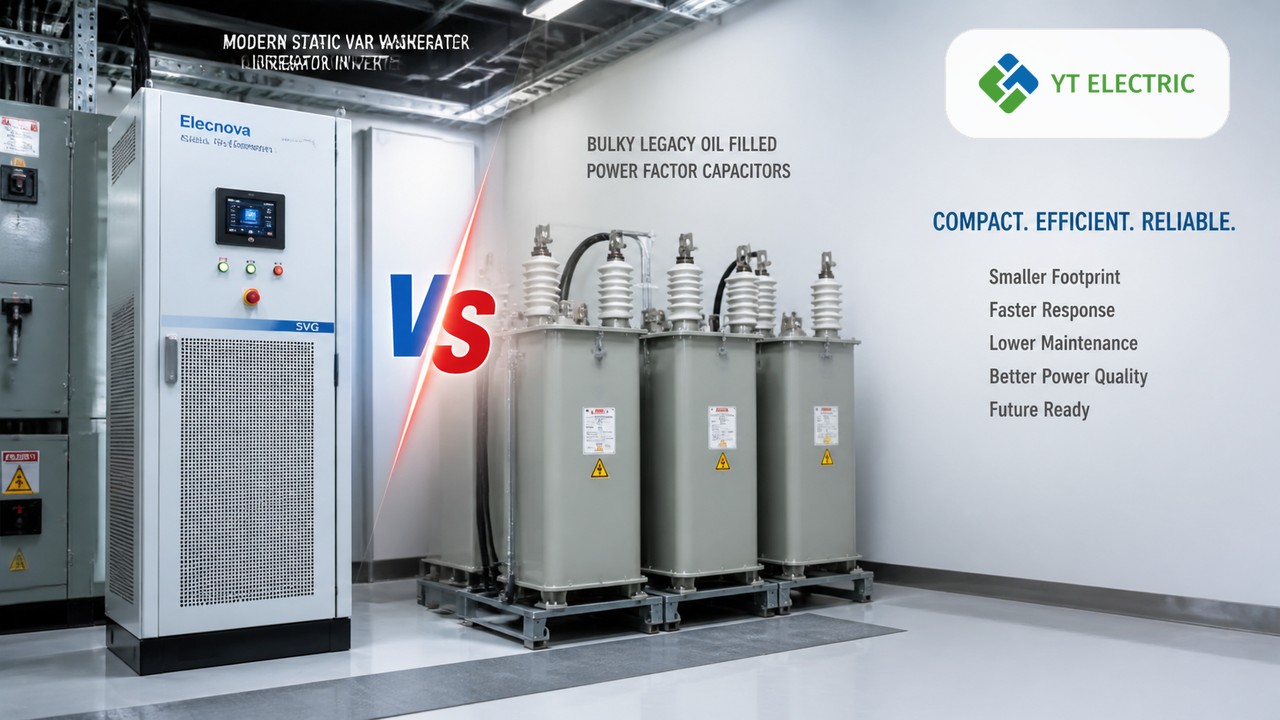
Static Var Generator (SVG) vs. Traditional Capacitor Banks: The Comprehensive Engineering & ROI Comparison Quick Engineering Answer: While traditional Automatic Power Factor Correction (APFC) capacitor banks rely on electromechanical contactors and discrete capacitor steps to supply static capacitive vars, a modern Static Var Generator (SVG) utilizes high-speed 3-level IGBT inverter technology...
The reactive power consumed by the transformer is generally about 10% to 15% of its rated capacity, and its no-load reactive power is about 1/3 of the full load. Therefore, in order to improve power factor (PF) of the power system, the transformer should not operate at no-load or in a long-term low-load operation state. Vigorously improving the power factor of transformers, reducing line losses, a...
Low voltage automatic contactor switched capacitor banks or filter banks typically use a delay time of 30 – 40 seconds between steps. This delay time is chosen to ensure that the capacitors have discharged prior to being re-connected. The long delay time limits the autobank’s ability to track rapidly changing loads. The slow response time may result in an overload condition in filter b...
Hybrid power factor correction Hybrid Active power factor correction systems utilise power electronics and digital control to achieve active reactive current compensation for specific and high performance solutions. YTPQC hybrid power factor correction system is comprised from both capacitor based and Static Var Generator(SVG,Active Power Factor correction). Static Var Generator is use...


 English
 français
 Deutsch
 español
 العربية
 中文





 IPv6 network supported