
 English
 français
 Deutsch
 español
 العربية
 中文
中文
Enhancing AHF Reliability with Conformal Coating Protection
Active Harmonic Filters (AHFs) play a critical role in modern power systems. They reduce harmonic distortion, improve power quality, and protect sensitive electrical equipment. As AHFs are increasingly deployed in industrial automation, renewable energy systems, EV charging infrastructure, and data centers, long-term operational reliability has become more important than ever.
One often overlooked factor affecting AHF durability is environmental exposure. Dust, moisture, corrosive gases, and temperature fluctuations can gradually damage internal electronic components. To address these challenges, manufacturers are increasingly adopting conformal coating protection inside AHF modules.
This article explores how conformal coating improves AHF reliability, the major coating technologies available, and why internal three-proof protection has become essential for advanced power electronics.
Conformal coating is a thin polymer film applied to printed circuit boards (PCBs) and electronic assemblies. The coating “conforms” to the contours of components, creating a protective barrier against environmental contaminants.
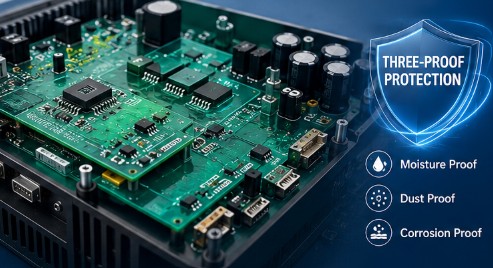
The term “three-proof protection” generally refers to resistance against:
Moisture and humidity
Dust and contamination
Corrosion and chemical exposure
For AHF systems operating in demanding industrial environments, these protective properties significantly improve long-term stability.
AHFs contain high-density electronic components, including:
IGBT modules
Capacitors
DSP control boards
Gate driver circuits
Current sensors
Communication interfaces
These components operate continuously under high electrical stress and thermal cycling. Without adequate protection, environmental contaminants can lead to:
| Environmental Factor | Potential Impact on AHF |
|---|---|
| Humidity | Insulation degradation and leakage current |
| Dust accumulation | Overheating and short circuits |
| Salt spray | Corrosion of PCB traces |
| Chemical vapors | Component oxidation |
| Condensation | Signal instability and failure |
In coastal regions, factories, mining facilities, and chemical plants, these risks are especially severe.
Moisture is one of the most common causes of electronic failure. Conformal coating forms a sealed barrier over sensitive circuits, reducing the risk of condensation and insulation breakdown.
For AHFs installed in humid environments or outdoor electrical cabinets, this protection is critical.
Industrial atmospheres often contain sulfur, chlorine, or other corrosive gases. Over time, these contaminants can corrode copper traces and solder joints.
A high-quality conformal coating minimizes direct exposure to corrosive substances and extends PCB lifespan.
Conformal coatings improve dielectric insulation performance. This helps prevent arcing, leakage current, and electrical tracking between densely packed conductors.
For high-voltage AHF applications, improved insulation directly supports system safety and operational stability.
Dust buildup can trap heat and reduce cooling efficiency. Conductive particles may also create unintended electrical paths.
The protective coating helps isolate sensitive circuitry and reduces contamination risks inside the module.
AHFs frequently experience heating and cooling cycles during operation. Repeated expansion and contraction can stress solder joints and components.
Flexible coating materials help absorb mechanical stress and reduce fatigue-related failures.
Different coating materials provide different performance characteristics. Selecting the correct material depends on the operating environment and reliability requirements.
| Coating Type | Main Advantages | Typical Applications |
|---|---|---|
| Acrylic | Easy repair and low cost | General industrial AHFs |
| Silicone | Excellent thermal resistance | High-temperature systems |
| Polyurethane | Strong chemical resistance | Chemical plants |
| Epoxy | High mechanical strength | Harsh environments |
| Parylene | Superior thin-film protection | High-end electronics |
Silicone and polyurethane coatings are commonly preferred for industrial AHFs because of their balance between thermal stability and environmental resistance.
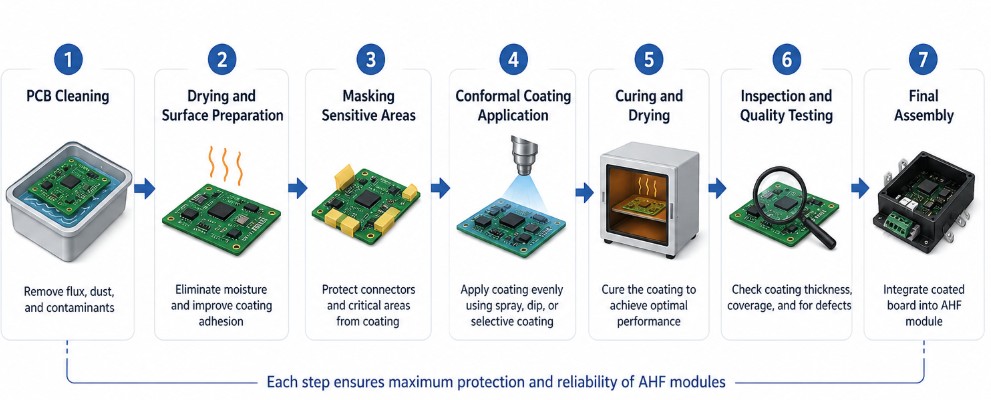
The coating process must be carefully controlled to ensure consistent protection.
Proper cleaning before coating is especially important. Any contamination trapped beneath the coating can reduce effectiveness and reliability.
When integrating conformal coating into AHF production, manufacturers should consider several important factors:
Excessively thick coatings may affect heat dissipation, while overly thin coatings may provide insufficient protection.
Typical coating thickness ranges from 25 to 100 microns depending on application requirements.
AHFs generate significant heat during operation. Coating materials must maintain performance under elevated temperatures without cracking or degrading.
Some coatings are easier to remove and repair than others. Acrylic coatings generally offer simpler maintenance compared to epoxy systems.
For high-volume manufacturing, automated spraying or selective coating systems improve consistency and reduce production variability.
Conformal coating protection is particularly valuable in industries where AHF systems operate continuously under demanding conditions.
Renewable energy inverters
Industrial motor drives
EV charging stations
Smart manufacturing systems
Data centers
Marine electrical systems
Mining operations
In these environments, enhanced environmental protection can significantly reduce maintenance frequency and downtime.
As power electronics continue evolving toward higher power density and smarter digital control, protective technologies must also advance.
Several emerging trends include:
Low-VOC environmentally friendly coatings
Nano-coating technologies
Automated robotic dispensing systems
AI-assisted coating inspection
High-thermal-conductivity protective materials
These innovations will further improve AHF operational reliability while supporting sustainable manufacturing goals.
Conformal coating protection has become an essential reliability strategy for modern Active Harmonic Filter systems. By protecting sensitive internal electronics from moisture, dust, corrosion, and thermal stress, manufacturers can significantly improve AHF durability and operational stability.
As industrial environments become increasingly demanding, internal three-proof protection is no longer optional—it is a critical part of high-performance AHF design.
For manufacturers and system integrators seeking long-term power quality performance, investing in advanced conformal coating technology offers both technical and economic advantages.



 IPv6 network supported