

 English
 français
 Deutsch
 español
 العربية
 中文
中文
Active Harmonic Filter for Solar Inverters
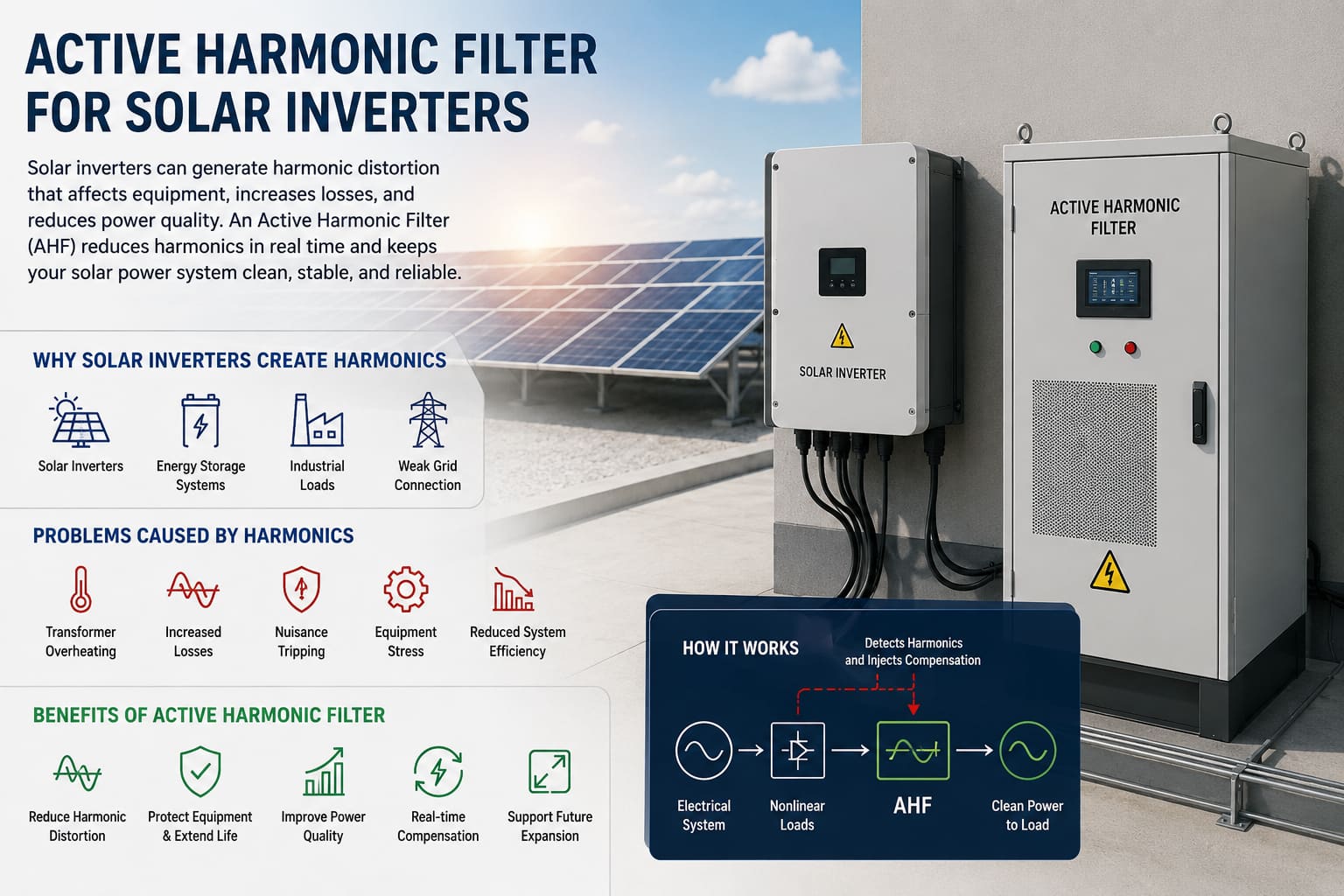
Solar inverter harmonics are common in commercial and industrial solar systems. When harmonic distortion increases, transformers, cables, breakers, and switchgear carry extra electrical stress. An active harmonic filter for solar inverters helps reduce harmonics in real time and improves solar power quality across the whole system.
Solar power systems are expanding fast in factories, farms, commercial buildings, and renewable energy plants. Solar inverters make this possible by converting DC power from solar panels into usable AC power.
But solar inverters can also create power quality problems.
One of the most common issues is harmonic distortion. If solar inverter harmonics are not controlled, they can raise heat, shorten equipment life, and harm electrical system stability.
This is why many solar projects now use an active harmonic filter. An AHF helps reduce harmonic distortion in solar systems and keeps the power network cleaner, safer, and more reliable.
A solar inverter is a power electronic device. It does not draw or deliver current in the same way as a simple linear load.
During operation, the inverter switches power electronically. This process can create harmonic currents. These unwanted currents move through the electrical system and distort the normal waveform.
Solar inverter harmonics are more common when the system includes:
· grid-tied solar inverters
· battery energy storage systems
· variable loads
· weak grid connection
· long cable distances
· mixed industrial loads
· transformer-based distribution systems
In small systems, the effect may be limited. In larger solar plants or commercial solar installations, harmonic distortion can become a serious power quality issue.
Harmonic distortion does not always cause immediate failure. The system may continue running while hidden electrical stress builds over time.
Common problems include:
· transformer overheating
· higher cable losses
· nuisance breaker trips
· unstable current waveform
· reduced inverter performance
· stress on switchgear and protection devices
· lower long-term reliability
This is why solar power quality should be reviewed during system design, not only after problems appear.
If the harmonic level becomes too high, the site may also face compliance issues with local grid requirements. For grid-connected solar projects, clean power output is not optional. It is part of stable and professional operation.
An active harmonic filter is a power quality device. It detects harmonic current and injects compensation current in real time.
In simple terms, it cancels unwanted harmonic currents before they spread through the system.
Unlike passive filters, an active harmonic filter does not depend on one fixed tuning point. It adjusts automatically as the solar inverter output changes. This makes it suitable for solar systems where power generation rises and falls throughout the day.
For solar projects, an AHF helps improve waveform quality, reduce harmonic distortion, and protect electrical equipment.
Solar generation is not constant. Cloud movement, sunlight intensity, and load changes can all affect the inverter output.
This makes solar systems dynamic.
A fixed harmonic solution may not respond well when the system condition changes. An active harmonic filter is more flexible because it follows the real electrical condition of the site.
Main benefits include:
· real-time harmonic compensation
· better solar power quality
· reduced transformer heating
· lower stress on cables and switchgear
· improved system reliability
· better support for weak-grid solar projects
· easier expansion for future solar capacity
This makes AHF for solar systems a practical choice for modern renewable energy projects.
Harmonics can appear at different points in a solar power system.
Common areas include:
· inverter output side
· low-voltage distribution panel
· transformer low-voltage side
· main incoming cabinet
· point of common coupling
· combined solar and load busbar
The correct installation point depends on the system layout. In many cases, engineers install the active harmonic filter near the main distribution point or close to the harmonic source.
A proper measurement is always better than guessing. The filter should be selected based on actual harmonic current, not only the inverter capacity.
Passive filters can work in some stable systems. They are usually designed for specific harmonic orders.
But solar systems often change during operation. Output changes in the morning, at noon, during cloudy periods, and in the evening. If the system also includes industrial loads, the harmonic profile can change even more.
This is where an active harmonic filter has a stronger advantage.
A passive filter is fixed.
An active harmonic filter is dynamic.
For solar inverter harmonics, dynamic compensation is often safer because the filter responds to the real waveform instead of relying on a fixed design condition.
Before selecting an active harmonic filter for solar inverters, the site should be reviewed properly.
Key points include:
· system voltage
· inverter capacity
· measured harmonic current
· THDi and THDv levels
· dominant harmonic orders
· transformer size
· load variation
· grid connection point
· existing capacitor banks
· target harmonic level
· future expansion plan
This information helps size the AHF correctly. It also prevents undersizing or installing the filter in the wrong location.
Solar projects are no longer small backup systems. Many sites now depend on solar power for daily operation.
Factories use solar to reduce energy cost. Farms use solar for pumping and irrigation. Commercial buildings use solar to reduce grid demand. Energy storage systems also connect with solar inverters to improve self-consumption and backup power.
As these systems grow, power quality becomes more important.
Poor solar power quality can reduce the value of the whole project. Clean power helps the site protect equipment, improve efficiency, and maintain stable operation.
An active harmonic filter supports that goal by reducing harmonics at the source.
An active harmonic filter can be used in many solar-related projects.
Office buildings, malls, hotels, and hospitals often combine solar inverters with HVAC, UPS systems, elevators, and LED lighting. These mixed loads can increase harmonic distortion.
Factories using solar power may already have VFDs, rectifiers, motors, and production equipment. Adding solar inverters can increase the need for harmonic control.
Solar pumping systems use inverters and motors. Harmonic distortion and poor power quality can affect pump reliability and motor life.
Battery energy storage systems use power converters. When combined with solar inverters, the harmonic environment can become more complex.
In weak-grid areas, harmonic distortion and voltage fluctuation can have a stronger impact. AHF helps improve power quality and reduce stress on the network.
Solar inverter harmonics can reduce system reliability if they are not controlled. Harmonic distortion adds heat, losses, and stress to transformers, cables, and protection devices.
An active harmonic filter is a practical power quality solution for solar systems. It reduces harmonics in real time, improves solar power quality, and helps the electrical system operate more reliably.
For commercial, industrial, and solar-plus-storage projects, AHF for solar inverter applications is becoming an important part of modern power quality design.



 IPv6 network supported