

 English
 français
 Deutsch
 español
 العربية
 中文
中文
Medium Voltage STATCOM for PF Correction
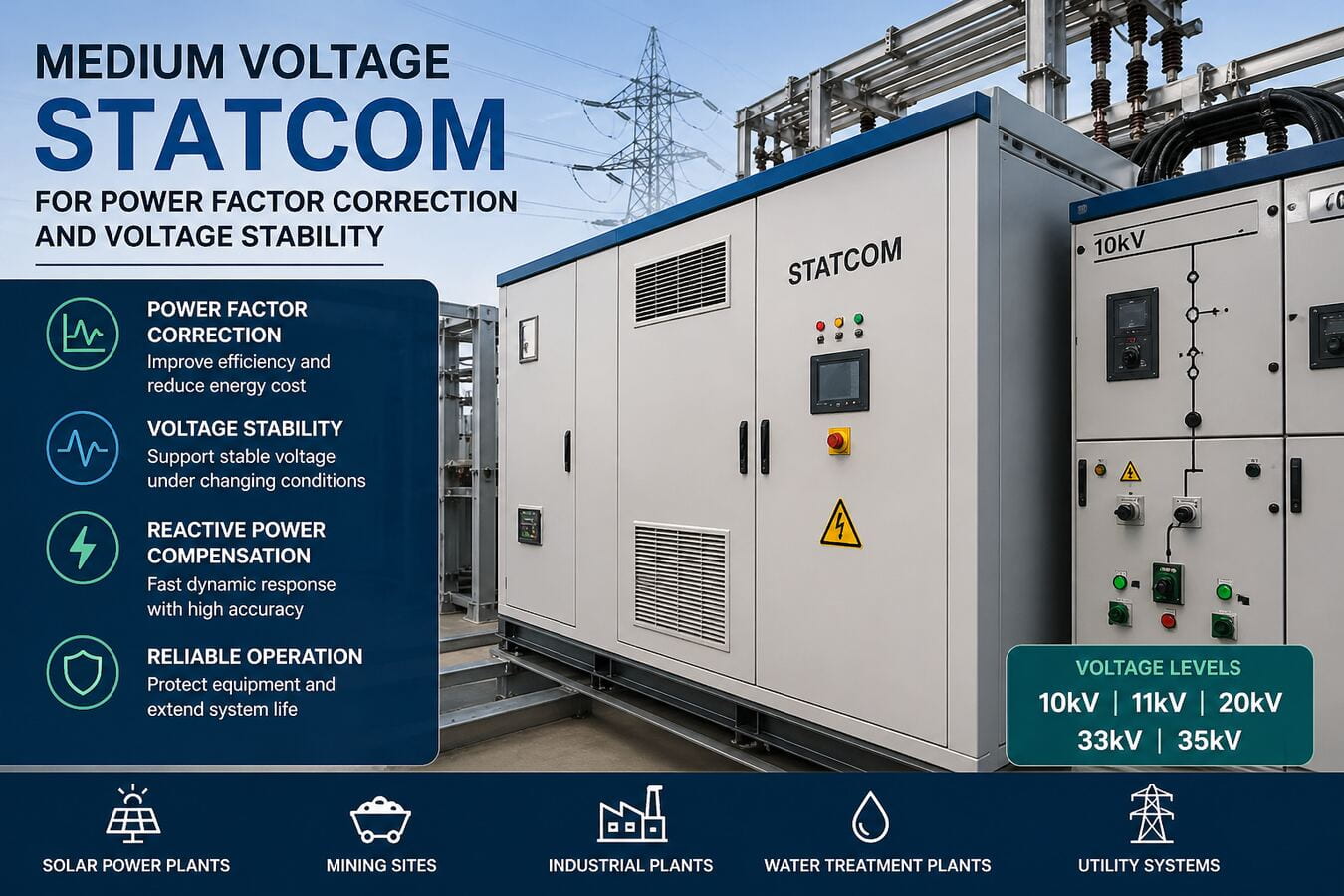
Medium voltage power systems need stable voltage and accurate power factor correction. Solar plants, mining sites, factories, water treatment plants, and utility projects often operate at 10kV, 11kV, 20kV, 33kV, or 35kV. At this level, poor power quality can affect the full electrical network.
A medium voltage STATCOM is used to solve this problem. It provides fast reactive power compensation and helps maintain voltage stability when load demand changes. It is also called medium voltage SVG in many power quality projects.
Unlike capacitor banks, a medium voltage STATCOM does not rely on fixed compensation steps. It adjusts output in real time. This makes it useful for systems with changing loads, solar generation, large motors, or unstable grid conditions.
A medium voltage STATCOM is a dynamic reactive power compensation system. It injects or absorbs reactive power according to the real condition of the electrical network.
When the system needs reactive power, the STATCOM supplies it. When the system has too much reactive power, the STATCOM absorbs it. This helps improve power factor correction and keeps voltage more stable.
A medium voltage SVG is commonly used in solar plants, mines, factories, wind projects, and utility-connected power systems. Its main job is to improve power factor, support voltage stability, and reduce unnecessary electrical stress.
Poor power factor means the system carries more current than needed. This increases losses in transformers, cables, and switchgear. It can also reduce usable system capacity.
In medium voltage systems, poor power factor can cause:
· higher utility penalties
· transformer heating
· cable losses
· voltage drops
· lower system efficiency
· reduced grid stability
· poor use of installed capacity
This is why power factor correction is important for large electrical systems. A medium voltage STATCOM helps keep the system close to the target power factor in real time.
Capacitor banks can help with power factor correction in stable systems. But many medium voltage systems do not have stable load demand.
Solar output changes during the day. Mining equipment starts and stops. Industrial motors create fast reactive power changes. These changes can make fixed capacitor steps too slow or inaccurate.
A capacitor bank may overcompensate or undercompensate when the load changes quickly. It may also face stress if harmonic distortion is present.
A medium voltage STATCOM gives dynamic reactive power compensation. It follows the real load condition and adjusts output continuously. This supports better voltage stability and smoother power factor control.
Solar power plants often connect to medium voltage grids. Common voltage levels include 10kV, 11kV, 20kV, 33kV, and 35kV.
Solar generation changes with sunlight, cloud movement, and grid demand. These changes affect reactive power and power factor.
A medium voltage STATCOM helps solar projects maintain power factor correction at the grid connection point. It also supports voltage stability during generation changes.
For utility-connected solar projects, medium voltage SVG can help meet grid requirements and reduce the risk of reactive power penalties.
Mining sites use large motors, crushers, conveyors, pumps, and fans. These loads can change quickly.
When large equipment starts or stops, reactive power demand can move sharply. This may cause voltage drops and unstable power factor.
A medium voltage STATCOM responds in real time. It improves reactive power compensation, supports voltage stability, and helps reduce electrical stress on transformers and cables.
For mining sites, stable power is directly linked to stable production. Poor voltage control can cause trips, delays, and higher maintenance cost.
A medium voltage STATCOM helps medium voltage power systems operate with better stability.
Main benefits include:
· fast power factor correction
· real-time reactive power compensation
· better voltage stability
· lower transformer stress
· fewer reactive power penalties
· reduced electrical losses
· better support for changing loads
These benefits are important for solar plants, mining sites, factories, and utility-connected projects.
Before choosing a medium voltage STATCOM, engineers should review the real system condition.
Important points include:
· voltage level
· system frequency
· target power factor
· reactive power demand
· load variation
· transformer capacity
· grid connection point
· existing capacitor banks
· voltage fluctuation level
· future expansion plan
The correct capacity depends on real reactive power demand. It should not be based on guesswork.
A 10kV solar project, an 11kV mining site, and a 33kV utility project may all need different system designs. The right medium voltage SVG solution depends on the actual power quality data.
Medium voltage systems need stable voltage and accurate power factor correction. In solar plants, mining sites, factories, and utility projects, load conditions can change quickly.
Traditional capacitor banks are not always enough for these systems.
A medium voltage STATCOM provides fast and dynamic reactive power compensation. It improves power factor correction, supports voltage stability, reduces losses, and helps protect electrical equipment.
For 10kV, 11kV, 20kV, 33kV, and 35kV power systems, medium voltage STATCOM is a strong solution for long-term power quality improvement.
If your project needs medium voltage power factor correction or voltage stability support, contact us for a free technical consultation.



 IPv6 network supported