

 English
 français
 Deutsch
 español
 العربية
 中文
中文
Capacitor Bank Failure from Harmonic Distortion
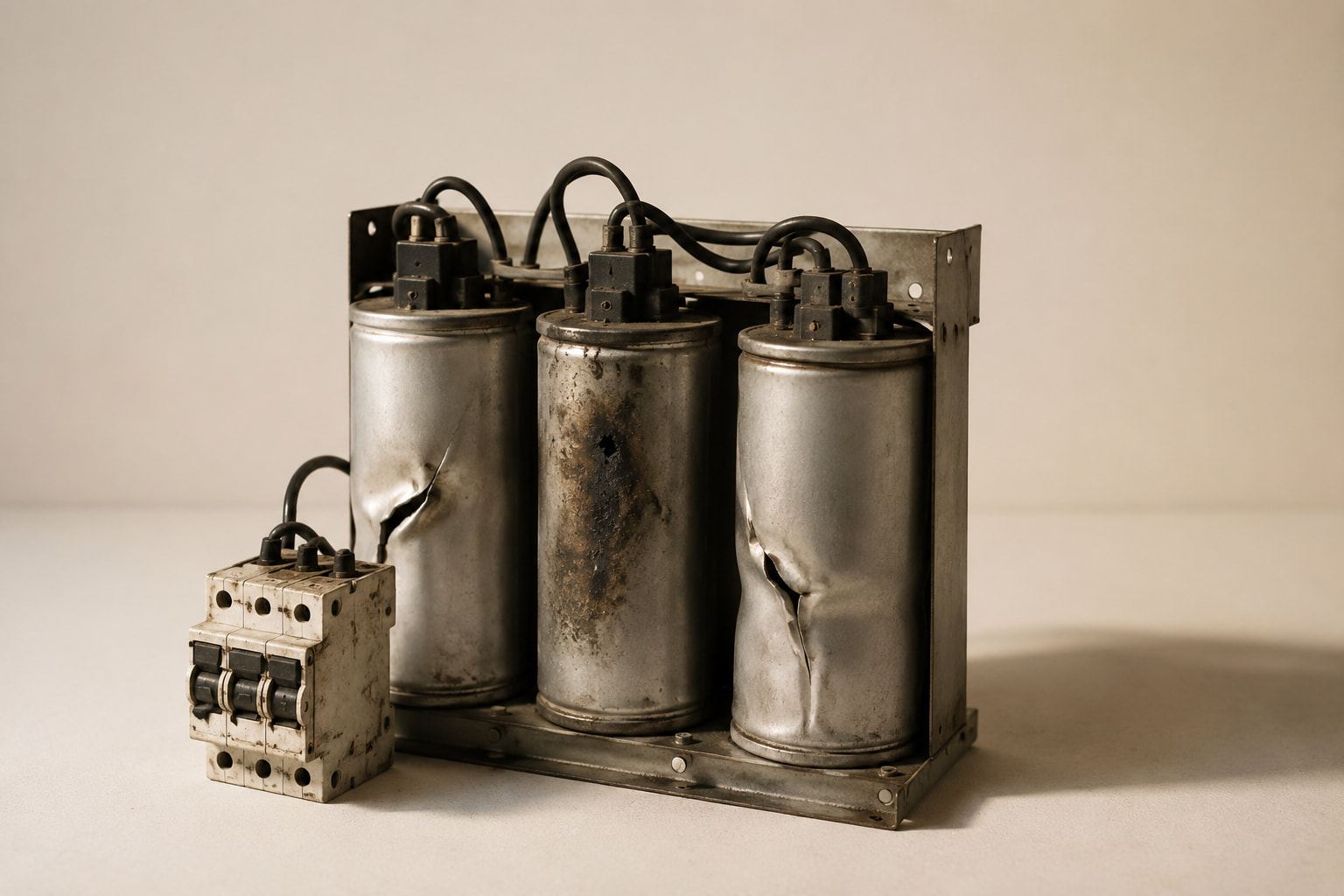
Capacitor bank failure is a common problem in modern industrial power systems. Many facilities install capacitor banks for power factor correction, but the equipment still overheats, trips, or fails early.
The main cause is often harmonic distortion.
Capacitor bank failure from harmonic distortion happens when nonlinear loads create distorted current in the electrical system. A capacitor bank is designed to supply reactive power. It is not designed to remove harmonic distortion. When harmonic distortion is high, the capacitor bank becomes exposed to extra electrical stress.
This is why capacitor bank failure should not be treated as only a capacitor problem. In many cases, capacitor bank failure is a power quality problem.
Capacitor bank failure usually happens when the system condition does not match the capacitor bank design.
In a clean electrical system, a capacitor bank can support power factor correction. It supplies reactive power and helps reduce unnecessary current. But in a system with harmonic distortion, the capacitor bank may become unstable.
Harmonic distortion creates extra frequency components in the electrical system. These harmonic currents add heat, losses, and stress. When the capacitor bank operates in this environment, capacitor bank failure becomes more likely.
Common causes of capacitor bank failure include:
Among these, harmonic distortion is one of the most important causes.
Harmonic distortion happens when current does not follow a clean sine wave.
In a normal power system, current should flow smoothly. But nonlinear loads draw current in pulses. These pulses create harmonic distortion.
Common nonlinear loads include:
These nonlinear loads are common in factories, data centers, commercial buildings, mines, water treatment plants, and renewable energy projects.
When nonlinear loads increase, harmonic distortion also increases. When harmonic distortion increases, capacitor bank failure becomes a bigger risk.
A capacitor bank is used for power factor correction. Its main job is to supply reactive power. It helps improve poor power factor and reduce reactive current in the system.
But a capacitor bank does not filter harmonic distortion.
When harmonic distortion is present, harmonic currents can flow through the capacitor bank. This increases heat and electrical stress. Over time, the capacitor bank may fail.
This is why capacitor bank failure is common in harmonic-rich systems.
A capacitor bank may look correct based on the kVAr calculation. But if harmonic distortion is ignored, the capacitor bank can still overheat. The result is repeated capacitor bank failure even when the rating seems correct on paper.
Capacitor bank failure often shows warning signs before complete breakdown.
Common signs include:
If these signs appear, the problem may not be the capacitor bank alone. The real problem may be harmonic distortion from nonlinear loads.
Replacing the same capacitor parts again and again will not solve the root cause. If harmonic distortion remains, capacitor bank failure can happen again.
Harmonic resonance is one of the most dangerous causes of capacitor bank failure.
Harmonic resonance happens when the capacitor bank interacts with the system impedance and amplifies certain harmonic frequencies. When this happens, current and voltage stress can rise quickly.
This makes capacitor bank failure much more severe.
Harmonic resonance can cause:
This is why harmonic distortion must be checked before installing or replacing a capacitor bank.
A capacitor bank can improve power factor correction, but if harmonic resonance appears, the same capacitor bank can become part of the problem.
Many facilities confuse power factor correction with harmonic filtering.
They are not the same.
Power factor correction reduces reactive power. Harmonic filtering reduces harmonic distortion. A capacitor bank is mainly used for power factor correction, not harmonic filtering.
This difference matters.
If the site only has poor power factor, a capacitor bank may be enough. But if the site has poor power factor and harmonic distortion, a normal capacitor bank may not be enough.
In that case, capacitor bank failure can happen because the system needs both reactive power compensation and harmonic control.
A good power quality design must check both problems.
Nonlinear loads are the main reason capacitor bank failure is becoming more common.
Modern facilities use more power electronics than before. Variable frequency drives, UPS systems, solar inverters, rectifiers, and EV chargers all improve efficiency, but they also create harmonic distortion.
When many nonlinear loads operate on the same electrical system, harmonic distortion can rise quickly.
This creates stress on:
The capacitor bank may be the first equipment to show damage, but the full electrical system is under stress.
This is why capacitor bank failure should be treated as a complete power quality issue.
Many sites respond to capacitor bank failure by replacing the damaged capacitors, contactors, or fuses.
This may solve the visible problem for a short time. But it does not solve the root cause.
If harmonic distortion is still present, capacitor bank failure may return.
Before replacing a capacitor bank, engineers should check:
This review helps identify whether the capacitor bank failed because of normal aging, poor sizing, high harmonic distortion, or resonance.
Without measurement, replacement is only guesswork.
The best way to prevent capacitor bank failure is to design the power factor correction system based on real power quality data.
The first step is measurement. Engineers should measure harmonic distortion, power factor, current, voltage, and load variation.
If harmonic distortion is low and the load is stable, a capacitor bank may work well.
If harmonic distortion is high, the system may need a stronger power quality solution. This may include harmonic filtering, dynamic reactive power compensation, detuned capacitor banks, or a combined solution depending on the site condition.
The goal is not only to improve power factor correction. The goal is to reduce stress, control harmonic distortion, improve power quality, and stop repeated capacitor bank failure.
A harmonic review is important before power factor correction in many applications.
These include:
These sites often contain nonlinear loads. That means harmonic distortion may already be present before the capacitor bank is installed.
If power factor correction is installed without checking harmonic distortion, capacitor bank failure becomes more likely.
Capacitor bank failure is usually a warning sign. It shows that the electrical system may have poor power quality.
When power quality improves, the full system benefits.
Better power quality can help:
This is why capacitor bank failure should not be ignored. It is often the first visible sign of a deeper electrical problem.
Capacitor bank failure is often caused by harmonic distortion, harmonic resonance, overheating, poor ventilation, incorrect sizing, repeated switching, or poor power quality.
Yes. Harmonic distortion can increase current stress and heat inside the capacitor bank. This can lead to capacitor bank failure.
No. A capacitor bank is mainly used for power factor correction. It supplies reactive power, but it does not remove harmonic distortion.
Nonlinear loads create harmonic distortion. When harmonic distortion flows through the electrical system, it can stress the capacitor bank and cause capacitor bank failure.
Capacitor bank failure can be prevented by measuring harmonic distortion, checking power factor, reviewing nonlinear loads, and selecting the correct power quality solution.
Yes. Harmonic distortion should be checked before power factor correction because high harmonic distortion can make a capacitor bank unstable or cause early failure.
Capacitor bank failure is not always caused by a bad capacitor. In many modern facilities, capacitor bank failure is caused by harmonic distortion from nonlinear loads.
A capacitor bank is useful for power factor correction, but it is not designed to remove harmonic distortion. When harmonic distortion is high, the capacitor bank can overheat, trip, or fail early.
This is why capacitor bank failure must be treated as a power quality problem.
Before replacing a capacitor bank, engineers should measure harmonic distortion, review nonlinear loads, check reactive power demand, and evaluate harmonic resonance risk.
A better power quality strategy can reduce capacitor bank failure, improve power factor correction, lower electrical stress, and support more reliable operation across the full power system.



 IPv6 network supported