Why Global Industries in 50+ Countries Trust YTPQC-SVG for Power Quality Excellence Quick Answer: Global industrial enterprises across 50+ countries (including North America, Europe, Southeast Asia, Latin America, and the Middle East) trust the YT Electric YTPQC-SVG Static Var Generator because it delivers sub-5ms stepless reactive compensation, active 3-phase unbalance correction, and harmonic su...
Electronic Arc Suppressors: Critical Protection for Switching Systems & SVGs The Core Challenge: Destructive Arcing When mechanical switches (contactors, relays, breakers) or semiconductors (IGBTs, thyristors) interrupt current – especially in inductive DC circuits – stored magnetic energy (1/2*LI^2) generates extreme voltage spikes (V=−Ldi/dt). This ionizes air bet...
Grid Interconnection Compliance for Waste-to-Energy Plants: Overcoming Interharmonics, Voltage Flicker, and Dynamic Reactive Demands Quick Engineering Answer: Connecting Waste-to-Energy (WtE) and biomass generation assets to the transmission grid requires satisfying rigorous Point of Common Coupling (PCC) power quality standards (IEEE 519-2022, IEC 61000-3-6, and EN 50549). Flue gas treatment driv...
The market's preference for the model of "sampling on the high-voltage side and mitigation on the low-voltage side" is not accidental. It is the optimal solution determined by a combination of factors including technical feasibility, economic efficiency, safety, and mitigation effectiveness. The logic behind this can be understood with a simple analogy: A doctor performs a "blood te...
YTPQC-SVG: The Modular Static Var Generator Solution for 21st-Century Power Quality Challenges Quick Answer: The YTPQC-SVG Static Var Generator is a 3-level IGBT active power electronics device that redefines modern reactive power compensation by delivering sub-5ms stepless bi-directional (inductive and capacitive) kVAR injection, 3-phase load unbalance correction, and harmonic filtering up to the...
While the terms are sometimes used interchangeably, there's a key conceptual difference between Real-Time Power Factor Correction and Active Power Factor Correction. 1. Real-Time Power Factor Correction (PFC) This is a functional description. It describes any power factor correction system that can dynamically adjust its compensation in response to changes in the load. Goal:&nb...
When we talk about modern power systems, two technical domains often overlap but are not always fully understood together: electromagnetic compatibility (EMC) and power quality. Both play crucial roles in ensuring that electrical and electronic equipment perform reliably and efficiently. For companies and industries adopting Static Var Generators (SVGs) and Active Harmonic Filters (AHFs)...
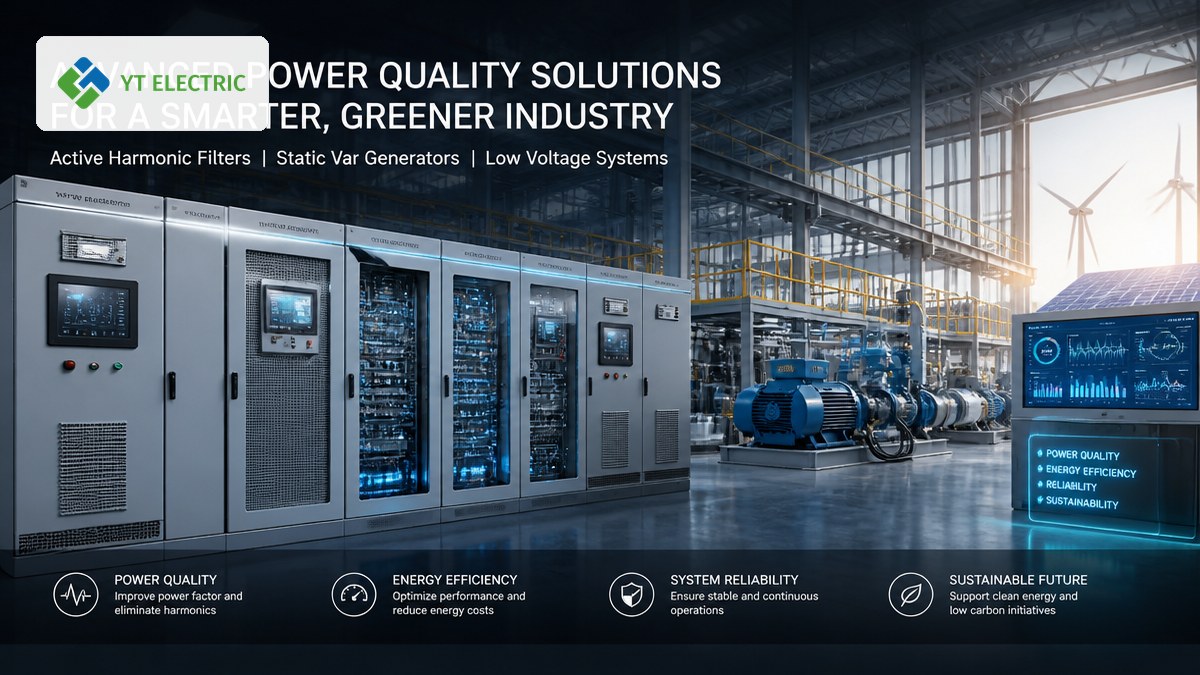
As the world accelerates toward cleaner energy, the grid is being asked to carry far more than it was ever designed for. Solar parks, wind farms, and EV charging stations are connecting at record speed. On the surface, this looks like a straightforward victory for decarbonization. Yet behind the scenes, one invisible factor quietly determines whether this energy transition can succeed: power quali...


 English
 français
 Deutsch
 español
 العربية
 中文




 IPv6 network supported

