

 English
 français
 Deutsch
 español
 العربية
 中文
中文
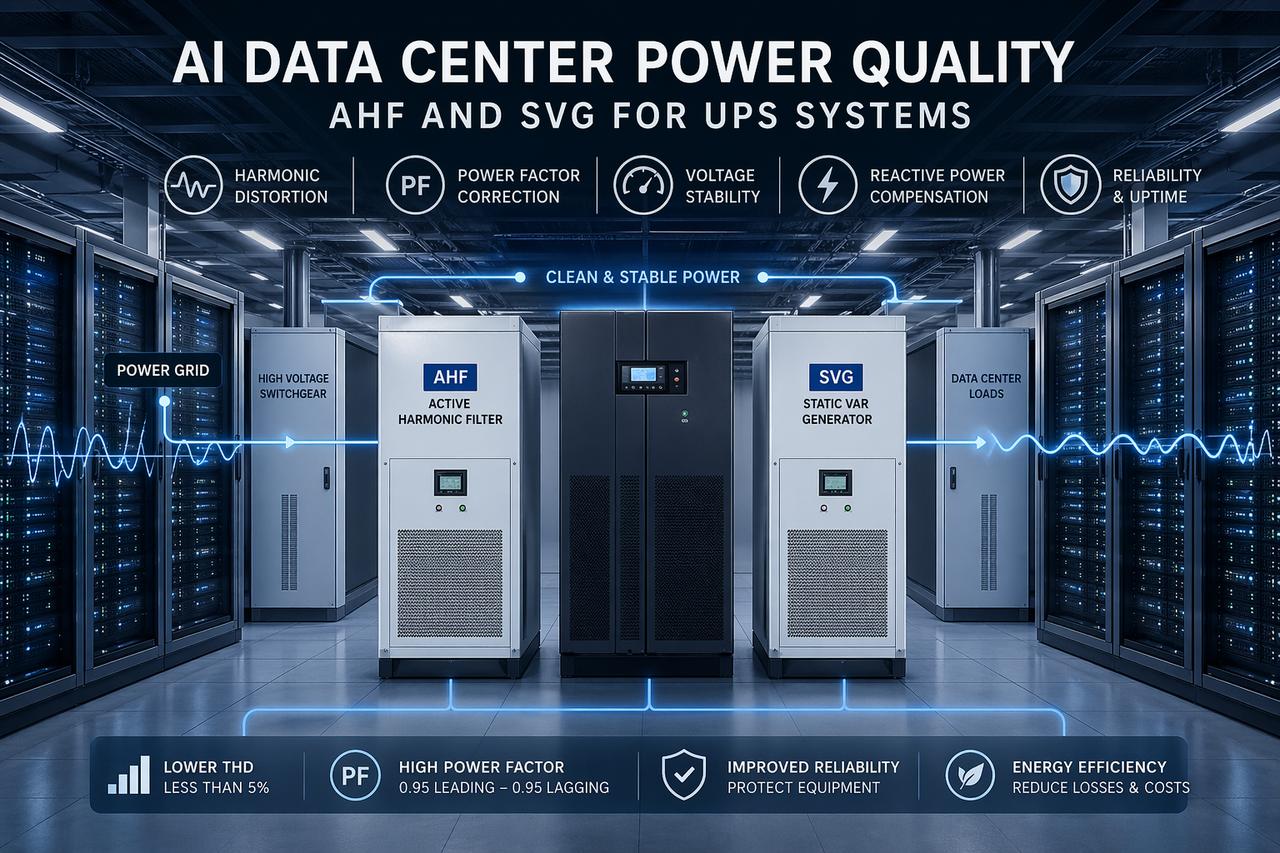
Modern data centers depend on stable electrical performance. As facilities add UPS systems, precision cooling, variable frequency drives, rectifiers, power distribution units, and high-density server racks, data center power quality becomes more difficult to control. Harmonic distortion, poor power factor, voltage fluctuation, and overheating can all appear in the same network. These issues increase electrical stress, reduce efficiency, and raise the risk of trips or equipment failure.
For this reason, more operators are treating power quality as part of core data center design rather than a secondary electrical issue. In many sites, the most effective approach is to combine an active harmonic filter with a Static Var Generator, also called SVG or STATCOM. One device targets harmonic distortion. The other supports dynamic reactive power compensation and voltage stability. Together, they help create a more reliable and efficient electrical system.
A modern data center is full of nonlinear loads. These loads do not draw current in a smooth sine wave. Instead, they pull current in pulses, which creates harmonic distortion in the electrical system. Common sources include UPS units, server power supplies, cooling drives, rectifiers, and other power electronic equipment. As rack density rises and AI workloads place more dynamic stress on power infrastructure, the electrical environment becomes even more demanding.
Poor data center power quality can lead to several problems:
These problems do not always appear as a single major failure. In many sites, they build slowly through extra heat, repeated alarms, or reduced reliability over time.
In a healthy power system, current follows the fundamental frequency of the supply. Harmonic distortion appears when connected equipment changes the waveform. This is common in facilities with heavy use of UPS systems, variable speed cooling loads, switched-mode power supplies, and rectifier-based equipment. These devices improve performance and efficiency, but they can also create extra frequency components that circulate through the network.
Once harmonic distortion rises, the effect spreads beyond the original source. It can increase current losses, create extra heat in conductors and transformers, and add stress to protection devices. In a mission-critical environment, even a moderate power quality problem can become serious because the cost of downtime is so high.
This is why data center operators often need more than standard compensation equipment. They need a solution that can handle changing operating conditions in real time.
An active harmonic filter is a dynamic power quality device. It monitors the current waveform and injects compensating current to reduce harmonic distortion. Unlike fixed passive methods, an active harmonic filter responds to actual system conditions. This makes it well suited for modern data centers, where loads can change quickly and the harmonic profile is not always predictable.
For a data center, an active harmonic filter offers several advantages:
In practical terms, the active harmonic filter helps keep the electrical system cleaner and more stable. That improves reliability across the whole facility, not only at one load point.
Harmonics are only part of the problem. Data centers also need strong reactive power control. This is where SVG becomes important.
A Static Var Generator provides dynamic reactive power compensation. It reacts quickly to changing load conditions and helps maintain stable power factor and voltage. Compared with traditional capacitor-based methods, SVG is more flexible under variable conditions and better suited to modern electrical systems with fast load changes.
In a data center, SVG helps by:
This matters because data center loads are not always steady. IT load growth, cooling demand, and switching events can all change the electrical profile. SVG helps the system stay controlled under those conditions.
An active harmonic filter and SVG solve different problems, but they work well together.
The active harmonic filter focuses on harmonic distortion created by nonlinear loads. SVG focuses on reactive power compensation and voltage support. When both issues exist in the same data center, using both technologies creates a more complete power quality strategy. This approach closely matches the logic that performed well in your previous high-scoring AHF/SVG content.
This combined approach is especially useful in facilities with:
Instead of treating harmonics and reactive power as separate problems, the site can improve overall data center power quality in one coordinated design.
UPS systems are essential for data center resilience, but they are not always the full answer to power quality across the distribution network. Depending on design and operating mode, a UPS may protect the critical load while upstream harmonic or power factor issues still affect the wider electrical system. In harmonic-rich environments, facilities often need additional mitigation strategy beyond the UPS itself.
That is why many projects review the entire system, including:
A stronger design starts with measurement, then applies the right active harmonic filter and SVG capacity based on actual conditions.
Before choosing a data center power quality solution, engineers should review the electrical condition of the site. The most important checks usually include:
This step matters because the best active harmonic filter or SVG configuration depends on real operating data. A fixed assumption can lead to undersizing, oversizing, or incomplete correction.
A data center may need an active harmonic filter and SVG in several areas of the electrical network:
Main low-voltage distribution
Used when multiple UPS systems, cooling loads, and rectifier-based equipment contribute to total system distortion.
Cooling systems
Variable frequency drives on CRAH, CRAC, chilled water pumps, and fans can create harmonic distortion and dynamic load behavior.
UPS input or common bus support
Useful when the wider network still experiences harmonic stress or poor power factor even though the critical load is protected.
Expansion-ready facilities
As AI racks and higher-density compute loads are added, data center power quality demands usually rise rather than fall.
A well-designed power quality solution does more than improve one measurement on a report. It supports long-term uptime, lower electrical stress, and more efficient operation.
Key long-term benefits include:
For a data center, these gains matter because reliability and continuity are the main priorities.
The most common causes are nonlinear loads such as UPS systems, rectifiers, variable frequency drives, and switched-mode power supplies. These loads can create harmonic distortion and reactive power issues.
An active harmonic filter reduces harmonic distortion in real time. It is especially useful where load conditions change and the harmonic profile is not fixed.
SVG provides dynamic reactive power compensation. It helps improve power factor correction and supports voltage stability under changing load conditions.
Not always. A UPS protects critical loads, but the wider distribution system may still experience harmonic distortion or poor power factor. Some sites need dedicated active harmonic filter and SVG support.
Facilities with large UPS systems, variable speed cooling, dense server racks, and growing AI or HPC loads usually benefit the most.
Data center power quality is no longer a minor design issue. As UPS infrastructure, cooling systems, and high-density computing loads grow, harmonic distortion and reactive power control become more important to long-term reliability.
An active harmonic filter helps control harmonics created by nonlinear loads. SVG helps stabilize power factor and support voltage. When applied together, they create a stronger and more flexible solution for modern data centers.
For facilities that need stable uptime, cleaner electrical performance, and room for future expansion, active harmonic filter and SVG are becoming essential parts of data center power quality design.



 IPv6 network supported