Industrial efficiency losses are not always mechanical. A plant can keep every machine healthy and still lose energy, capacity and uptime to harmonics, reactive power and three-phase current imbalance that never appear on a maintenance checklist. VFDs, rectifier-fed equipment and fast-switching electronics make production more efficient while making the network underneath less forgiving. This arti...
SVG sizing for power factor correction cannot be estimated from transformer capacity or a motor nameplate alone. Those figures describe how much load a site could connect, not how much reactive power the load actually exchanges with the supply at the point of common coupling (PCC). A Static Var Generator chosen from nameplate data will either leave the power factor short of target or spend on capa...
Capacitor bank overheating after adding VFDs is a power quality symptom, not a capacitor defect. VFD rectifiers inject harmonic current, the bank offers a low-impedance path at those frequencies, and parallel resonance between the bank and the supply can amplify that current until fuses open, contactors chatter and capacitor cans swell. A capacitor bank supplies reactive power to correct power fac...
Certificate Documentations in Power Quality Selection: Meaning and Guide A procurement engineer receives an Active Harmonic Filter quotation with a compliance certificate attached. The certificate names a product family, but the quotation specifies another voltage, current rating, enclosure layout, ambient condition, and feeder arrangement. The correct question is not “Does the suppli...
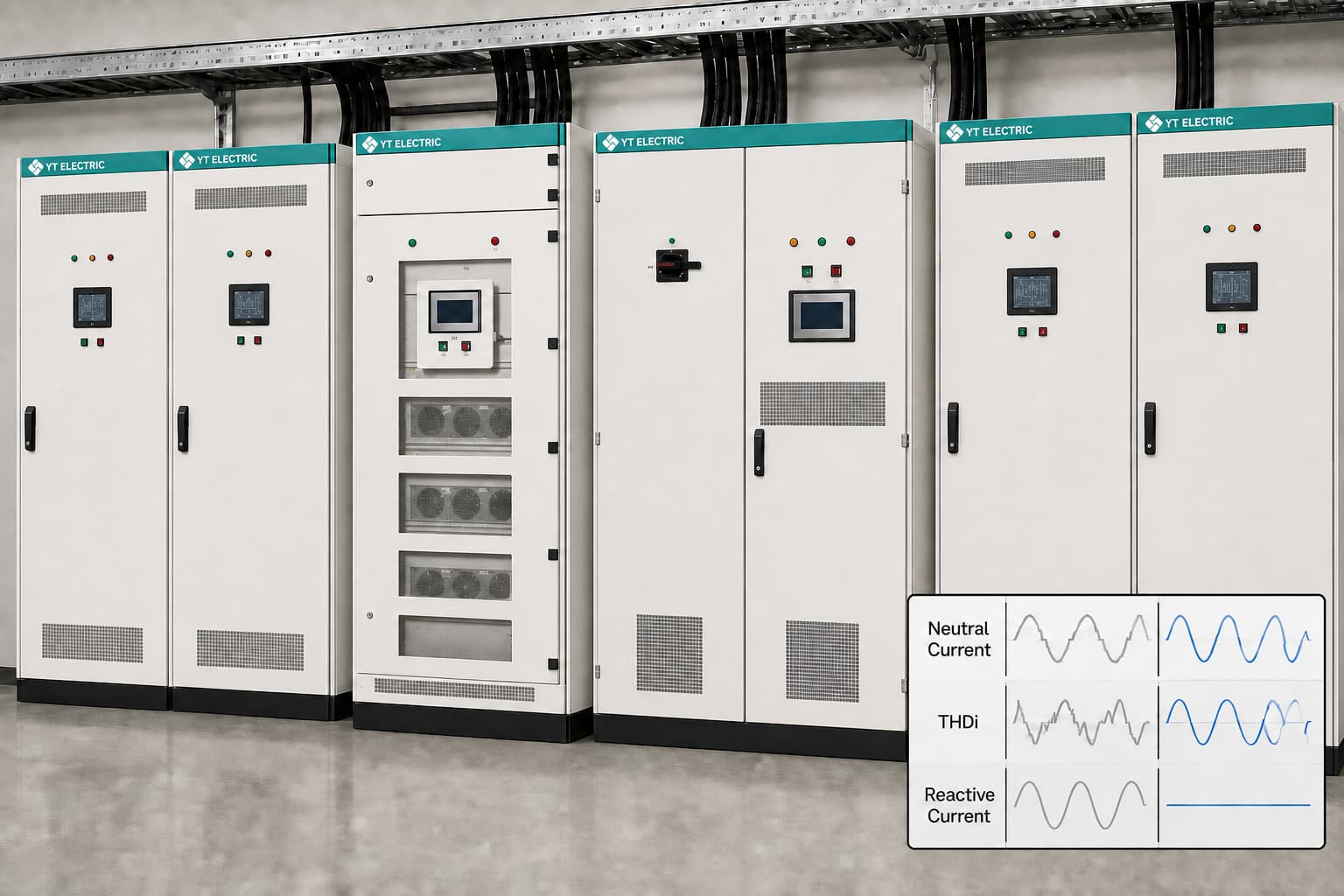
From Energy Waste to Energy Intelligence: How AHF and SVG Transform Industrial Power Systems Why distorted current becomes energy waste A six-pulse VFD, rectifier, UPS front end, or welding supply draws current in pulses rather than a clean sine wave. Those pulses contain characteristic harmonic components, and the resulting Total Harmonic Distortion increases RMS current even...


 English
 français
 Deutsch
 español
 العربية
 中文
中文




 IPv6 network supported