

 English
 français
 Deutsch
 español
 العربية
 中文
中文
High-density data centers, semiconductor fabs, and offshore platforms expose a weakness in many silicon-based active harmonic filters (AHF) and static var generators (SVG): the correction target moves faster than the thermal design. At 20–25.6 kHz, a conventional silicon IGBT converter can correct current distortion, but switching loss, 45°C full-load temperature rise, heatsink volume, and acoustic noise become limiting factors. The question is not whether silicon carbide (SiC) works. The engineering question is whether its higher capital cost produces measurable power-quality and total-cost benefits at the point of common coupling (PCC).
SiC MOSFETs change that balance through a wide-bandgap material with higher critical electric field, lower charge storage, and faster transitions. A properly designed SiC AHF can operate at 50–100 kHz, reduce switching losses by 60–70%, and reach system efficiency above 98.5%. Those numbers matter only when the site has high load hours, tight space, high ambient temperature, or rapid nonlinear-load changes.
Silicon IGBTs remain a sound choice for many industrial installations. Their gate-drive ecosystem is mature, procurement is predictable, and field technicians understand the failure modes. However, an IGBT must carry a tail current during turn-off. Increasing switching frequency improves current ripple and control bandwidth, but it also increases switching energy. At 25.6 kHz, the semiconductor, gate driver, busbar, and cooling system must dissipate that energy continuously.
In a 45°C room, the thermal margin narrows quickly. The designer may derate output, enlarge the heatsink, increase fan speed, or accept higher junction temperature. Each option has a cost: cabinet volume, fan noise, maintenance, or reduced lifetime. The same trade-off appears in an offshore platform where salt-laden air, restricted HVAC capacity, and limited floor area punish oversized cooling assemblies.
The link between switching frequency and filter size is physical. Higher frequency moves the dominant ripple away from the fundamental and permits a smaller filter inductor. If an IGBT design cannot raise frequency without excessive loss, the inductor and passive damping network remain larger. This is why a high-power-density AHF is not achieved by changing firmware alone.
SiC has a wider bandgap and stronger breakdown field than silicon. The MOSFET structure eliminates the IGBT tail-current mechanism, so turn-on and turn-off transitions can be faster with lower energy per cycle. The converter can therefore use a 50–100 kHz switching frequency while retaining a practical thermal design. The controller sees a cleaner current waveform, and the smaller inductor reduces stored energy and cabinet footprint.
Fast switching is not a free benefit. High dv/dt can excite common-mode capacitance, stress motor insulation, and increase electromagnetic interference. A robust design controls gate resistance, uses a low-inductance commutation loop, applies active dv/dt shaping, and validates conducted and radiated emissions. The target is a quiet cabinet, not merely a fast oscilloscope edge. With correct layout and modulation, acoustic noise can fall below 45 dB while the AHF delivers sub-50 μs instantaneous response and less than 5 ms full response to a step change.
For product architecture, SiC should be evaluated alongside the complete active power filter platform and the reactive-power duty handled by a static var generator solution. A semiconductor advantage becomes a plant advantage only when sensing, control, thermal paths, and protection are engineered as one system.
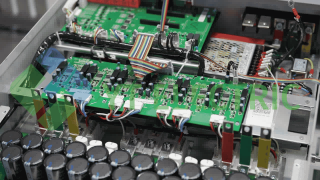
SiC active harmonic filter topology and thermal-density illustration.
| Parameter | Silicon IGBT AHF/SVG | SiC MOSFET AHF | Engineering implication |
|---|---|---|---|
| Typical switching frequency | 20–25.6 kHz | 50–100 kHz | Higher control bandwidth and smaller ripple filter |
| Switching loss | Reference 100% | 40–30% of reference | 60–70% reduction when gate loop is optimized |
| System efficiency | Typically 97.0–98.0% | Typically above 98.5% | Lower heat rejection during long operating hours |
| Power density | Baseline cabinet volume | 20–40% higher potential | Smaller inductor and heatsink for the same rating |
| Thermal design at 45°C | Often needs derating or larger fans | More margin at full load | Verify junction and capacitor temperatures, not just air temperature |
| Acoustic noise | Often 50–65 dB | Target below 45 dB | Lower fan speed and optimized modulation reduce noise |
| Dynamic response | Typically <100 μs instantaneous | <50 μs instantaneous; <5 ms full response | Useful for pulsed data-center and fab loads |
A quotation based only on transformer kVA is incomplete. At the PCC, record RMS current, voltage unbalance, displacement power factor, THDi, and individual harmonic orders under representative operating states. Six-pulse drives, UPS rectifiers, welders, and variable-speed compressors create different spectra. The fifth and seventh harmonics may dominate one plant, while high-order components from switched-mode power supplies shape another.
Log load fluctuation rate and step magnitude, not only a daily average. A data center with a stable 70% load may require less transient current than a fab tool line that repeatedly starts vacuum pumps. Place split-core CTs at the feeder or PCC specified by the control strategy, with correct polarity and phase identification. Do not install a compensation CT downstream of a branch that excludes the loads to be corrected. Confirm CT ratio, burden, saturation margin, and cable routing during commissioning.
The final AHF capacity should follow measured harmonic current, reactive current, crest factor, and future expansion. The APF product specification and SVG product specification are starting references, not substitutes for a single-line diagram and PCC data.
| Industrial scene | Typical constraint | Preferred starting point | TCO assessment |
|---|---|---|---|
| Data center | High load hours, UPS harmonics, strict noise and space limits | SiC AHF where THDi and density targets are tight | Higher initial cost can be offset by heat, HVAC, and floor-space savings |
| Semiconductor wafer fab | Sensitive tools, rapid load steps, clean power requirements | SiC AHF after spectrum and transient logging | Value depends on avoided disturbances and uptime risk; avoid unverified ROI claims |
| Heavy industry and mining | Large drives, dust, high ambient temperature, rugged service | IGBT for cost-sensitive steady loads; SiC for space or response limits | Compare cooling maintenance, derating, and expected service life |
| Commercial building | Moderate harmonics, variable occupancy, budget control | IGBT AHF or mixed solution after PCC survey | SiC premium is justified only by noise, space, or high operating hours |
Do not assume drop-in compatibility. Different switching speeds, dead-time requirements, gate-drive voltages, protection thresholds, and current-sharing behavior can create circulating current. A mixed installation needs a validated control platform, independent protection coordination, and a measured impedance model. In many projects, separate converter cabinets on a common bus are safer than mixing semiconductor legs inside one bridge.
SiC modules, gate drivers, insulation, layout, and EMC validation typically increase initial cost. The correct comparison adds the cooling system, cabinet footprint, commissioning time, and energy consumed by fans and HVAC. Use the measured duty cycle and electricity tariff; do not apply a generic payback period.
SiC provides thermal and switching margin, but reliability still depends on junction temperature cycling, DC-link capacitor life, solder or sintered interconnects, airflow, and contamination control. Require 45°C ambient full-load data, overload curves, protection logs, and service intervals. A field survey must verify the actual cabinet inlet temperature.
Build a project-specific model using measured THDi, load profile, operating hours, cooling energy, floor-space value, maintenance labor, and the cost of nuisance trips or power-quality penalties. Compare an IGBT baseline, a SiC option, and a no-action case. The final capacity and configuration must be determined from the site single-line diagram and PCC measurements; this article does not claim an unverified customer ROI.
SiC AHF is worth considering when high switching frequency, low loss, compact construction, low acoustic noise, and fast transient response solve a documented site constraint. IGBT remains technically and economically appropriate for many steady industrial and commercial loads. YT Electric can review your single-line diagram, CT location, harmonic spectrum, and load profile to propose a defensible power-quality design. For application discussion, see the 3-level AHF reference and contact YT Electric for a measured, site-specific technical solution.



 IPv6 network supported