

 English
 français
 Deutsch
 español
 العربية
 中文
中文
A procurement engineer receives an Active Harmonic Filter quotation with a compliance certificate attached. The certificate names a product family, but the quotation specifies another voltage, current rating, enclosure layout, ambient condition, and feeder arrangement. The correct question is not “Does the supplier have a certificate?” but “Can the supplier connect this offered cabinet to its regulatory file, design evidence, factory inspection record, and project acceptance plan?”
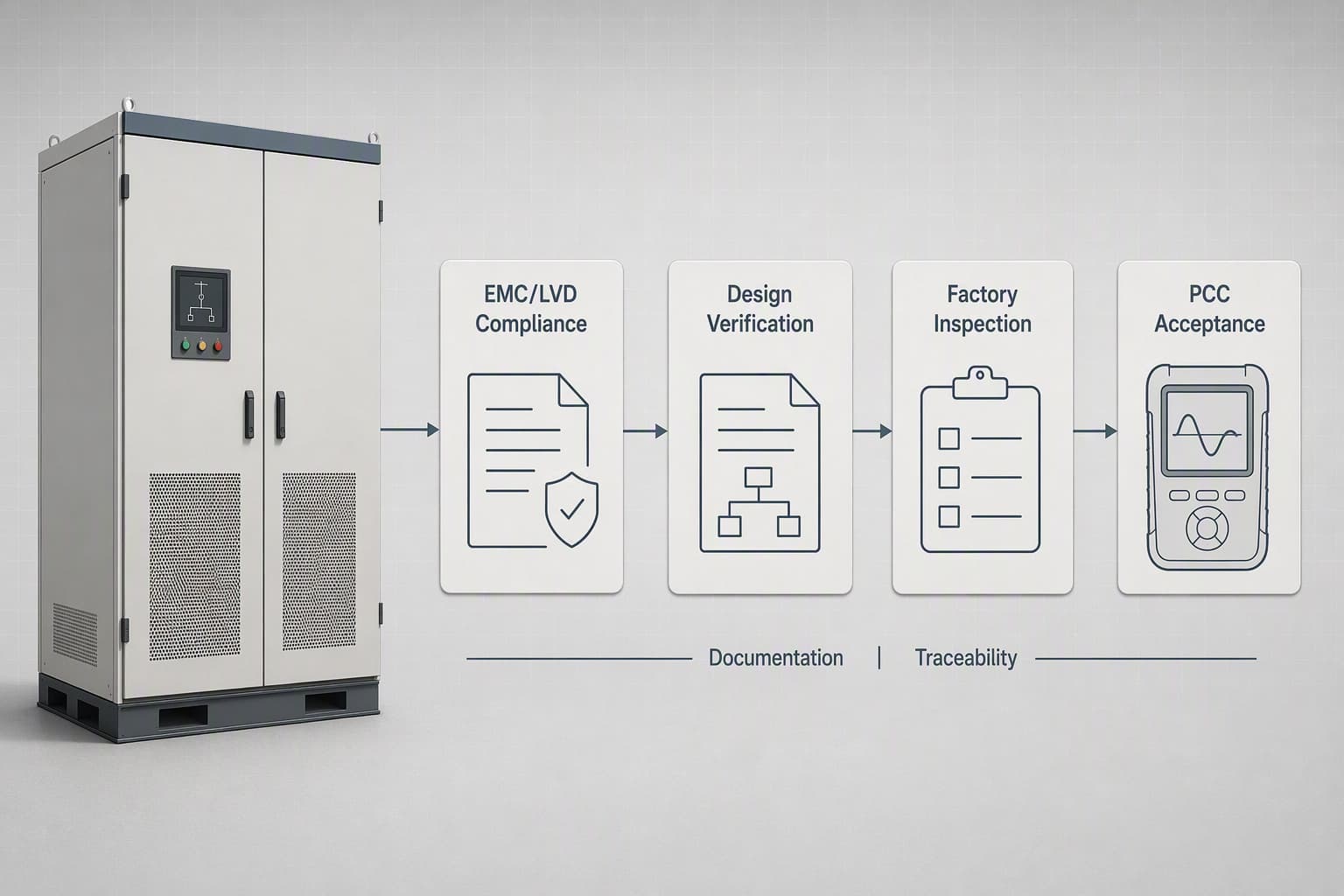
Power Quality Documentation answers that question. For AHF, APF, SVG, and related power-electronic assemblies, one document cannot prove every part of product quality. A useful review separates four layers: regulatory compliance, representative design verification, individual-unit factory control, and installed-system acceptance.
This distinction is practical in VFD-intensive plants. A series-level document may support an EMC/LVD compliance path, but it does not prove that a proposed 480 V or 690 V cabinet has the correct CT interface, thermal arrangement, neutral-current capability, protection coordination, or commissioning settings for the actual load.
Compliance documentation identifies the stated regulatory path for a named product series. YT Electric’s supplied FQC STANDARD Certificates of Compliance cover listed AHF/APF and SVG/ASVG series, cite EMC Directive 2014/30/EU and Low Voltage Directive 2014/35/EU, and list applicable standards including EN IEC 62477-1, EN IEC 61000-6 series, and EN IEC 61439-1.
This is meaningful evidence, but buyers should not stretch its meaning. The certificate states that its attestation basis is the manufacturer’s Declaration of Conformity and presented technical documentation. It supports a documented EMC/LVD compliance path for the listed series; it is not a serial-numbered factory release report, a site-performance result, or a laboratory report showing every project configuration.
A buyer should verify the product-series name, voltage range, intended application, and document validity before placing it in a tender file. When the selected cabinet differs materially from the document scope, request a written configuration review rather than relying on the certificate title.
Type testing and design verification address the representative design, not every future cabinet automatically. According to the applicable standard and project scope, the evidence may address dielectric strength, protective bonding, temperature rise, enclosure construction, EMC behavior, functional performance, or other stated design requirements.
Coverage must be checked, not assumed. Voltage, rated current, compensation capacity, enclosure dimensions, cooling path, IP rating, incoming device, busbar arrangement, control architecture, and major power components can affect electrical, thermal, or mechanical behavior.
A company can provide applicable type-test or design-verification documentation according to the selected model and project configuration. This supports an engineering review of the proposed solution without making the unsupported claim that every capacity and cabinet option has identical test coverage.
A representative design can be valid while a particular cabinet is incorrectly assembled. A loose power termination, reversed CT polarity, incorrect auxiliary wiring, unsuitable firmware setting, or missing label can affect operation even when the product family has a compliance file.
Factory Quality Control closes this gap. For each project device, the requested record should identify the model, serial number, inspection date, items checked, result, and inspector. The agreed inspection plan can include appearance, wiring, protective-earth continuity, insulation or dielectric checks where applicable, power-up function, alarms, communications, CT logic, and nameplate verification.
Factory inspection does not replace type-test evidence. It proves that the actual delivered unit was checked against approved production and project requirements. A company can provide factory inspection and traceability records for project equipment as required.
|
Evidence layer |
Main question |
Typical content |
What it cannot prove alone |
|
EMC/LVD compliance documentation |
Is there a stated compliance path for the named series? |
Certificate scope, DoC, directives, listed standards |
Exact project configuration or site result |
|
Type test/design verification |
Does a representative design have relevant evidence? |
Tested configuration, scope, method, conclusion |
Coverage of every capacity or cabinet option |
|
Factory inspection record |
Was the shipped unit checked? |
Model, serial number, checklist, result, sign-off |
Design validation or long-term site performance |
|
Project acceptance record |
Does the installed system meet agreed criteria? |
PCC data, settings, commissioning record |
Performance of unrelated projects |
In a three-phase four-wire system, triplen harmonics can add in the neutral rather than cancel. The resulting zero-sequence current can overheat the neutral conductor even when phase-current readings appear acceptable. An AHF review must therefore identify the 3P3W or 3P4W topology, harmonic spectrum, CT location, and neutral-current compensation requirement.
Thermal claims also need configuration evidence. IGBT switching devices create conduction and switching losses; reactors, terminals, busbars, and airflow determine where the heat accumulates. A requirement for full-load operation at 45°C ambient temperature requires a review of component derating, ventilation, cabinet spacing, and protection settings, rather than a generic statement on a brochure.
SVG selection follows the same discipline. The controller measures reactive-current demand and commands compensation through SPWM modulation, but field performance depends on CT ratio and placement, upstream impedance, load transients, capacitor-bank condition, and response settings. A kVar number on its own does not prove voltage stabilization or power-factor correction at the PCC.
|
Project condition |
Key risk |
Required document focus |
Acceptance focus |
|
400/415 V VFD production line |
THDi and neutral heating |
AHF series file, applicable design support, serial FQC record |
PCC distortion and neutral-current trend |
|
480 V data center with UPS |
UPS interaction and bypass modes |
Interface review, factory function record, commissioning plan |
Stable operation in normal, battery, and bypass modes |
|
690 V mining/process load |
Thermal stress, dust, generator interaction |
Environmental review, applicable SVG/AHF design support, project FQC |
Reactive response under defined load steps |
|
Capacitor-bank retrofit |
Resonance and switching interaction |
Site measurement, SVG selection basis, protection review |
No adverse resonance and agreed power-factor target |
Consider a representative Southeast Asian textile facility, used here as an illustrative scenario rather than a named customer case. Its 415 V distribution system supplies VFD-driven spinning equipment, rectifier loads, and legacy capacitor banks. Maintenance reports neutral heating, capacitor-bank alarms, and elevated current distortion during high-production shifts.
Start with measurement and documentation. Record transformer rating, feeder arrangement, harmonic spectrum, neutral current, load duty cycle, ambient temperature, capacitor-bank status, and PCC measurement point. These inputs determine three-phase-four-wire AHF need, SVG coordination with capacitor steps, and justified capacity margin.
The release package can combine applicable 415 V series compliance documents, model-matched type-test or design-verification support where available, an approved single-line diagram, CT polarity instructions, and a serial-numbered factory inspection record. At commissioning, define the PCC THDi target, neutral-current trend, power-factor target, operating-load condition, and observation period.
This process creates a traceable path from the offered equipment to measurable project criteria and records the final electrical outcome.
No. It supports the named product series’ documentation path, while site performance depends on load spectrum, network impedance, CT installation, capacity selection, protection coordination, and commissioning settings. Require project-matched review and defined acceptance criteria.
Compare voltage, rated current or kVar, cabinet structure, cooling method, IP rating, topology, power components, and environment against the quotation. Ask the supplier to explain any material difference and state the available coverage or additional verification.
Request the model, serial number, date, inspection checklist, result, and sign-off. Add project-relevant checks such as protective-earth continuity, insulation or dielectric testing where applicable, wiring, CT logic, alarm function, communications, and nameplate details.
They can be engineered for these systems, but compatibility should be reviewed before release. Check resonance and capacitor switching, UPS operating modes, generator impedance, CT locations, protection settings, and commissioning scenarios.
Power Quality Documentation should allow a buyer to follow one line from the regulatory scope to the representative design, from the design to the serial-numbered cabinet, and from that cabinet to the project acceptance record. That is the difference between a certificate-led sales package and an engineering-led delivery process.
YT Electric has established a technical-documentation support framework: EMC/LVD compliance documentation for applicable product series; applicable type-test or design-verification support for representative designs; factory inspection and traceability records for project equipment as required; and support for project acceptance documentation based on defined commissioning criteria. Send the single-line diagram, voltage, load profile, and document requirements to the YT Electric Power Quality Division before final selection.
Explore YT Electric product specifications and application guidance: https://www.ytelect.com/blog/guide-to-selecting-active-harmonic-filters_b321
Reference: IEEE 519-2022, IEEE Standard for Harmonic Control in Electric Power Systems: https://standards.ieee.org/ieee/519/10677/
Need a site-specific solution? Share your single-line diagram, load list, measured power factor, THDi/TDD data, and ambient conditions with YT Electric. Our sales engineers can review the data and prepare a technical proposal.



 IPv6 network supported