The Impact of Voltage 3 Phase-Unbalanced Three-phase power systems are essential for industrial and small-scale applications, providing efficient energy distribution. Proper planning ensures their safety and functionality. This guide explains unbalanced loads in three-phase systems. It identifies the causes and solutions. It also covers their use in solar energy setups. We look at how to manage im...
Is Your Power System Suffering from Three-Phase Imbalance? In an ideal three-phase AC power system, the voltages and currents on all three phases (L1, L2, L3) are equal in magnitude and perfectly spaced 120 degrees apart. Three-phase imbalance occurs when the magnitudes of these voltages or currents deviate significantly from each other. This common power quality issue can stem from seve...
Why Global Industries in 50+ Countries Trust YTPQC-SVG for Power Quality Excellence Quick Answer: Global industrial enterprises across 50+ countries (including North America, Europe, Southeast Asia, Latin America, and the Middle East) trust the YT Electric YTPQC-SVG Static Var Generator because it delivers sub-5ms stepless reactive compensation, active 3-phase unbalance correction, and harmonic su...
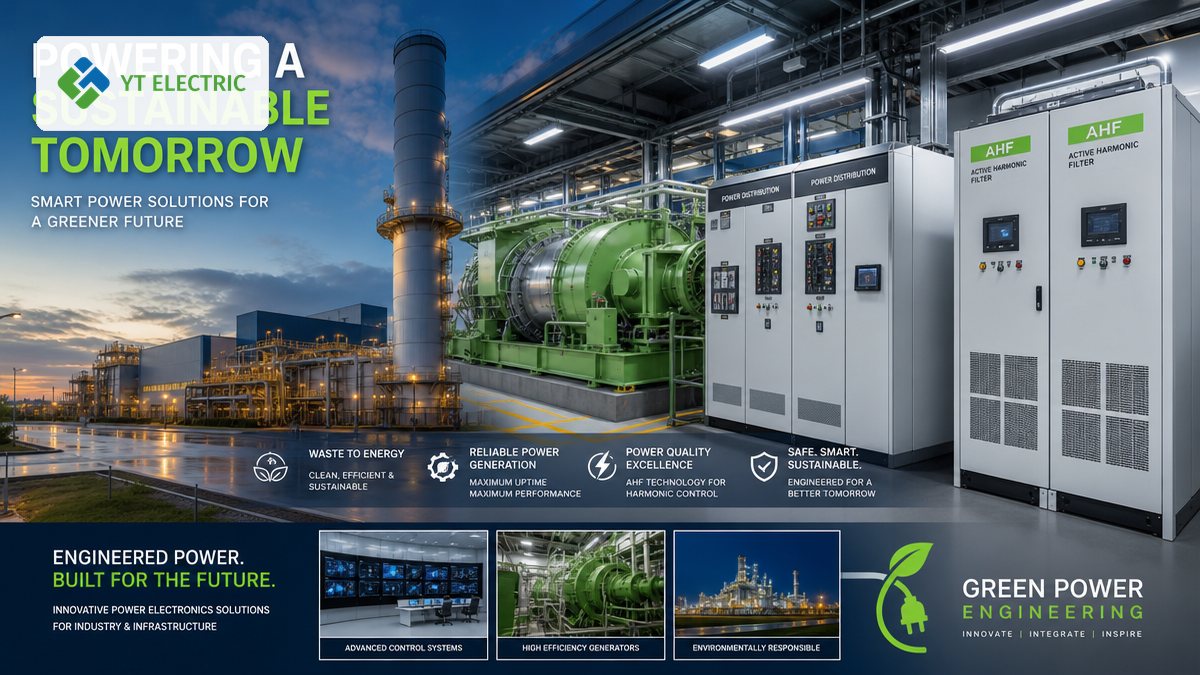
Power Quality Revolution: How Active Harmonic Filters Unlock Sustainable Waste-to-Energy Operations Quick Engineering Answer: Waste-to-Energy (WtE) and municipal biomass incineration plants operate complex electrical networks where massive variable frequency drives (VFDs) on boiler draft fans, flue gas scrubbers, and leachate pumps inject severe harmonic distortion (THDi > 22%), while synchrono...
I. Why Are Non-Linear Loads So Ubiquitous in Our Daily Lives? The fundamental reason is technological advancement and our relentless pursuit of efficiency and control. The core of non-linear loads is various power electronic devices that precisely control electrical energy through rapid switching. Here are the specific reasons for their ubiquity: Demand for Energy Savings and Efficiency:...
As electric vehicle (EV) adoption continues to grow across Europe, Italy is accelerating its efforts to expand charging infrastructure. To support this transition, YTElect recently delivered 300 units of 22 kW three-phase AC charging stations to an Italian distributor — a major step toward strengthening the country’s public and private charging network. This deployment underscores YTEl...
The choice between installing an Active Harmonic Filter (AHF) on the power side (at the Point of Common Coupling - PCC) versus the load side (at the source of harmonics) is a critical design decision with significant technical and financial implications. Here is a detailed analysis comparing both installation strategies. Executive Summary Load-Side Installation (Local Compensation): Targets s...
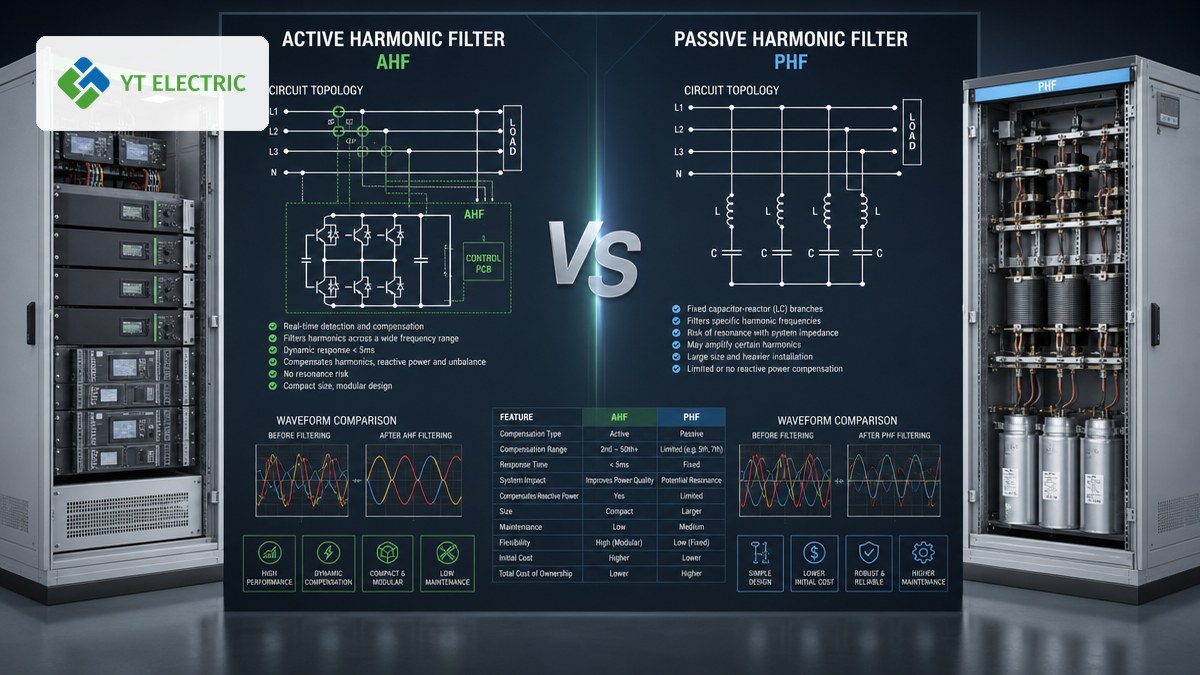
Active Harmonic Filter vs. Passive Harmonic Filter: The Definitive Engineering & TCO Comparison Quick Engineering Answer: The fundamental difference between an Active Harmonic Filter (AHF) and a Passive Harmonic Filter (PHF) lies in circuit topology: PHFs use fixed inductor-capacitor (LC) tuned shunt branches that can only target 1 or 2 specific harmonic orders (e.g., 5th or 7th) and suffer fr...


 English
 français
 Deutsch
 español
 العربية
 中文




 IPv6 network supported

