

 English
 français
 Deutsch
 español
 العربية
 中文
中文
The Principle of High-Voltage Passive Filtering
In high-voltage power systems, the widespread application of non-linear loads such as electric arc furnaces, frequency converters, and rectifiers generates a large amount of harmonic currents. These harmonics not only cause power grid voltage distortion and increase line losses but also may interfere with the operation of precision equipment and damage power components. As a low-cost and high-reliability harmonic governance solution, high-voltage passive filtering devices realize the suppression and filtering of specific frequency harmonics by virtue of the combined characteristics of passive components such as capacitors, inductors, and resistors, and are important equipment to ensure the power quality of high-voltage power grids. This article will comprehensively analyze the core logic of high-voltage passive filtering from four aspects: core composition, working principle, filtering types, and key characteristics.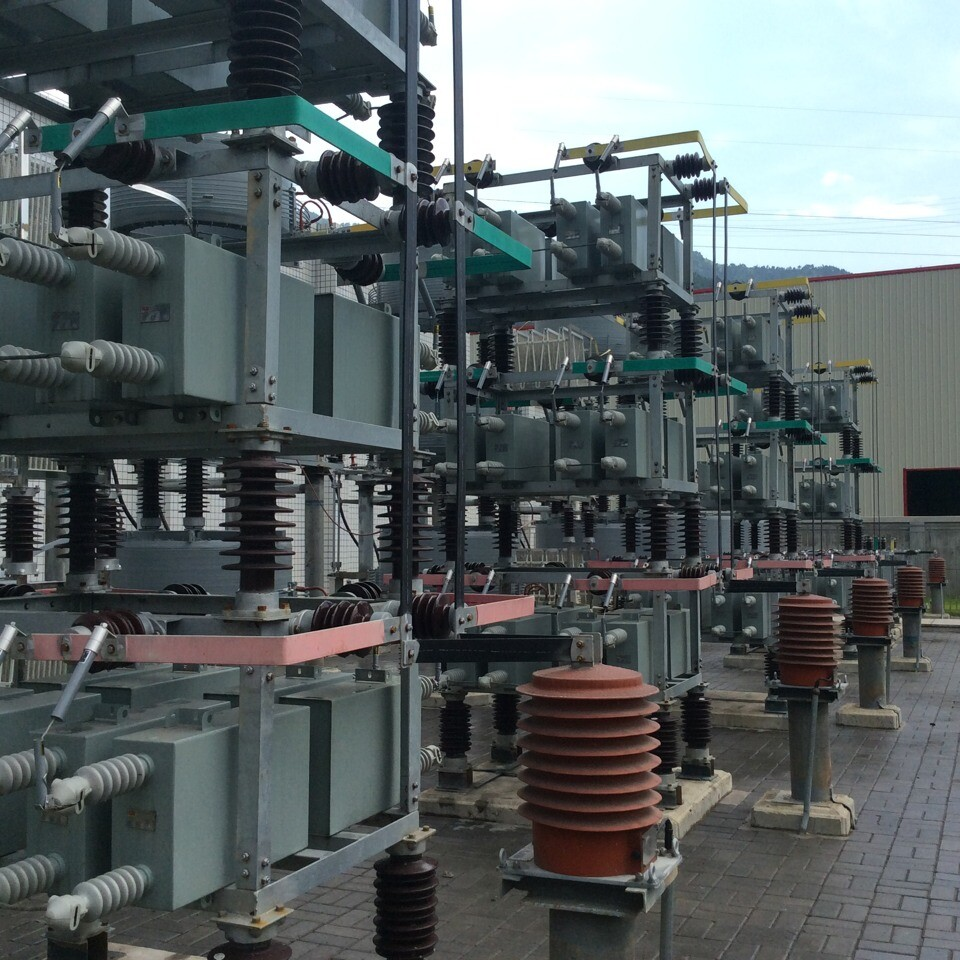
I. Core Composition of High-Voltage Passive Filtering
The core of a high-voltage passive filtering device is a passive filtering network composed of capacitors (C), inductors (L), and resistors (R). By reasonably designing component parameters, the filtering network exhibits specific impedance characteristics at specific harmonic frequencies, thereby achieving harmonic shunting or suppression. Among them:
Capacitor: Its core function is to provide capacitive impedance. It can also perform reactive power compensation at the fundamental frequency to improve the system power factor; it cooperates with inductors to form a resonant circuit at harmonic frequencies.
Inductor: Usually, air-core inductors or iron-core inductors are used to provide inductive impedance. It forms an LC resonant circuit with capacitors and is a key component for realizing specific frequency harmonic filtering.
Resistor: It is mainly used to suppress resonant overvoltage, consume harmonic energy, improve the damping characteristics of the filtering network, avoid series or parallel resonance with the system, and enhance the stable operation of the device.
In addition, high-voltage passive filtering devices also include auxiliary components such as high-voltage switches, fuses, and surge arresters, which are used to realize switching control, overcurrent protection, and overvoltage protection of the device, and adapt to the needs of power grids with different high-voltage levels such as 6kV, 10kV, and 35kV.
II. Core Working Principle of High-Voltage Passive Filtering
The essence of high-voltage passive filtering is to use the resonant characteristics of LC components to make the filtering network present a low-impedance state at the target harmonic frequency, thereby "attracting" harmonic currents to the filtering branch, avoiding their flow into the main power grid, and ultimately reducing the harmonic content of the main power grid. Its core logic can be divided into two key links: "resonance matching" and "harmonic shunting":
An LC series or parallel circuit has a fixed resonant frequency, and its resonant frequency calculation formula is: f₀ = 1/(2π√(LC)) Among them, f₀ is the resonant frequency, L is the inductance value of the inductor, and C is the capacitance value of the capacitor.
In the design of high-voltage passive filtering, according to the main harmonic frequencies in the power grid (such as 3rd, 5th, 7th, 11th, etc.), the parameters of L and C are adjusted to make the resonant frequency f₀ of the filtering network completely consistent with the target harmonic frequency. At this time, the filtering branch presents extremely low impedance at the harmonic frequency (the impedance approaches zero in series resonance, and the impedance approaches infinity in parallel resonance), providing a low-impedance path for harmonic currents.
When harmonic currents generated by non-linear loads are injected into the power grid, they will follow the law that "current prefers to flow to low-impedance branches". Since the impedance of the filtering branch at the target harmonic frequency is much lower than that of the main power grid, most harmonic currents will flow through the filtering branch instead of the main power grid. In the filtering branch, harmonic energy will be consumed by resistors (converted into heat energy) or "absorbed" through the resonant characteristics of the LC circuit, thereby realizing the filtering of harmonics in the main power grid.
It should be noted that while filtering harmonics, the capacitive components of high-voltage passive filtering devices present capacitive impedance at the fundamental frequency, which can provide reactive power to the system and realize the dual functions of "harmonic governance + reactive power compensation". This is also an important reason for its wide application in industrial high-voltage scenarios.
III. Common Topologies and Principle Differences of High-Voltage Passive Filtering
According to the topology of the filtering network, high-voltage passive filtering is mainly divided into three types: series type, parallel type, and hybrid type. Different structures have differences in filtering principles and applicable scenarios, among which parallel filtering is the mainstream application form in high-voltage scenarios:
Series filtering is composed of an LC series circuit connected in series with the main power grid. When the circuit is in a resonant state, the series circuit presents extremely low impedance to target harmonics, almost without affecting the transmission of fundamental current; however, it presents high impedance to non-target harmonics or currents whose frequency deviates from the resonance point, thereby blocking their propagation. This structure is suitable for precise suppression of specific frequency harmonics, but due to being connected in series in the main circuit, it is more sensitive to changes in system impedance, and is mostly used for harmonic protection of low-voltage or specific precision loads, with less application in high-voltage scenarios.
Parallel filtering is composed of an LC circuit connected in parallel with the main power grid, and is the mainstream form of high-voltage passive filtering. Its core principle is that the LC parallel circuit presents high impedance at the target harmonic frequency, making it difficult for harmonic currents in the main power grid to pass through, and instead flow into the parallel filtering branch (series resonant low-impedance branch). This structure has the advantages of high filtering efficiency, little impact on the operation of the main power grid, and can take into account reactive power compensation. It is suitable for the governance of characteristic harmonics such as 5th and 7th harmonics in industrial high-voltage scenarios. Common forms include single-tuned filters (for a single frequency harmonic), double-tuned filters (for two frequency harmonics), and high-pass filters (for high-frequency harmonics).
Hybrid filtering is composed of multiple single-tuned, double-tuned, or high-pass filters with different resonant frequencies connected in parallel, which can filter multiple different frequency harmonics at the same time. For example, for the 3rd, 5th, and 7th harmonics generated by electric arc furnaces in steel plants, a hybrid filtering device composed of three single-tuned filters can be designed to lock the 3rd, 5th, and 7th harmonic frequencies respectively, realizing synchronous governance of multiple frequency harmonics. This structure is suitable for high-voltage scenarios with complex harmonic components and is the most commonly used filtering scheme in industrial high-voltage systems.
IV. Key Characteristics and Limitations of High-Voltage Passive Filtering
Relying on advantages such as simple structure, low cost, high reliability, and dual functions of reactive power compensation, high-voltage passive filtering has become a basic solution for harmonic governance in high-voltage power grids. However, limited by the characteristics of passive components, it also has certain limitations:
Advantages: Stable structure, no need for complex control units, adaptable to high-voltage and high-current working conditions; low operating loss (mainly resistor loss); dual functions of harmonic governance and reactive power compensation, high cost performance; low maintenance cost and long service life (usually up to 15-20 years).
Limitations: Fixed filtering characteristics, only effective for preset frequency harmonics, poor adaptability to changes in power grid harmonic frequencies; easy to generate series or parallel resonance with system impedance, leading to overvoltage and overcurrent risks; filtering effect is greatly affected by power grid voltage fluctuations and component parameter drift; limited governance effect on low-order harmonics (such as 3rd harmonic), large volume, and large floor space.
V. Conclusion
High-voltage passive filtering realizes precise shunting and suppression of harmonics through the resonant characteristics of LC components. It is a low-cost and high-reliability harmonic governance solution in high-voltage power grids, especially suitable for industrial high-voltage scenarios with relatively fixed harmonic components. Its core value lies in realizing the dual functions of harmonic filtering and reactive power compensation through the logic of "resonance matching - harmonic shunting", effectively improving the power quality of the power grid and reducing line losses. Although it has limitations such as fixed filtering characteristics and easy resonance, it still occupies an important position in high-voltage scenarios with clear harmonic governance needs and cost sensitivity. With the development of power electronics technology, high-voltage passive filtering is often used in combination with active filtering devices such as SVG to form a "passive + active" hybrid governance solution, which takes into account both cost and filtering effect and better adapts to the power quality governance needs of complex high-voltage power grids.



 IPv6 network supported