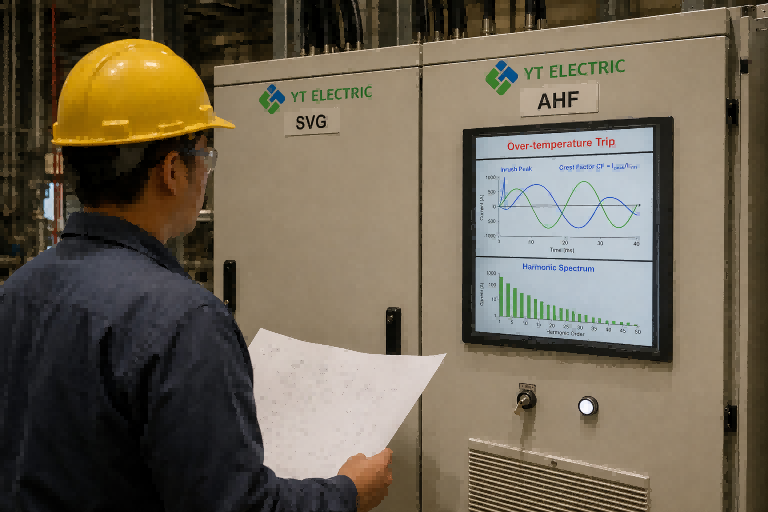
Active Harmonic Filter Sizing: What Happens When You Get It Wrong Learn how harmonic current, load cycles, topology, temperature, and SVG/AHF selection affect THDi performance. Consider a textile mill with dozens of VFD-driven spinning frames. A 100 A active harmonic filter (AHF) is installed, but THDi at the PCC falls only from 28% to 19%. The unit is operating normally; it is simpl...
High THDi — total harmonic distortion of current — is the ratio of the RMS value of all current harmonics to the fundamental current, expressed as a percentage. It rises when nonlinear loads such as variable frequency drives (VFDs), rectifiers, UPS units and chargers draw current in pulses instead of a clean sine wave. A high reading must be explained, not simply cleared: measure the s...
Harmonic Resonance in Data Center UPS Eco-Mode: AHF vs Active Line Conditioning Hyper-scale enterprise data centers and colocation cloud facilities are under relentless pressure to optimize Power Usage Effectiveness (PUE) and reduce megawatt-scale operational electricity costs. To capture energy savings of 2% to 4% across large uninterruptible power supply (UPS) fleets, engineering managers increa...
SiC Active Harmonic Filter: Why Ultra-Compact Architecture Maximizes Efficiency in Modern Industrial Power Systems Quick Engineering Answer: A Silicon Carbide (SiC) Active Harmonic Filter (AHF) utilizes wide-bandgap (WBG) SiC MOSFET power switches to achieve switching frequencies above 50 kHz—more than triple conventional silicon IGBT filters. This ultra-high switching frequency slashes inte...
Why Is Neutral Current Higher Than Phase Current? Third Harmonics and Zero-Sequence Overload Explained Quick Engineering Answer: In three-phase four-wire electrical systems powering modern single-phase non-linear switch-mode power supplies (SMPS), neutral current frequently exceeds phase current (reaching 130% to 173% of line current) due to the in-phase arithmetic summation of zero-sequence tripl...


 English
 français
 Deutsch
 español
 العربية
 中文




 IPv6 network supported

