The choice between installing an Active Harmonic Filter (AHF) on the power side (at the Point of Common Coupling - PCC) versus the load side (at the source of harmonics) is a critical design decision with significant technical and financial implications. Here is a detailed analysis comparing both installation strategies. Executive Summary Load-Side Installation (Local Compensation): Targets s...
AI-Powered AHF: Smarter Power Quality Analyzed Explained Modern power systems face more stress than ever before. Many loads in factories and buildings now use power electronics. These devices work fast and switch many times each second. This creates distorted waveforms and uneven currents. These problems lead to harmonics. Harmonics raise heat, waste energy, and shorten equipment lif...
The pursuit of perfect power quality is undergoing a fundamental shift, driven by a new semiconductor material: Silicon Carbide (SiC) . Comparing a traditional Active Harmonic Filter (AHF) with a SiC-based model reveals more than incremental upgrades; it showcases a leap in performance, efficiency, and capability. For decades, traditional AHFs have relied on silicon-based IGBTs. These components w...
Boosting Hybrid PCS Performance with SiC Devices Hybrid PCS, or hybrid power conversion systems, are now common in energy storage and EV charging. They link batteries, solar panels, and the power grid. To work well, a hybrid PCS must be fast, efficient, and reliable.This is where silicon carbide (SiC) devices make a big difference. What Is a Hybrid PCS? A hybrid PCS can manage...
Modern power systems face a hidden threat: resonance. This occurs when harmonic currents from non-linear loads (like VFDs and rectifiers) match the electrical system's natural frequency. The result? Dangerous amplification of harmonic voltages and currents, leading to capacitor failures, overheating, and equipment damage. Traditional passive filters can ironically cause this problem by introducing...
Power Quality Evaluation: The Cornerstone of Stable Solar PV System Operation As solar photovoltaic (PV) systems gain widespread adoption in commercial and industrial settings, interest in financial returns and performance expectations has intensified. However, a critical yet often overlooked aspect throughout the entire lifecycle of solar projects—from planning and installation to oper...
The Ultimate Solution for Power Quality ---SVG & AHF Reliable power quality is key for efficient work in today's factories and businesses. Two main issues often come up: harmonic distortion and wasted reactive power. Here are two advanced technologies can solve these problems: Active Harmonic Filter (AHF) and Static Var Generator (SVG). They help reduce risks and make power systems work better...
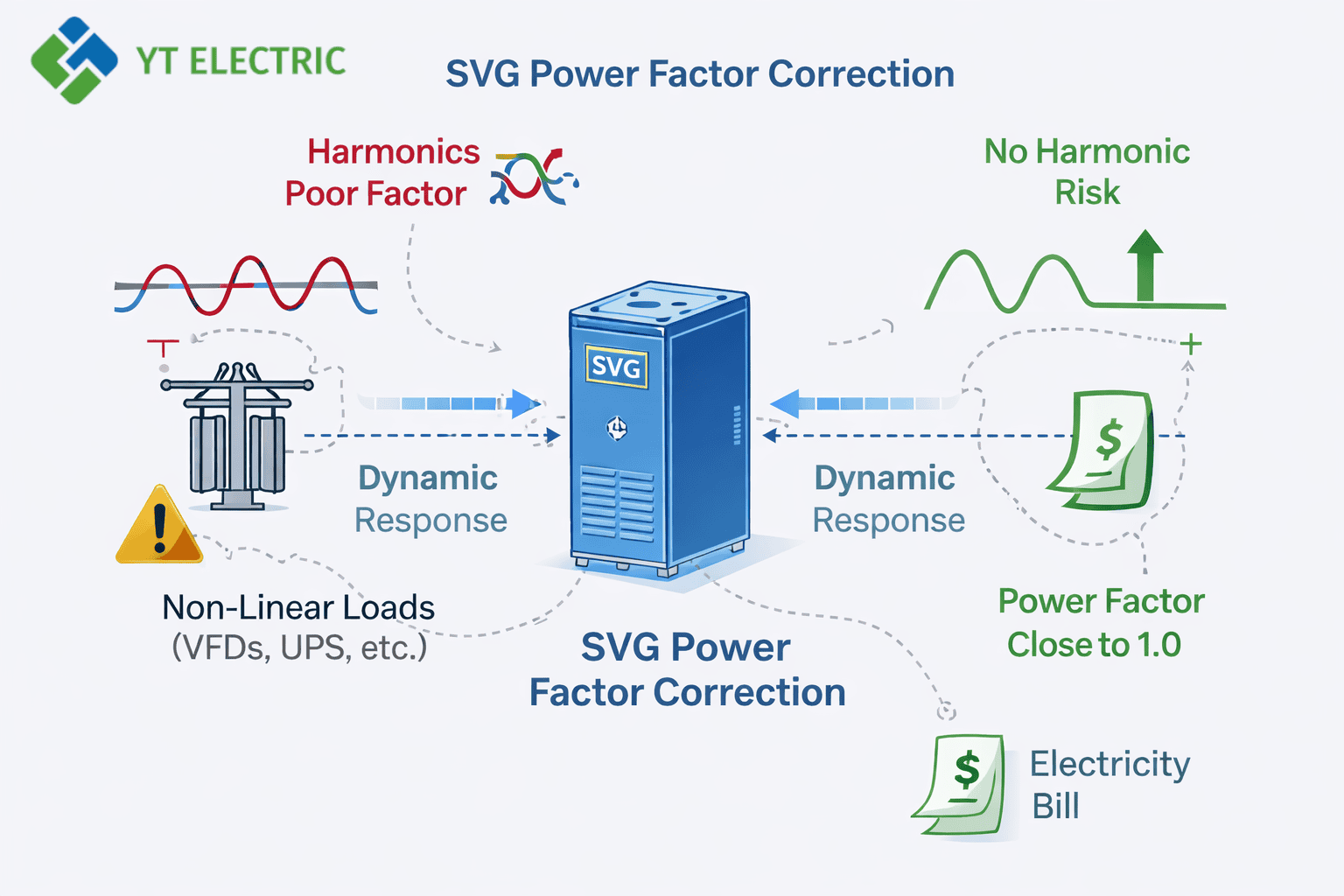
What Is SVG Power Factor Correction? SVG power factor correction is an advanced method of reactive power compensation used in modern electrical systems to maintain a power factor close to 1.0 in real time. Unlike traditional capacitor banks, SVG (Static Var Generator) provides dynamic and precise power factor correction for facilities with non-linear loads such as VFDs, UPS systems, EV chargers, a...


 English
 français
 Deutsch
 español
 العربية
 中文
中文



 IPv6 network supported