What is difference between THD and TDD? While power electronics have created considerable energy savings, they can distort the quality of electrical power delivered through the building they serve, reducing the effectiveness and life span of the power electronics contained within that building. THD is described as the instantaneous value of the ratio of the root-mean-square (rms) of the harmonic c...
What are scenarios causing power factor displacements 1. Poorly designed electrical systems with inadequate power factor correction equipment. 2. Large inductive loads such as motors, transformers, and generators that cause lagging power factor. 3. Unbalanced three-phase loads that cause phase displacement of the current and voltage waveforms. 4. Unbalanced single-phase loads that cause current an...
Achieving capable factory functional test requires meeting multiple criteria to ensure the highest quality product. These criteria include test capability and repeatability, system upgradability and supportability, and production scalability. Setting up new production test not only involves implementing new test systems, but also managing schedule risk and budget which are often impacted by techni...
Electricity is generated by generating stations and transmitted to load centers from where it is distributed to end consumers. These load centers are controlled by distribution utilities, and there is an inter-change of energy between different utilities connected to the grid. Consumers connected to the distribution utilities, though consuming active energy may or may not consume reactive energy. ...
Night-Time Reactive Power Management and Ferranti Effect Voltage Control in Long Solar PV Feeder Networks Quick Engineering Answer: In large-scale solar PV farms with extensive medium-voltage (MV 33kV/35kV) underground collector networks (often exceeding 50 km in cumulative length), zero-generation night-time conditions trigger the Ferranti Effect. The distributed shunt capacitance of lightly load...
Power factor is a measurement of electrical system efficiency. Many utilities have a power factor penalty built into their rate structure to penalize users with a low power factor reading in their electrical system. To improve the power factor, the most common solution is to install a capacitor banks, But Static Var Generator is the best power factor correction product. There are 3 kinds of...
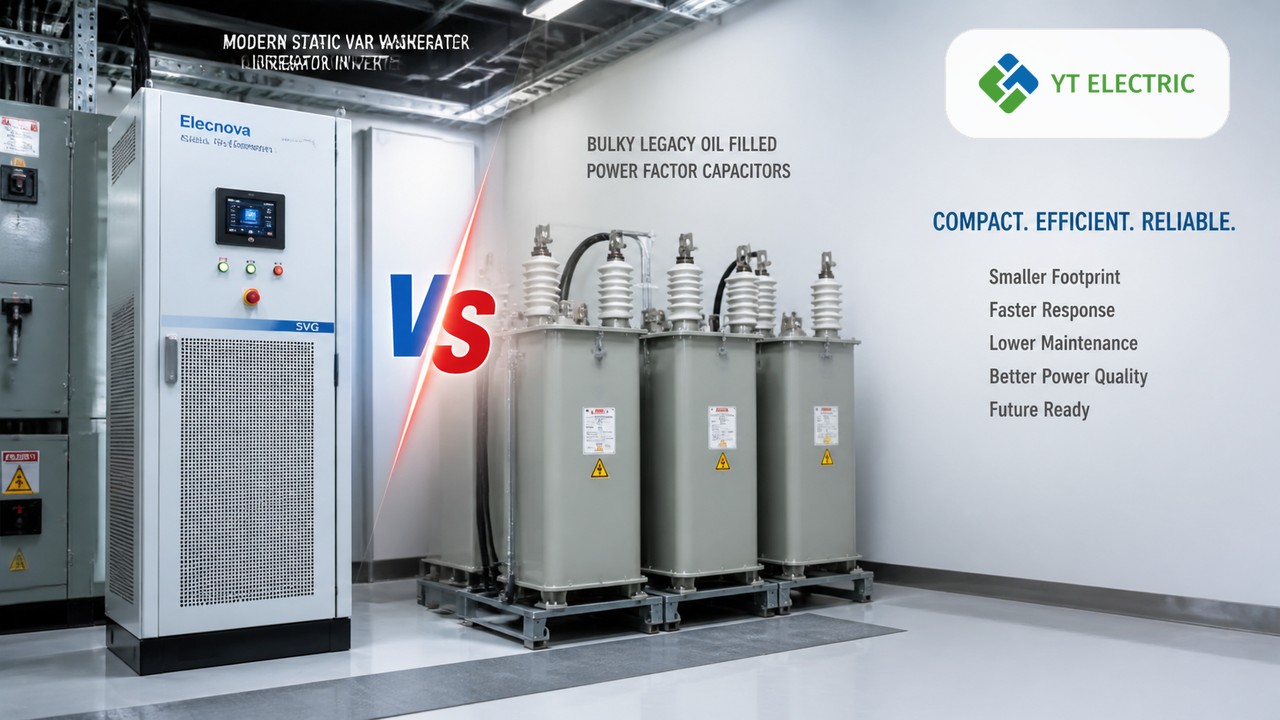
Static Var Generator (SVG) vs. Traditional Capacitor Banks: The Comprehensive Engineering & ROI Comparison Quick Engineering Answer: While traditional Automatic Power Factor Correction (APFC) capacitor banks rely on electromechanical contactors and discrete capacitor steps to supply static capacitive vars, a modern Static Var Generator (SVG) utilizes high-speed 3-level IGBT inverter technology...
The reactive power consumed by the transformer is generally about 10% to 15% of its rated capacity, and its no-load reactive power is about 1/3 of the full load. Therefore, in order to improve power factor (PF) of the power system, the transformer should not operate at no-load or in a long-term low-load operation state. Vigorously improving the power factor of transformers, reducing line losses, a...


 English
 français
 Deutsch
 español
 العربية
 中文





 IPv6 network supported

