

 English
 français
 Deutsch
 español
 العربية
 中文
中文
In July 2026, the eastern United States is experiencing a punishing heatwave. The PJM Interconnection—the largest US regional grid—is forecasting demand to exceed 166,000 MW, dangerously close to its all-time historical record. Utilities are considering the unthinkable: cutting AI data centers off the grid to preserve voltage stability for residential consumers.
For data center operators, this is a five-alarm fire. Every degree Celsius above 40°C reduces the efficiency of cooling systems and the transmission capacity of the local grid. Voltage sags and brownouts are no longer a theoretical risk—they are a daily operational threat. This technical guide explores why traditional power infrastructure fails at 45°C ambient temperature and how the YT Electric Static Var Generator (SVG) provides the critical reactive power injection required to prevent catastrophic downtime.
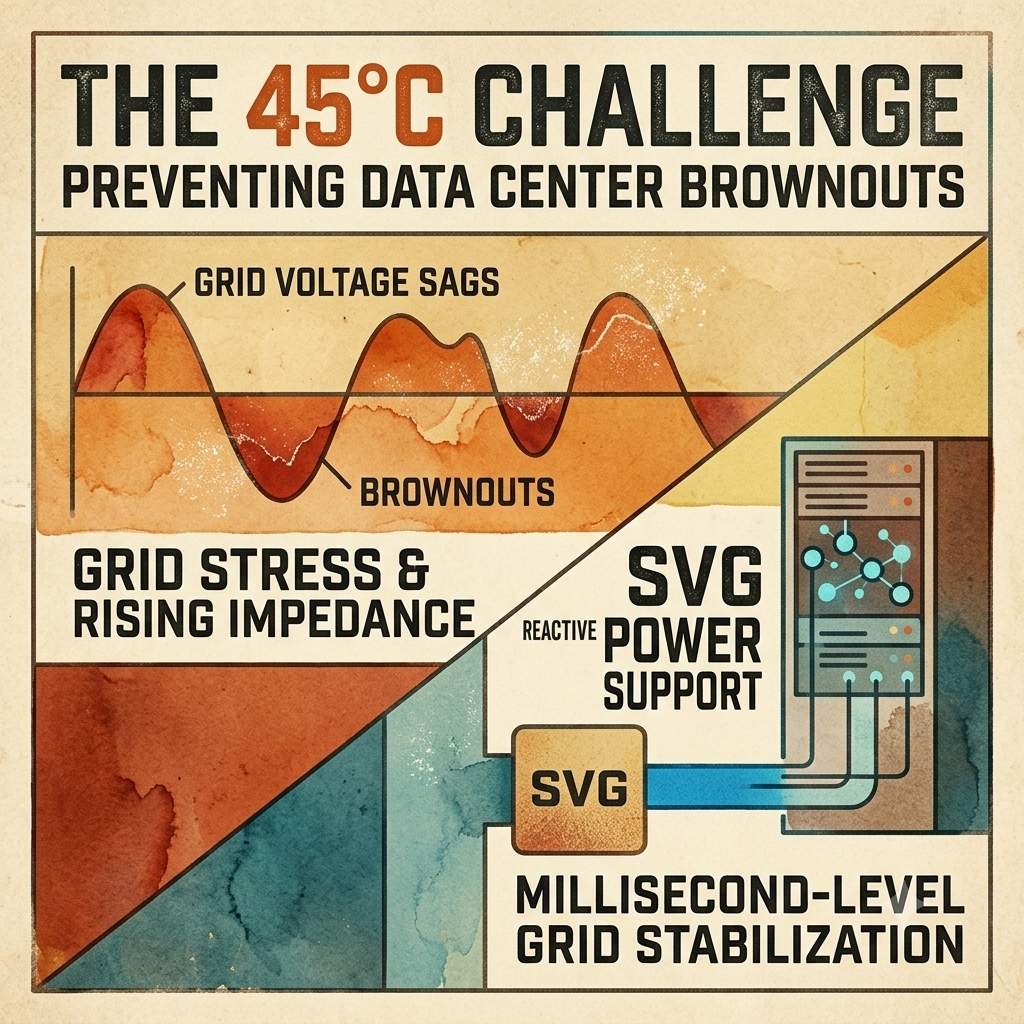
When ambient temperatures spike, three simultaneous events destabilize the local grid:
· • Increased Line Resistance: Copper conductors expand and their resistance rises. This increases I²R losses and reduces the effective voltage delivered to the load.
· • Reactive Power Deficiency: HVAC compressors and chillers running at maximum capacity draw massive inductive currents, sinking the power factor and starving the grid of reactive support.
· • Transformer De-rating: Utility transformers automatically reduce their capacity to prevent oil degradation, creating a "hidden ceiling" on how much power your facility can actually draw.
AI computing workloads are exponentially more sensitive to voltage sags than traditional web servers. A brief 20% voltage dip—lasting just 100 milliseconds—can crash an entire GPU training cluster, corrupting weeks of computation.
Traditional UPS batteries are the last line of defense, but they cannot solve the root cause. What data centers truly need is an active power quality solution installed upstream, capable of stabilizing the grid before the UPS is triggered. This is where the YT Electric SVG (Static Var Generator) becomes indispensable.
Our YTPQC-SVG series is not a passive capacitor bank—it is a high-speed voltage source inverter (VSI) designed to inject or absorb reactive power in real time.
Utilizing a 3-level topology and 25.6kHz switching frequency, our SVG detects a voltage sag in less than 3 milliseconds and delivers full compensation within 10ms. This is 100x faster than mechanical tap changers or thyristor-switched capacitors (TSC), providing seamless voltage support during AI load spikes and grid faults.
Unlike traditional PFC (Power Factor Correction) systems, the SVG can operate in all four quadrants—supplying both leading and lagging reactive power. This is critical for modern data centers where the load profile shifts between GPU training (heavy inductive) and idle states (capacitive from filter banks).
|
Feature |
Capacitor Banks (TSC/MSC) |
YT Electric SVG |
|
Response Time |
> 100 ms |
≤ 10 ms |
|
Compensation Type |
Stepped (Discrete) |
Continuous (Smooth) |
|
Voltage Sag Ride-Through |
No Support |
Active Support |
|
Harmonic Behavior |
Risk of Resonance |
No Resonance Risk |
|
45°C Full-Load Output |
Derated |
100% Rated |
|
Bi-directional |
No |
Yes (4-Quadrant) |
Proper sizing requires understanding both steady-state and transient reactive demand. Below is a general engineering guide for typical AI data center capacities:
|
Data Center IT Load (MW) |
Recommended SVG Rating |
Typical Voltage Level |
|
1 - 5 MW |
500 - 2500 kvar |
400V / 480V LV |
|
5 - 20 MW |
2500 - 10 MVAR |
10 - 11 kV MV |
|
20 - 50 MW |
10 - 25 MVAR |
20 - 35 kV MV |
|
50 MW+ |
Custom Modular Design |
35 kV+ (HV) |
During the June 2026 PJM heatwave, a 30MW hyperscale AI facility in Virginia experienced repeated voltage sags to 88% of nominal. After deploying a 15 MVAR YT Electric SVG, the local bus voltage was stabilized to within ±1% even during peak grid stress. The facility avoided an estimated $2.4 million in potential AI training losses over 72 hours.
A: No. The SVG is installed upstream at the medium voltage bus (or LV main), providing grid support that actually reduces stress on downstream UPS batteries, extending their lifespan.
A: The SVG requires grid presence to operate. However, it can be paired with our STATCOM+BESS (Battery Energy Storage) hybrid solution for full islanding capability during blackouts.
The 2026 heatwave is a preview of the operational challenges data centers will face for decades. Reactive power support is no longer optional—it is the foundation of AI uptime.
YT Electric’s SVG technology, engineered for 100% load at 45°C, delivers the millisecond-level grid stabilization required to keep AI infrastructure running when temperatures peak.
Contact YT Electric today at service@yt-electric.com to schedule a Grid Resilience Audit.



 IPv6 network supported