

 English
 français
 Deutsch
 español
 العربية
 中文
中文
A 120 kW DC fast charger is not a resistive load, and ten of them are not ten kettles. When a highway charging hub starts a batch of charging sessions within the same minute, the transformer, cables and switchgear see a load profile closer to a small welding workshop than a retail site. The consequences—harmonic distortion, reactive power and three-phase imbalance—surface as tripped breakers, overheated transformers, reduced charger output, and utility power-factor penalties.
This guide is written for EPC contractors, procurement engineers and electrical engineers who design or build EV charging infrastructure. It explains what actually happens inside a charging station's electrical system, where Active Power Filters (APF) and Static Var Generators (SVG) fit, and how to make a first-pass sizing decision before a detailed site study.
Modern DC chargers use non-linear AC-DC front-end converters to push high DC power into vehicle batteries. The input current drawn by these converters is far from sinusoidal, and the distortion is worst precisely when it matters most: during ramp-up, at partial load, and when several piles start at once.
Charger rectifiers generate harmonic currents dominated by the 5th, 7th, 11th and 13th orders. Field measurements at typical stations show total harmonic current distortion (THDi) in the 25–40% range at the point of common coupling (PCC) when multiple piles operate simultaneously. These harmonics do not stay inside the charger:
During a charging session, the charger front-end consumes reactive power, so the station power factor drops—sometimes well below 0.9 at partial load. Utilities increasingly meter reactive energy at commercial tariffs, and a station that draws excess kvar pays for it twice: once as a penalty, and once as oversized kVA demand. On sites backed by diesel or battery generators (temporary event charging, remote depots), reactive current also steals generator capacity that should be delivering active kW to vehicles.
Many charging cabinets are single-phase connected internally, and session start times are not synchronized across phases. Uneven loading creates three-phase imbalance, which derates the distribution transformer, increases losses, and causes voltage imbalance that makes other three-phase loads—HVAC, lifts, workshop machinery—run hotter and less efficiently.
Capacitor banks, the classic remedy for poor power factor, are often the wrong tool at a charging station. Their switching is stepped and slow, so they cannot track the rapid load ramps of charging sessions; they can even create harmonic resonance with the transformer leakage inductance, converting a modest harmonic problem into a severe one. Passive harmonic filters are tuned to a fixed frequency and become detuned as components age or temperature changes. What charging stations need is dynamic compensation that responds in milliseconds and covers harmonics and reactive power simultaneously—which is exactly the domain of APF and SVG.
Active Power Filter (APF), Static Var Generator (SVG) and Static Power Compensator (SPC, hybrid solutions) are frequently mixed up during procurement. The table below compares their core functions.
| Capability | APF (Active Power Filter) | SVG (Static Var Generator) | SPC (Hybrid Compensator) |
|---|---|---|---|
| Harmonic mitigation | Yes—2nd to 50th harmonic orders, full spectrum compensation | No (harmonics are not its function; configuration-dependent) | Partial—fixed tuning range, detuning risk with load changes |
| Reactive power compensation | Auxiliary capability on many models; split is application-dependent | Yes—continuous leading and lagging kvar | Yes—stepped, contactor-switched stages |
| Three-phase imbalance correction | Yes—per-phase compensation on supported models | Limited; effectiveness is application-dependent | No |
| Response speed | Fast—25.6 kHz switching, millisecond-level response | Fast—millisecond-level response | Slow—seconds per step, mechanical switching |
| Best suited for | Harmonic-heavy sites with many DC piles | Sites with poor power factor or weak voltage support | Stable industrial loads with limited harmonics |
For a charging station, the practical rule is simple: if measured THDi is the dominant problem, choose APF; if power factor or voltage support is the problem, choose SVG; if both are severe, plan a combined APF + SVG solution rather than a hybrid that compromises on both.
The table below gives a first-pass selection guideline. Final ratings must be confirmed by measurement or simulation, because pile utilisation, charger front-end topology and transformer impedance all change the outcome. Ratings marked with an asterisk are subject to site study.
| Station capacity | Typical configuration | Typical PQ risk | Recommended solution |
|---|---|---|---|
| Up to 500 kW | 4–8 fast piles, one 630 kVA transformer | Moderate THDi, some imbalance | APF 50–100 A per feeder*; verify neutral current |
| 500 kW – 1 MW | 10–20 fast piles, one 1,250 kVA transformer | High THDi at peak, PF below 0.9 at partial load | APF 150–300 A* + SVG for PF correction* |
| 1 – 2 MW | 20–40 piles or HPC, multiple feeders | High THDi, imbalance between feeders | Modular APF banks per feeder*; central SVG* |
| Above 2 MW | Depot / hub with dedicated substation | Utility compliance risk, transformer heating | Full site study; APF + SVG + possibly SPC on non-PQ feeders* |
*Subject to site study: final ratings depend on measured harmonic spectrum, load profile and transformer configuration.
YT Electric manufactures modular active power filters and static var generators purpose-built for harsh, high-density power environments such as EV charging hubs. The APF series provides harmonic mitigation from the 2nd to the 50th order with a 25.6 kHz switching frequency, delivering millisecond-level response up to product specification, and is available in IP20 to IP54 enclosure options to suit indoor switchrooms or outdoor containerised stations. The SVG series provides continuous leading and lagging reactive power compensation for power factor and voltage support.
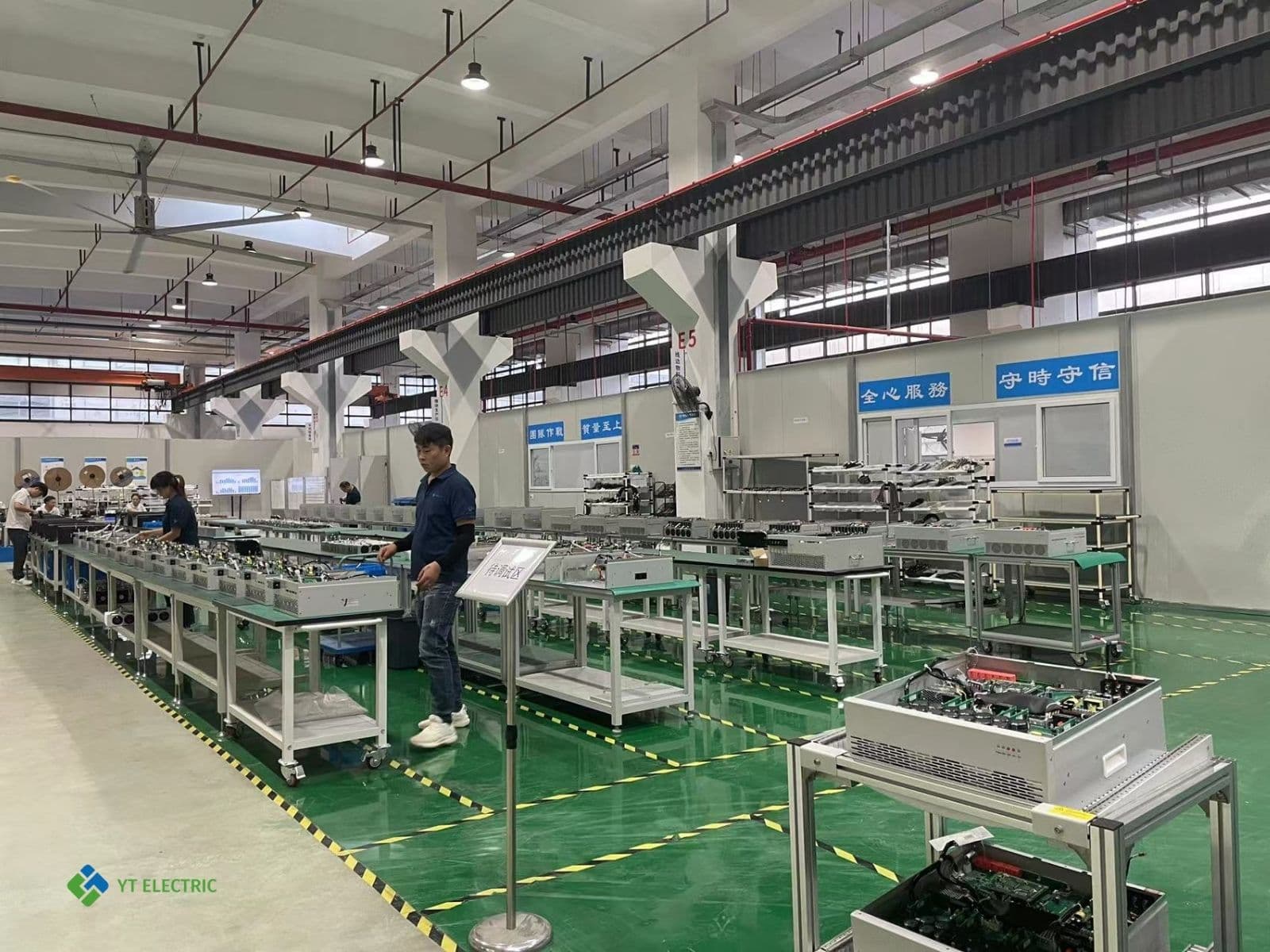
Modules can be paralleled to scale capacity as the station grows, and mixed APF + SVG configurations are supported in a single control architecture. For precise ratings, YT Electric engineers work from your measured data or a site study—every application is confirmed against the actual harmonic spectrum and load profile rather than a generic rule of thumb.
Many YT Electric APF models are designed to deliver harmonic mitigation plus auxiliary reactive power compensation, and per-phase compensation capability helps with imbalance on supported models. How much of each function a single unit can provide depends on its rating and your site's demands—the split is application-dependent and is confirmed during the sizing study.
Measure first. If harmonic distortion (THDi) is the dominant problem, APF is the right device. If the issue is a low power factor or weak voltage support, SVG is the right device. Many stations have both problems at different times of day, and a combined APF + SVG solution is often the cost-effective answer. A site study will tell you which one dominates before you commit.
Ratings are driven by the measured or simulated harmonic spectrum, the reactive power demand, and the transformer and cable configuration. A rough estimate can be made from station capacity (see the matrix above), but final sizing is subject to site study—YT Electric provides load analysis support to EPC partners and plant engineers before you place an order.
Charging infrastructure is expensive, and power quality equipment is only a small fraction of the budget—but the wrong choice costs far more in penalties, downtime and transformer damage. Send YT Electric your station layout, transformer data and (if available) a power-quality measurement, and our engineers will return a device configuration, rating recommendation and quotation. No generic brochures—just a solution sized for your site.
Contact the YT Electric engineering team today for a free site study and quotation for your EV charging station project.



 IPv6 network supported