Capacitor Banks vs. Active SVG: Which Power Factor Correction Is Right for You? When your electricity bill suddenly spikes — or your utility sends a power-factor penalty notice — a common fix is to install power factor correction (PFC). For decades, that meant one thing: capacitor banks. Today you have a second, modern option: the Static Var Generator (SVG). Both i...
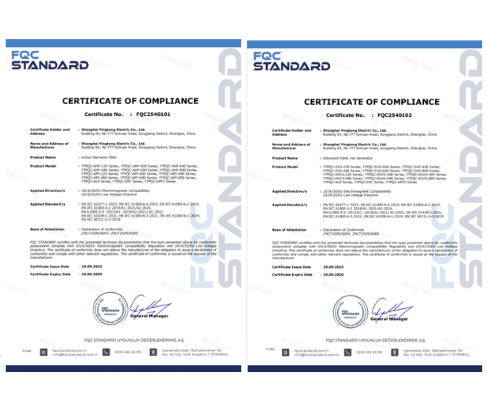
Certificate Documentations in Power Quality Selection: Meaning and Guide A procurement engineer receives an Active Harmonic Filter quotation with a compliance certificate attached. The certificate names a product family, but the quotation specifies another voltage, current rating, enclosure layout, ambient condition, and feeder arrangement. The correct question is not “Does the suppli...
Dear Customers and Partners, As China’s National Day approaches, YT Electric would like to express our sincere appreciation to all customers, distributors and partners for your continued trust and support. Please be informed that our office will be closed for the China National Day Holiday from October 1 to October 7, 2026. During this period, responses to emails, technical inquiries and ord...
High-density data centers, semiconductor fabs, and offshore platforms expose a weakness in many silicon-based active harmonic filters (AHF) and static var generators (SVG): the correction target moves faster than the thermal design. At 20–25.6 kHz, a conventional silicon IGBT converter can correct current distortion, but switching loss, 45°C full-load temperature rise, heatsink volume, a...
Centralized or Distributed Compensation? How to Place AHF and SVG in Multi-Transformer Facilities In modern industrial complexes, continuous process plants, chemical refineries, automotive manufacturing hubs, and large commercial campuses, electrical power is distributed via multi-transformer substations (often configured as Main-Tie-Main or dual-ended secondary selective substations). A standard ...
SVG Reactive Power Compensation: Beyond PF Correction For decades, plant electrical engineers and facility managers viewed reactive power compensation through a single, narrow lens: avoiding utility low power factor penalty surcharges. Traditional solutions—primarily fixed capacitor banks and automatic power factor correction (APFC) panels—were designed solely to supply bulk capacitive...
Why Does an APFC Panel Keep Switching? Causes of Capacitor Step Hunting and How to Stop It In commercial buildings, manufacturing plants, and distribution substations, Automatic Power Factor Correction (APFC) panels are deployed to maintain target power factor (typically 0.95 to 0.98 lagging) and avoid costly utility reactive power penalties. An APFC panel relies on a microprocessor-based power fa...
Harmonic Resonance in Data Center UPS Eco-Mode: AHF vs Active Line Conditioning Hyper-scale enterprise data centers and colocation cloud facilities are under relentless pressure to optimize Power Usage Effectiveness (PUE) and reduce megawatt-scale operational electricity costs. To capture energy savings of 2% to 4% across large uninterruptible power supply (UPS) fleets, engineering managers increa...


 English
 français
 Deutsch
 español
 العربية
 中文
中文



 IPv6 network supported