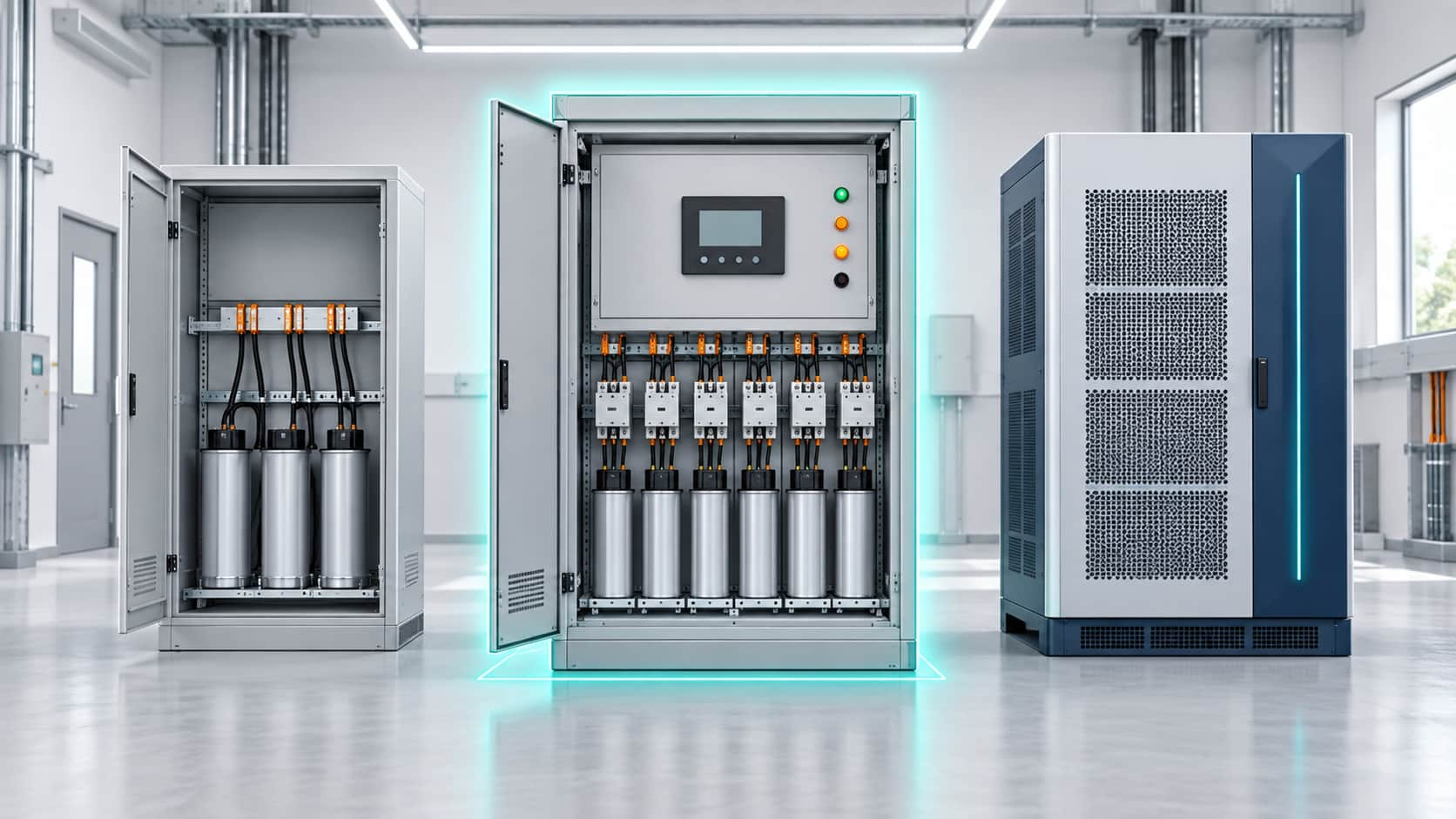
A fixed capacitor bank is often the most economical way to correct power factor — provided the load stays reasonably steady. When motors cycle or production changes by shift, it may overcompensate overnight and undercompensate at peak. An Automatic Power Factor Correction (APFC) panel switches capacitor steps as demand changes; a Static Var Generator (SVG) adjusts reactive power continuously...
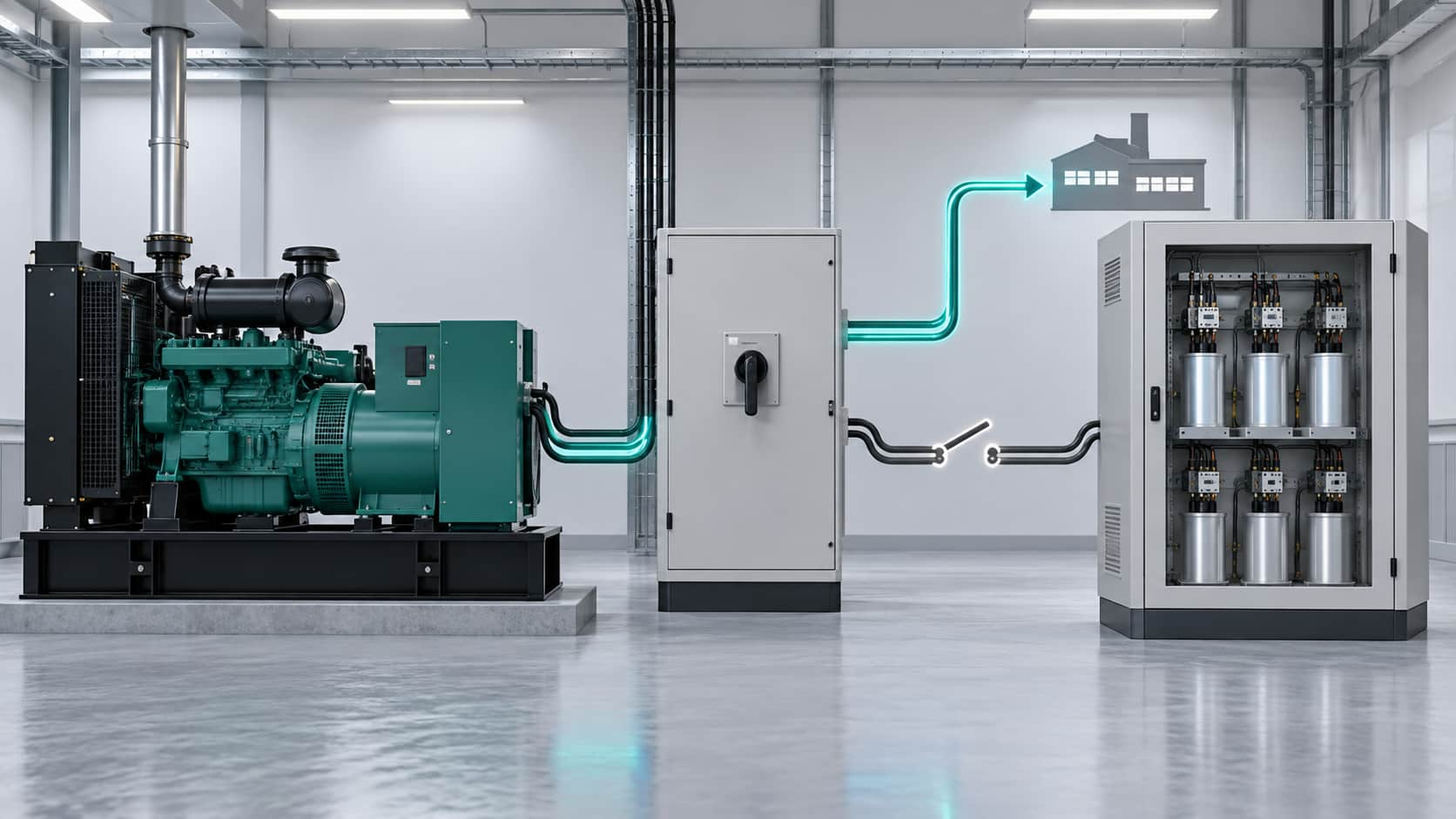
Quick Answer An APFC panel is not simply permitted or forbidden on generator power. Compatibility depends on generator capacity, the power factor of the load that stays online, the size of each load step, harmonic distortion, available short-circuit capacity, governor and excitation response, the generator manufacturer’s limits, and the logic inside the APFC controller. On many standby syste...
High-density data centers, semiconductor fabs, and offshore platforms expose a weakness in many silicon-based active harmonic filters (AHF) and static var generators (SVG): the correction target moves faster than the thermal design. At 20–25.6 kHz, a conventional silicon IGBT converter can correct current distortion, but switching loss, 45°C full-load temperature rise, heatsink volume, a...
Why Does an APFC Panel Keep Switching? Causes of Capacitor Step Hunting and How to Stop It In commercial buildings, manufacturing plants, and distribution substations, Automatic Power Factor Correction (APFC) panels are deployed to maintain target power factor (typically 0.95 to 0.98 lagging) and avoid costly utility reactive power penalties. An APFC panel relies on a microprocessor-based power fa...
Harmonic Resonance in Data Center UPS Eco-Mode: AHF vs Active Line Conditioning Hyper-scale enterprise data centers and colocation cloud facilities are under relentless pressure to optimize Power Usage Effectiveness (PUE) and reduce megawatt-scale operational electricity costs. To capture energy savings of 2% to 4% across large uninterruptible power supply (UPS) fleets, engineering managers increa...
Three-Phase Unbalance in Heavy-Duty EV Fleet Depots: Active Load Balancer vs SVG The rapid global electrification of commercial transportation has accelerated the deployment of megawatt-scale electric bus and heavy-duty truck charging depots. A standard fleet charging hub routinely integrates 20 to 60 high-power DC fast chargers (rated at 120 kW to 360 kW each), megawatt-hour energy storage system...
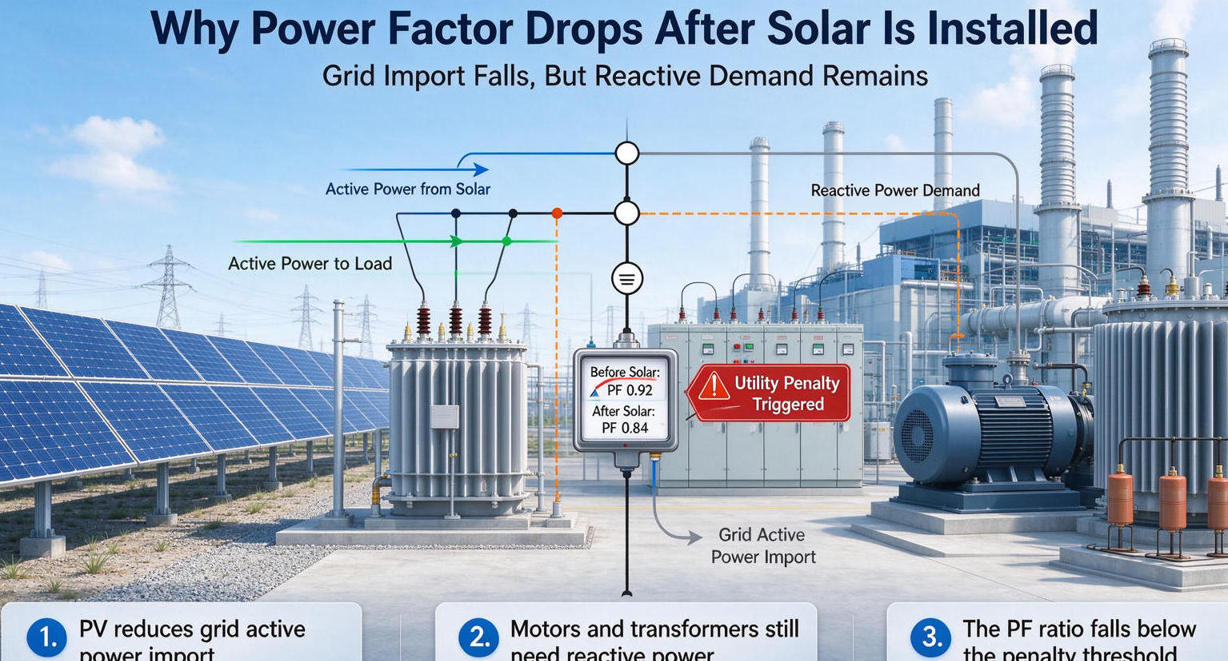
Solar Farm Power Factor Penalties: How SVG Stops Grid Fees Utility-scale and distributed solar photovoltaic (PV) plant operators worldwide face escalating monthly utility penalties for power factor (PF) non-compliance at the Point of Common Coupling (PCC). While solar farm developers engineer their systems for maximum active power generation during peak irradiance, grid codes such as IEEE 1547, IE...
APF in Automotive Manufacturing: Where Harmonics Come From, What They Cost, and How to Mitigate Them In high-throughput automotive manufacturing plants, electrical power reliability directly dictates production output and vehicle yield. An assembly plant does not suffer from a single, uniform harmonic problem—it contends with three fundamentally distinct harmonic generation profiles across i...


 English
 français
 Deutsch
 español
 العربية
 中文





 IPv6 network supported