

 English
 français
 Deutsch
 español
 العربية
 中文
中文
Capacitor Bank Failure Solution:
When to Use SVG, AHF, or a Hybrid System
Learn why capacitor banks fail under harmonic loads and when to use an SVG, AHF, or hybrid system for stable power factor and lower distortion.
Harmonic currents can accelerate capacitor dielectric aging, increase transformer losses, and contribute to nuisance trips. At the same time, rapidly changing reactive demand can cause unstable power factor and repeated capacitor-bank switching.
These are related but different power-quality problems. A static var generator (SVG) provides fast reactive-power compensation and power-factor correction. An active harmonic filter (AHF) targets harmonic current. Where both problems exist, a coordinated SVG/AHF or verified hybrid solution is normally the safer engineering choice.
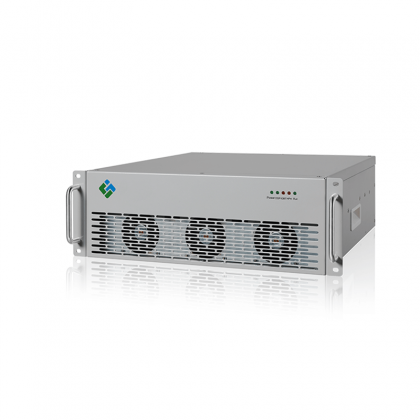
YTPQC-SVG static var generator for dynamic reactive-power compensation
Capacitive reactance falls as frequency rises. At harmonic frequencies, a capacitor bank can therefore absorb more current than expected, especially in systems with VFDs, UPS units, rectifiers, or other nonlinear loads. The additional current raises dielectric losses and operating temperature, which can shorten capacitor life.
Harmonic current also increases transformer copper and eddy-current losses. The actual impact depends on the harmonic spectrum, loading, transformer design, ventilation, and ambient temperature. A power-quality measurement is more reliable than estimating the effect from nameplate data alone.
IEEE 519-2022 establishes steady-state voltage and current distortion goals at the point of common coupling (PCC). Compliance should be evaluated using measured data and the applicable system voltage and short-circuit ratio. Passive filters may work well for stable harmonic spectra, but changing loads often require an active or hybrid approach.
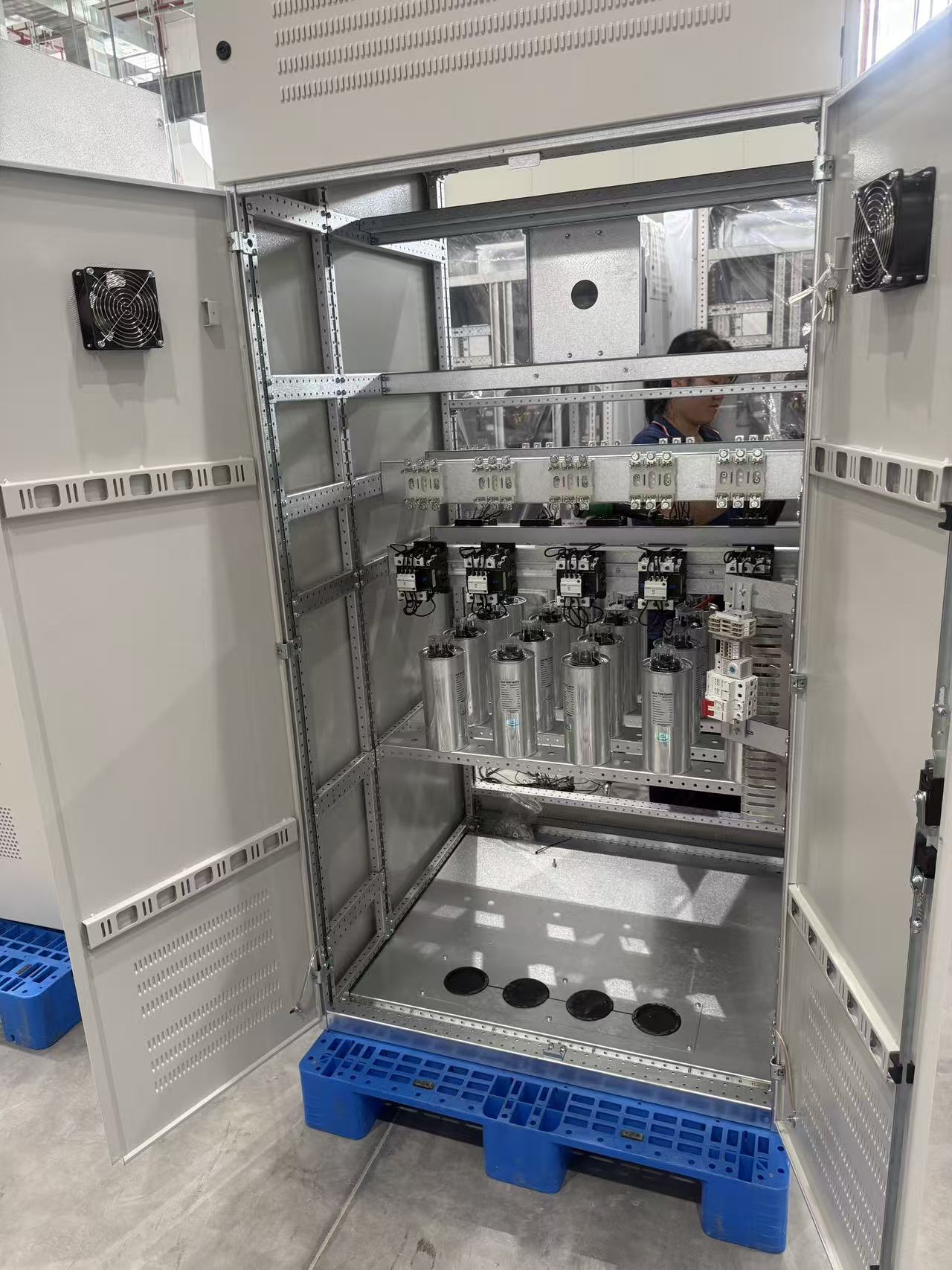
Actual structure of a YT capacitor bank on site
|
Parameter |
Capacitor Bank |
SVG |
|
Compensation type |
Fixed / stepped capacitive |
Continuous, both capacitive and inductive |
|
Response time |
100 ms – 3 seconds (mechanical contactors) |
<5 ms (electronic) |
|
Achievable power factor |
0.92–0.95 typical |
0.99 or better |
|
Harmonic interaction |
Amplifies existing harmonics |
Standard SVG corrects reactive power; use AHF or verified hybrid unit for harmonic mitigation |
|
Neutral current compensation |
Not available |
Available in 4-wire models (zero-sequence) |
|
Voltage regulation capability |
None |
Yes (droop or constant-voltage modes) |
Select SVG capacity from the maximum measured inductive and capacitive kvar demand over a representative production cycle, then include an agreed design margin. If harmonic current is significant, size a separate AHF or a validated hybrid unit from the measured harmonic spectrum. Existing capacitor banks may remain for base reactive power if resonance and switching coordination are checked during the study.
|
System Voltage |
Load Profile |
Recommended SVG Rating |
Ambient Temperature |
|
480V / 3P4W |
VFDs, UPS, data centers |
30–200 kvar per feeder |
45°C full load |
|
480V / 3P3W |
Conveyors, crushers, mines |
100–600 kvar |
50°C derated |
|
690V / 3P3W |
Marine, offshore |
200–800 kvar |
45°C full load |
|
6.6 kV / 3P3W |
Steel mills, concentrators |
1–5 Mvar |
40°C full load |
YTPQC-SVG uses a three-level IGBT voltage-source inverter to generate inductive or capacitive current in real time. The controller measures load current, calculates the fundamental reactive component, and adjusts output to maintain the target power factor. Harmonic mitigation should be handled by YTPQC-AHF or a confirmed hybrid configuration when required.
Response time: up to 5 ms, depending on the selected model and system configuration.
Compensation accuracy: target power factor above 0.98 when the system is correctly sized and commissioned.
Compensation range: continuous inductive and capacitive reactive-power compensation.
Harmonic mitigation: use YTPQC-AHF or a verified hybrid AHF/SVG configuration; a standard SVG should not be treated as a replacement for an AHF.
Topology benefit: a three-level structure reduces the voltage step across each switching device and supports compact, efficient power-electronic compensation.
Q1: How do I size an SVG for my plant?
Measure reactive power at the PCC over a representative operating cycle. Record the peak inductive and capacitive kvar values, load steps, voltage, and ambient temperature. Add an appropriate design margin. If harmonic distortion is also a concern, measure the harmonic spectrum and size an AHF separately or select a verified hybrid configuration.
Q2: Can an SVG work with my existing capacitor banks?
Yes. In a coordinated hybrid system, the capacitor bank supplies base reactive power while the SVG handles rapid reactive changes. If harmonic current is significant, an AHF can be added. Detuning, switching thresholds, CT location, and controller coordination should be confirmed during the site study.
Q3: What maintenance does an SVG require?
Routine maintenance typically includes cleaning air filters, inspecting fans and terminals, and reviewing alarms and temperature records. The exact interval should follow the product manual and site conditions.
Q4: Does installation require a plant shutdown?
The SVG connects in parallel. However, CT installation, breaker work, and final commissioning must follow the site safety procedure. Some work may require a planned outage or isolation of the monitored bus. Confirm the method with the site electrical team before installation.
YT Electric develops active harmonic filters, static var generators, active load balancers, and hybrid compensation systems for industrial and commercial power networks. Modular product options support wall-mounted, rack-mounted, and cabinet installations.
Product selection and final performance depend on measured site conditions, system impedance, CT configuration, ambient temperature, and commissioning settings.
Contact YT Electric for site measurement, harmonic analysis, equipment selection, and a project-specific technical proposal.
Explore YT Electric product specifications and application guidance: https://www.ytelect.com/static-var-generator-svg_p11.html
Reference: IEEE 519-2022, IEEE Standard for Harmonic Control in Electric Power Systems: https://standards.ieee.org/ieee/519/10677/
Need a site-specific solution? Share your single-line diagram, load list, measured power factor, THDi/TDD data, and ambient conditions with YT Electric. Our sales engineers can review the data and prepare a technical proposal.



 IPv6 network supported