Why Does an APFC Panel Keep Switching? Causes of Capacitor Step Hunting and How to Stop It In commercial buildings, manufacturing plants, and distribution substations, Automatic Power Factor Correction (APFC) panels are deployed to maintain target power factor (typically 0.95 to 0.98 lagging) and avoid costly utility reactive power penalties. An APFC panel relies on a microprocessor-based power fa...
Harmonic Resonance in Data Center UPS Eco-Mode: AHF vs Active Line Conditioning Hyper-scale enterprise data centers and colocation cloud facilities are under relentless pressure to optimize Power Usage Effectiveness (PUE) and reduce megawatt-scale operational electricity costs. To capture energy savings of 2% to 4% across large uninterruptible power supply (UPS) fleets, engineering managers increa...
The same capacitor bank that improves power factor during full production can push a facility into leading power factor when the load falls. This overcompensation often appears at night, on weekends, or after large motors stop while capacitors remain connected. A meter may remain close to 1.00, but “leading,” “capacitive,” or the direction of kVAr shows that the syst...
Variable frequency drives (VFDs) are often described as having a high power factor. That can be correct and still be misleading. A VFD may have little phase shift but draw pulsed input current, creating harmonics that reduce true power factor. The result is a common contradiction: one meter displays a cos φ close to 1.00, while another shows a lower total power factor. Both may be reporting co...
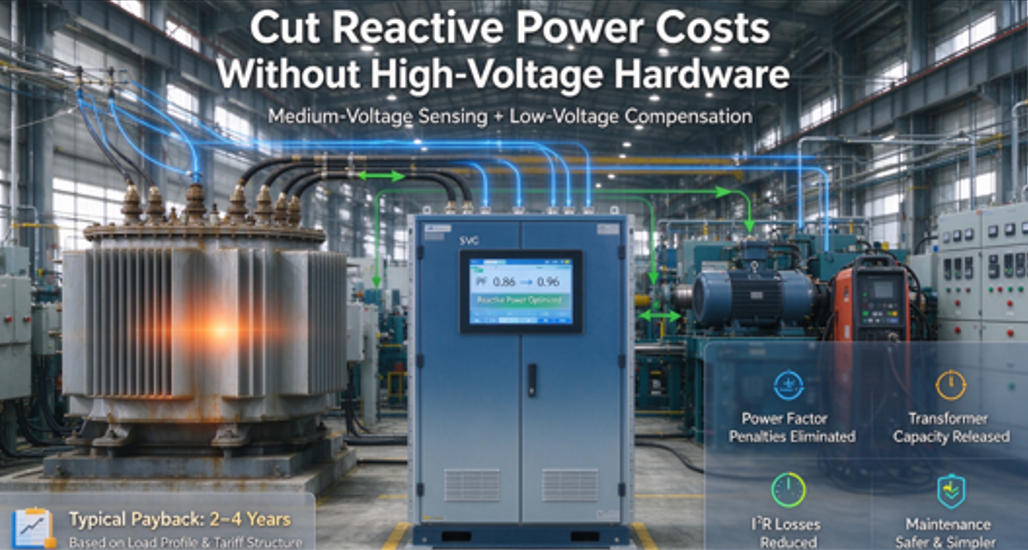
Medium-Voltage Sensing, Low-Voltage SVG Architecture Industrial plants, manufacturing complexes, and large commercial facilities frequently face a challenging power quality engineering dilemma: utility metering occurs on the medium-voltage (MV) intake bus (such as 6.6 kV, 10 kV, 13.8 kV, or 35 kV), while the vast majority of non-linear and inductive loads operate on the low-voltage (LV) 400V, 480V...
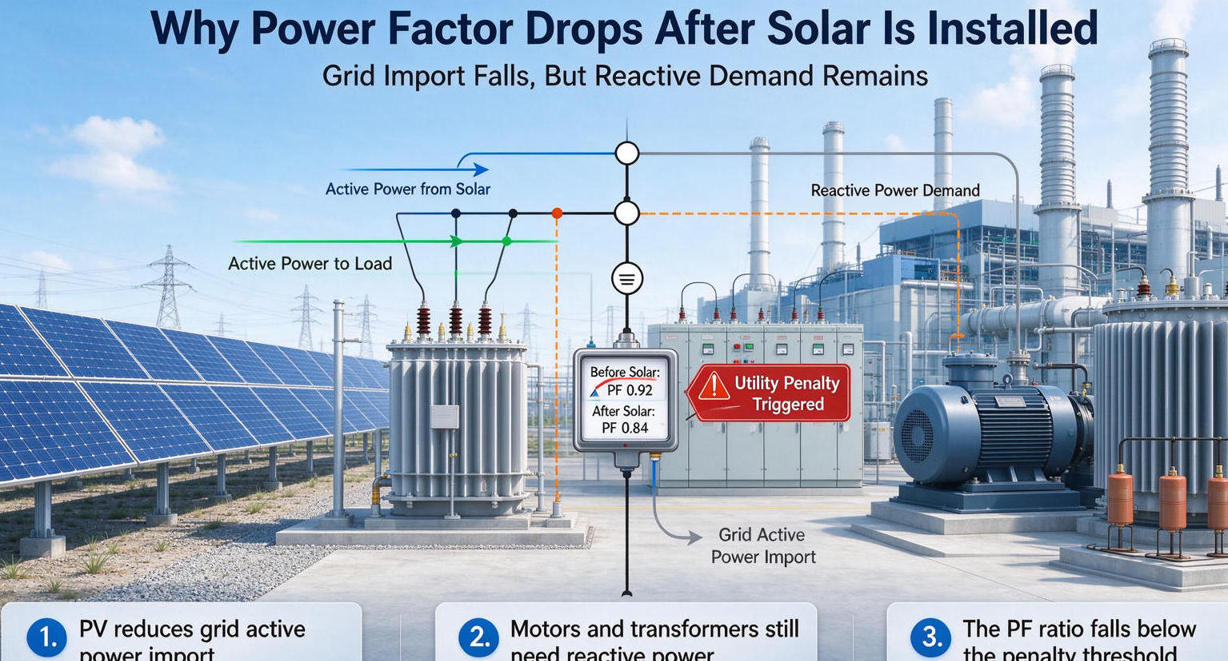
Solar Farm Power Factor Penalties: How SVG Stops Grid Fees Utility-scale and distributed solar photovoltaic (PV) plant operators worldwide face escalating monthly utility penalties for power factor (PF) non-compliance at the Point of Common Coupling (PCC). While solar farm developers engineer their systems for maximum active power generation during peak irradiance, grid codes such as IEEE 1547, IE...
APF in Automotive Manufacturing: Where Harmonics Come From, What They Cost, and How to Mitigate Them In high-throughput automotive manufacturing plants, electrical power reliability directly dictates production output and vehicle yield. An assembly plant does not suffer from a single, uniform harmonic problem—it contends with three fundamentally distinct harmonic generation profiles across i...
BESS & Microgrid Power Quality: SVG & AHF Integration Utility-scale Battery Energy Storage Systems (BESS) and industrial renewable microgrids are fundamentally reshaping modern electrical infrastructure. However, interconnecting gigawatt-scale inverter-based resources (IBR) into weak transmission corridors and distribution grids with low Short-Circuit Ratios (SCR < 2.0) introduces unpre...


 English
 français
 Deutsch
 español
 العربية
 中文






 IPv6 network supported

