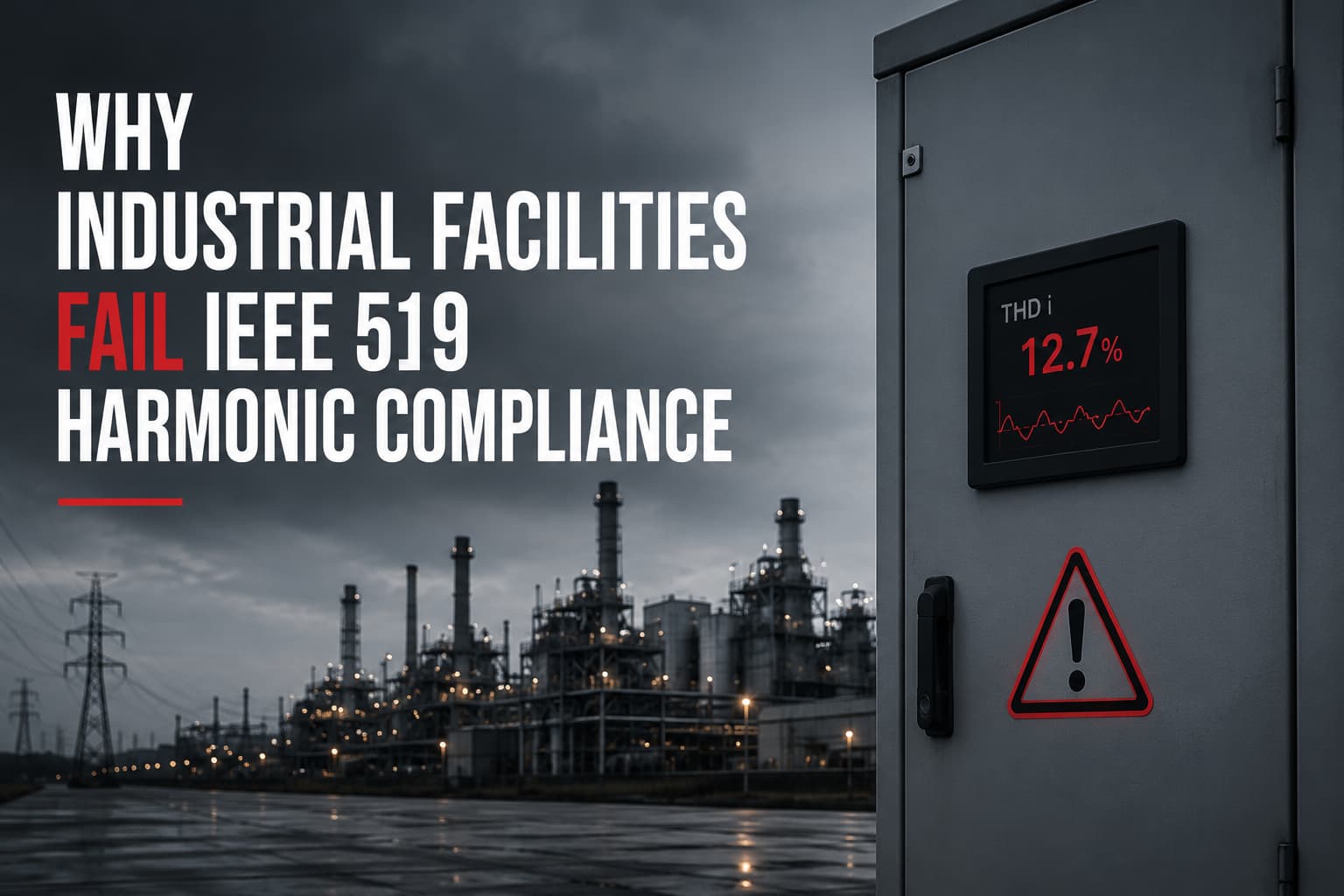
Why Industrial Facilities Fail IEEE 519 Harmonic Compliance Introduction As industrial facilities become increasingly dependent on variable frequency drives (VFDs), automated production lines, switch-mode power supplies, and renewable energy systems, maintaining good power quality has become more challenging than ever. While these technologies improve efficiency and reduce energy con...
How to Reduce Electrical Losses in Industrial Power Systems Electrical losses raise operating costs, heat cables and transformers, and reduce available system capacity. They usually result from conductor resistance, inefficient loading, poor power factor, harmonic currents, and aging equipment. To reduce electrical losses in industrial power systems, engineers need accurate measurements, correct e...
A plastics extrusion plant in Ohio replaced motor starters with VFDs and cut drive energy use by 4%. Three months later, its 1000 kVA transformer ran 18 K above nameplate temperature, two capacitor banks tripped on overcurrent, and the utility applied a power-factor penalty. THDi on the 480 V bus measured 32% at full production. Adding capacitors would make that worse, not better. The fix i...
High THDi — total harmonic distortion of current — is the ratio of the RMS value of all current harmonics to the fundamental current, expressed as a percentage. It rises when nonlinear loads such as variable frequency drives (VFDs), rectifiers, UPS units and chargers draw current in pulses instead of a clean sine wave. A high reading must be explained, not simply cleared: measure the s...
Neutral conductor overheating in a three-phase four-wire system is a zero-sequence problem, so measure harmonic orders first and only then select a filter. A neutral that runs hot while the phases stay comfortably cool is rarely a coincidence. It points to zero-sequence current driven by triplen harmonics, which behaves nothing like a balanced-load calculation predicts. This article follows the or...
SVG sizing for power factor correction cannot be estimated from transformer capacity or a motor nameplate alone. Those figures describe how much load a site could connect, not how much reactive power the load actually exchanges with the supply at the point of common coupling (PCC). A Static Var Generator chosen from nameplate data will either leave the power factor short of target or spend on capa...
Capacitor bank overheating after adding VFDs is a power quality symptom, not a capacitor defect. VFD rectifiers inject harmonic current, the bank offers a low-impedance path at those frequencies, and parallel resonance between the bank and the supply can amplify that current until fuses open, contactors chatter and capacitor cans swell. A capacitor bank supplies reactive power to correct power fac...
Capacitor Banks vs. Active SVG: Which Power Factor Correction Is Right for You? When your electricity bill suddenly spikes — or your utility sends a power-factor penalty notice — a common fix is to install power factor correction (PFC). For decades, that meant one thing: capacitor banks. Today you have a second, modern option: the Static Var Generator (SVG). Both i...


 English
 français
 Deutsch
 español
 العربية
 中文
中文




 IPv6 network supported