

 English
 français
 Deutsch
 español
 العربية
 中文
中文
Power Quality Challenges Created by Battery Energy Storage Systems
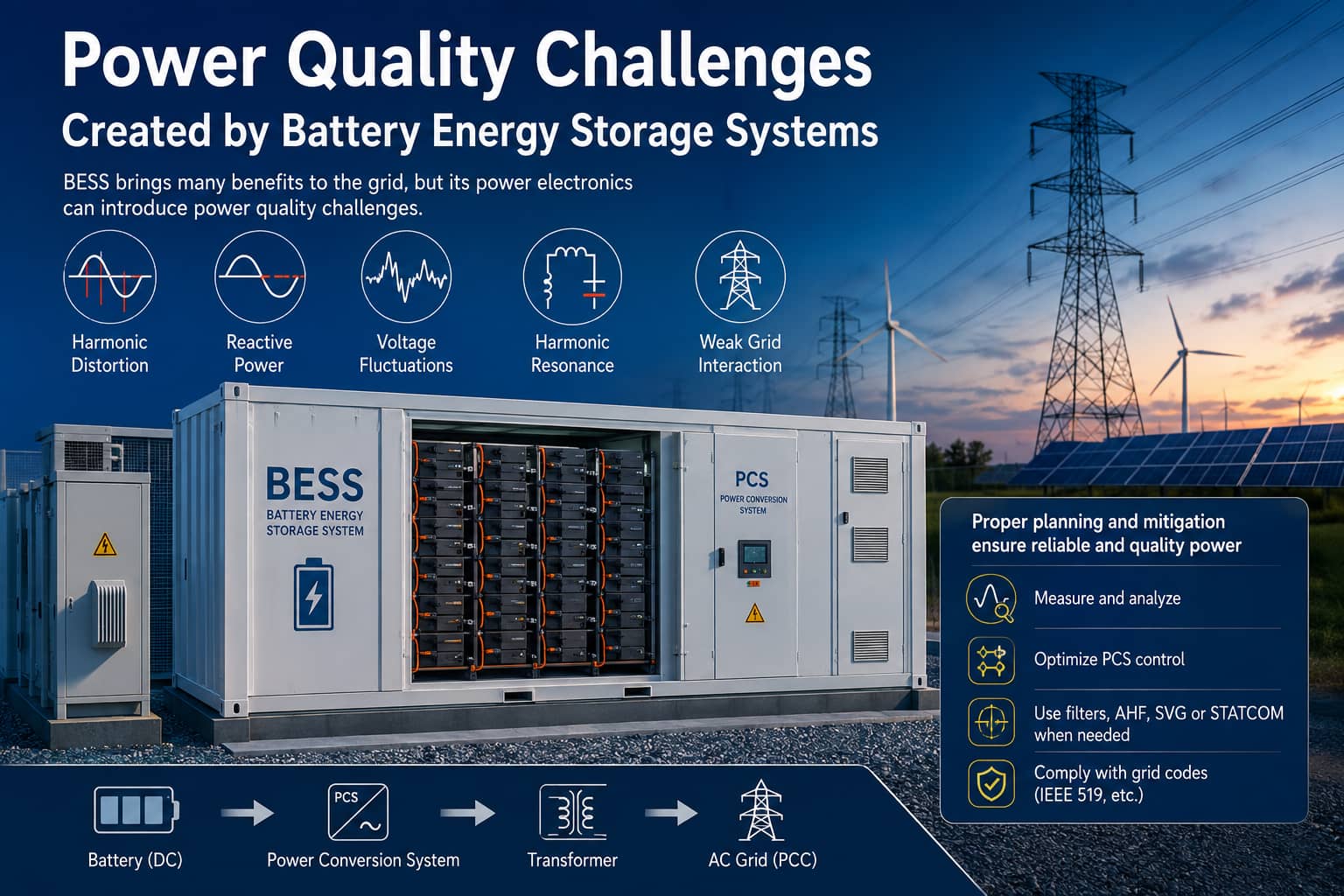
Battery energy storage systems (BESS) are becoming a major part of modern electrical infrastructure. Utilities, renewable energy plants, industrial facilities, data centers and microgrids increasingly use battery storage to manage peak demand, stabilize power supply and integrate renewable energy.
However, connecting large battery energy storage systems to an electrical network can also create new power quality challenges.
A BESS does not connect batteries directly to the AC grid. It uses a power conversion system (PCS) to convert DC battery power into AC power and vice versa. Because the PCS relies on high-speed power electronics, it can interact with transformers, cables, capacitor banks and other nonlinear loads.
Harmonic distortion, reactive power, voltage fluctuations, resonance and weak-grid conditions therefore need to be considered when designing a BESS installation.
A typical BESS includes battery racks, a battery management system (BMS), a power conversion system, transformers, switchgear and an energy management system.
From a power quality perspective, the PCS is one of the most important components.
During charging, the PCS converts AC power from the network into DC power for the batteries. During discharging, it converts DC battery power back into AC power.
Modern converters use semiconductor switching devices such as IGBTs or silicon carbide (SiC) devices to control this process. These converters provide fast and precise control, but switching can also introduce harmonic currents and interact with the impedance of the electrical network.
Power quality can also change continuously because a BESS may move between full charging, partial charging, standby and full discharging within a relatively short period.
The main challenges can be summarized as follows:
| BESS power quality challenge | Main cause | Potential impact | Typical mitigation |
|---|---|---|---|
| Harmonic distortion | PCS/inverter switching | Heating, losses, high THD | PCS filtering, AHF, passive filters |
| Reactive power | Changing converter operation | Poor power factor, voltage variation | PCS control, SVG or STATCOM |
| Voltage fluctuations | Rapid charging/discharging | Flicker, unstable voltage | Dynamic reactive power control |
| Harmonic resonance | Network capacitance and inductance | Amplified harmonics, capacitor stress | Harmonic study, tuned filtering |
| Weak-grid interaction | High network impedance | Increased voltage distortion | Control optimization, STATCOM |
Understanding these problems before installation is much easier and less expensive than correcting them after commissioning.
Harmonic distortion is one of the primary power quality concerns associated with battery energy storage systems.
Ideally, voltage and current in an AC system follow a sinusoidal waveform. Power electronic converters switch current rapidly to control energy flow, creating frequency components above the fundamental 50 Hz or 60 Hz frequency.
These components are known as harmonics.
Total harmonic distortion (THD) is commonly used to describe their overall magnitude. Excessive harmonic distortion can increase electrical losses and heating in transformers, cables, motors and other equipment.
Modern PCS equipment normally includes built-in filtering and advanced switching controls. However, actual harmonic performance depends on the complete electrical system, not only the converter.
Important factors include:
Grid impedance
Transformer impedance
BESS operating load
Existing nonlinear loads
Capacitor banks
Other power converters
Cable length and capacitance
Charging and discharging conditions
This means a converter that performs well under one network condition may produce different results when installed in another.
Large BESS projects should therefore evaluate harmonics at the point of common coupling (PCC) rather than considering only the PCS specification.
Battery energy storage systems are primarily designed to exchange active power, but modern PCS equipment can often control reactive power as well.
Active power performs useful work and is measured in kW or MW. Reactive power supports electric and magnetic fields and is measured in kVAR or MVAR.
Their relationship with apparent power can be expressed as:
S² = P² + Q²
where P is active power, Q is reactive power and S is apparent power.
The ability of a BESS to control reactive power can actually improve power quality. A properly controlled PCS may support voltage, improve power factor or compensate for reactive power elsewhere in the network.
However, the converter has a limited apparent-power capacity.
When the BESS is operating close to maximum active power, less converter capacity may be available for reactive power compensation. Engineers therefore need to consider the PCS capability curve rather than assuming that its full reactive power capacity is always available.
In networks with rapidly changing loads, additional dynamic compensation may be required if the PCS cannot provide sufficient reactive power under every operating condition.
One of the major advantages of battery energy storage is speed.
A BESS can rapidly increase charging power, reduce it or change from charging to discharging. This makes battery storage valuable for frequency regulation, peak shaving and renewable energy balancing.
But rapid changes in power can also affect network voltage.
The effect is particularly important in weak grids, remote industrial networks and microgrids where short-circuit capacity is relatively low.
Possible effects include:
Rapid voltage changes
Voltage flicker
Equipment nuisance trips
Unstable voltage regulation
Transformer tap-changer activity
Grid strength therefore becomes an important part of BESS power quality analysis.
In a strong network, a large change in BESS output may cause only a small voltage change. The same BESS connected to a weaker network can have a much greater effect.
Reactive power control from the PCS, SVG or STATCOM can be used where fast voltage support is required.
A BESS does not operate in isolation.
Industrial electrical networks may already contain capacitor banks, transformers, long cables, variable frequency drives, UPS systems, solar inverters and other power-electronic equipment.
These components influence the impedance of the network at different frequencies.
Capacitance and inductance can create natural resonance frequencies. If a significant harmonic occurs close to one of these frequencies, harmonic voltage or current can become amplified.
Capacitor banks require particular attention.
Power factor correction capacitors may interact with transformer and network inductance. Adding a large BESS or other converter-based equipment can change the harmonic environment and expose an existing capacitor bank to higher harmonic currents.
Potential consequences include capacitor overheating, fuse operation, reactor overheating, excessive voltage distortion and premature capacitor failure.
For larger industrial or medium-voltage BESS projects, a harmonic study or frequency scan can identify potential resonance before equipment is installed.
Unlike many conventional electrical loads, a battery energy storage system does not remain at one operating point.
It can operate at:
Full charging
Partial charging
Standby
Partial discharging
Full discharging
Harmonic performance, reactive power and voltage behavior can change across these conditions.
For example, THDi may appear significantly higher when the PCS operates at light load because the fundamental current becomes smaller. Reactive power capability may also change as active power approaches the converter's maximum rating.
For this reason, measuring a BESS at one operating point does not provide a complete picture.
Power quality studies should evaluate several realistic charging and discharging scenarios, especially for large systems connected to sensitive industrial networks.
There is no single solution for every BESS power quality problem. Mitigation should be selected according to actual measurements, network studies and the type of disturbance.
The PCS itself should be evaluated first. Modern converters use control algorithms and output filters to reduce harmonic emissions and can often provide reactive power control.
If additional harmonic mitigation is required, passive harmonic filters can target specific harmonic frequencies. They are often suitable for large, relatively stable medium-voltage applications, but their design must consider network resonance.
An active harmonic filter (AHF) measures harmonic currents and injects compensating current. This makes active filtering useful in low-voltage networks where harmonic conditions change with operating load.
For dynamic reactive power and voltage problems, Static Var Generators (SVG) or STATCOM systems can provide rapid compensation. STATCOM is particularly relevant to larger medium-voltage networks and weak-grid applications where voltage stability is important.
The correct solution depends on the problem. Installing compensation equipment without first understanding the network can create additional problems rather than solving them.
Baseline power quality measurements should ideally be taken before installation.
Important parameters include voltage THD, current THD, individual harmonic orders, active power, reactive power, power factor, voltage variation and voltage imbalance.
Engineers should also identify:
Short-circuit capacity at the PCC
Transformer impedance
Existing capacitor banks
Large nonlinear loads
Long underground cables
Other inverter-based equipment
PCS reactive power capability
Applicable harmonic limits
For large projects, harmonic load-flow analysis and frequency scans can provide a clearer understanding of how the proposed BESS will interact with the existing network.
Standards such as IEEE 519 are commonly referenced when evaluating harmonic distortion at the PCC, although local grid codes and utility requirements must also be considered.
Yes, they can. A BESS uses a power electronic converter to exchange power with the AC network. Converter switching can generate harmonic currents, although modern PCS equipment includes filtering and control methods designed to minimize them.
Yes. Many modern BESS converters can control reactive power as well as active power. This means the PCS may be able to support power factor correction, depending on its rating and available capacity.
A BESS can interact with existing network impedance and contribute to resonance conditions. Transformers, capacitor banks and cables all influence the resonance frequencies of an electrical network.
No. Additional filtering should be selected only when measurements or engineering studies indicate that it is necessary. Depending on the system, the appropriate solution could involve PCS optimization, passive filtering, active harmonic filtering or other power quality equipment.
Battery energy storage systems provide major benefits for renewable integration, peak management and grid flexibility, but their connection to modern electrical networks also creates new power quality considerations.
The most important challenges include harmonic distortion, reactive power, voltage fluctuations, harmonic resonance and weak-grid interaction.
At the same time, BESS technology can also improve power quality. Modern power conversion systems can provide reactive power control, voltage support and other grid services when properly designed.
The key is to evaluate the complete electrical network rather than treating the battery converter as an isolated device. Baseline measurements, harmonic analysis and proper system studies make it possible to identify problems before commissioning and determine whether additional solutions such as passive filters, active harmonic filters, SVG or STATCOM systems are actually required.
As battery energy storage systems continue to expand across industrial and utility networks, power quality will become an increasingly important part of reliable BESS design.



 IPv6 network supported