How Harmonics Form, Spread, and Clean Up in Non-Linear Loads 1. Introduction The industrial revolution changed life with technology, notably electrical power globally distributed by utilities. Today, power quality is essential for constant equipment operation, demanding glitch-free, stable power for domestic and industrial users. Utilities mandate high-quality equipment to prevent system power iss...
How does power quality affect motors? Understanding the significance of power quality in the context of motor and electrical equipment efficiency is crucial. Power quality is evaluated through several key parameters, including harmonics, voltage unbalance, and voltage fluctuations. In an alternating current (AC) system, the interaction between voltage potential and current through th...
What interharmonics are & do and where they come from? Introduction The use of advanced power electronics and communication systems is improving power system efficiency, flexibility, and reliability, but it is also increasing interharmonic distortion. Knowledge of interharmonics, their sources, effects, measurement, limits, and mitigation will help the industry prevent interharmo...
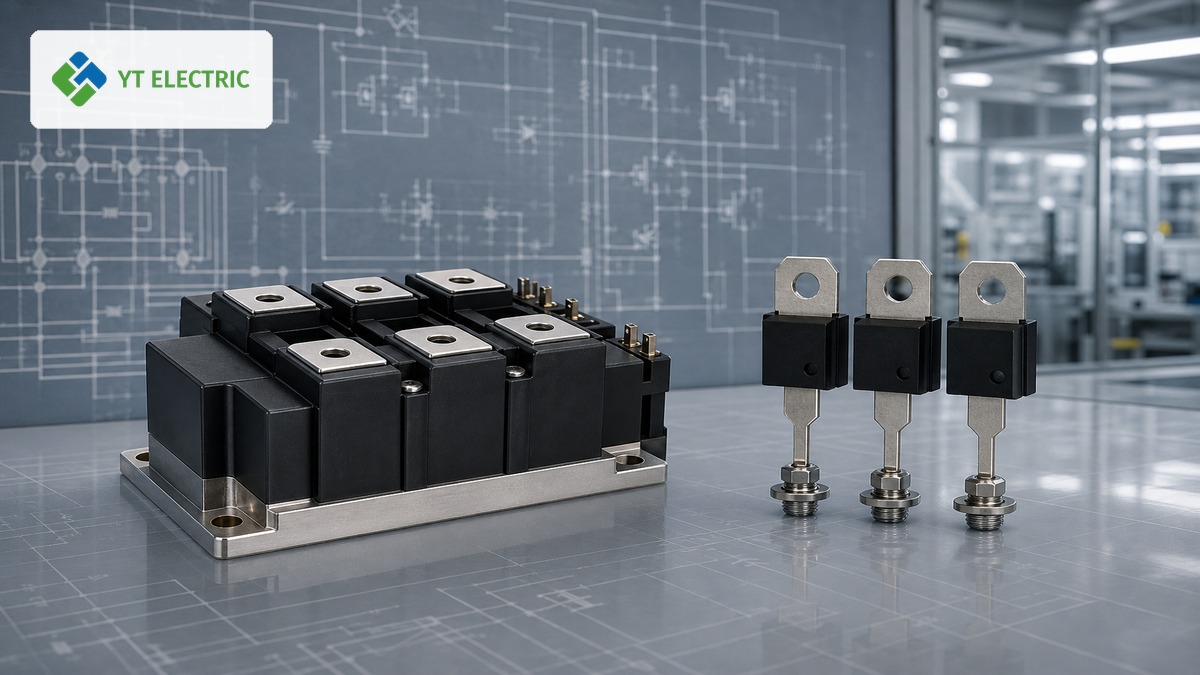
Modular IGBT Power Modules vs. Discrete Single-Tube Packages in AHF and SVG Inverters: The Engineering & Reliability Comparison Quick Engineering Answer: In active power quality equipment like Active Harmonic Filters (AHF) and Static Var Generators (SVG), integrated Modular IGBT Power Modules (e.g., EconoPACK™, PrimePACK™, or intelligent power modules with Direct Bonded Copper cera...
Why Detect and Eliminate Harmonics? Understanding Harmonic Disturbances Harmonics in electrical distribution networks represent significant disturbances that can degrade the quality of electrical power and reduce system efficiency. These disturbances, caused by non-linear loads, introduce unwanted frequencies into the power system, resulting in several adverse effects. Main Ri...
How to eliminate harmonic components in power systems? Harmonics can significantly impact power systems, leading to transformer failures, motor burnouts, nuisance tripping of circuit breakers, and overheating of neutral conductors and other components in a power distribution network. This overheating can be severe enough to cause electrical fires. Nonlinear loads, which draw current ...
Resonance and Active Harmonic Filters Resonance in power systems can lead to significant issues such as harmonic amplification, overvoltages, and equipment damage. Active Harmonic Filters (AHFs) play a crucial role in mitigating harmonic distortion and preventing resonance. Understanding how resonance occurs and how AHF can be used to manage it is key to maintaining a stable and efficient electric...
Understanding IEEE 519-2022 Standard for Harmonic Distortion The IEEE 519 standard sets the criteria for voltage and current harmonic distortion in electrical systems. The recent IEEE 519-2022 edition, which replaces the 2014 edition as of December 2022, introduces significant changes that impact the design and management of electrical installations. Key Changes in IEEE 519-2022 &nbs...


 English
 français
 Deutsch
 español
 العربية
 中文




 IPv6 network supported