

 English
 français
 Deutsch
 español
 العربية
 中文
中文
How Regenerative Loads Affect Industrial Power Quality
Regenerative loads are common in modern industrial systems. They appear when a motor changes from consuming power to returning power.This often happens during braking, lowering, deceleration, or rapid speed changes.Cranes, hoists, elevators, rolling mills, centrifuges, test benches, and conveyor systems can all create regenerative loads.These systems improve control and energy use. However, regenerative loads can also affect industrial power quality.They may cause voltage rise, DC bus overvoltage, unstable power factor, and stress on industrial drives.The problem becomes more serious when the electrical system cannot absorb the returned energy.This article explains how regenerative loads work, how they affect industrial power quality, and how dynamic compensation can improve system stability.
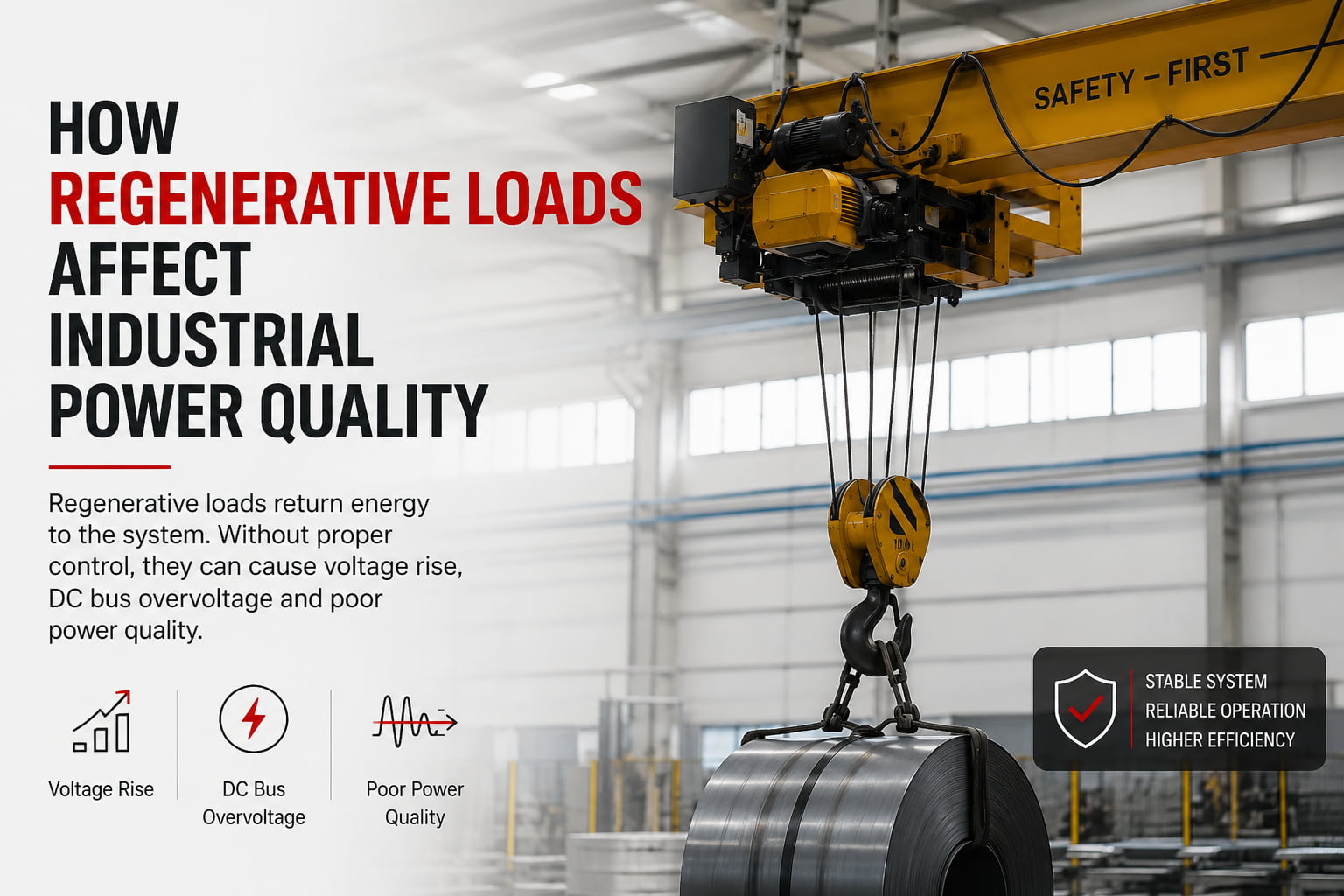
Regenerative loads return electrical energy to the system.A normal motor load takes electrical power from the grid. It converts that power into mechanical movement.A regenerative load works in the opposite direction for part of its operating cycle.The motor acts like a generator. Mechanical energy returns through the industrial drive.This condition often appears when:
Regenerative loads are not faults.They are a normal part of many industrial processes.The challenge is controlling the returned energy without creating power quality problems.
Regenerative loads appear when the mechanical system drives the motor.Consider a crane lifting a heavy object.During lifting, the motor consumes electrical power. During lowering, gravity pulls the load downward.The motor must control that movement. It acts as a generator and sends energy back toward the industrial drive.The same process happens during rapid deceleration.A rotating motor and machine contain stored mechanical energy. When the system slows, that energy must go somewhere.
It may be:
If the system cannot manage this energy, voltage can rise quickly.
Industrial drives control motor speed, torque, acceleration, and braking.During normal motor operation, the drive takes power from the electrical supply.During regeneration, power moves back toward the DC bus.
This can cause DC bus overvoltage.The DC bus contains capacitors that store electrical energy. When regenerative loads return too much energy, the DC bus voltage rises.If the voltage exceeds the safe limit, the industrial drive may trip.Common results include:
A drive trip protects the equipment. However, repeated trips reduce production reliability.The solution depends on how often regeneration happens and how much energy returns.
DC bus overvoltage is one of the most common problems linked to regenerative loads.The problem appears when returned energy enters the DC bus faster than the system can remove it.The voltage then rises.A short regenerative event may create only a small change. A heavy load or fast braking cycle can create a much larger voltage rise.DC bus overvoltage is common in:
Frequent DC bus overvoltage can damage capacitors and power electronic components.It can also force operators to use slower braking times.This may reduce production speed.
Regenerative loads can also cause voltage rise in the wider electrical system.When power returns to the network, the local voltage may increase.The effect depends on the strength of the electrical supply.
A strong power grid can usually absorb more returned energy. A weak grid has less capacity to control voltage rise.Voltage rise becomes more likely when the site has:
The combination of regenerative loads and solar generation can create a difficult condition.Both systems may send power toward the grid at the same time.This can raise voltage at the point of common connection.
Regenerative loads affect more than the drive.They can influence industrial power quality across the connected network.Main power quality problems include:
The exact problem depends on the drive design.Some industrial drives use diode rectifiers. These drives cannot return energy directly to the grid.Other systems use active front-end drives. They can send energy back to the electrical supply.Active front-end drives offer better regenerative control. However, they still need correct system design.Poor control can create voltage, harmonic, or reactive power problems.
Braking resistors are a common solution for regenerative loads.They convert returned electrical energy into heat.This helps prevent DC bus overvoltage.Braking resistors are simple and effective for short braking cycles. However, they also have clear limits.
They:
A braking resistor may solve the DC bus problem inside one drive.It does not control voltage rise or reactive power across the whole electrical system.For frequent regenerative operation, a regenerative drive or active front end may offer better performance.
Regenerative loads can also create changing reactive power demand.The industrial drive may operate differently during motor and generator modes.During one part of the cycle, the system may consume reactive power. During another part, the reactive power condition may change quickly.This can create unstable power factor.Traditional capacitor banks may not follow these rapid changes.A capacitor bank works in fixed steps. It may react too slowly during short regenerative cycles.
This can lead to:
Dynamic reactive power compensation responds more accurately to changing regenerative loads.
A Static Var Generator provides dynamic reactive power compensation.It measures current, voltage, power factor, and reactive power in real time.The SVG then supplies or absorbs reactive power according to the actual system condition.This is useful for regenerative loads because their electrical behavior changes quickly.
An SVG can help:
The SVG does not absorb the active regenerative energy stored in the DC bus.That function belongs to a braking resistor, regenerative drive, energy storage system, or active front end.The SVG controls the reactive power and voltage condition around the regenerative load.This distinction is important.A complete solution may need both regenerative energy control and dynamic reactive power compensation.
Industrial drives are nonlinear loads.They can create harmonic distortion while controlling regenerative loads.The harmonic level depends on the drive topology.A standard six-pulse drive often creates strong 5th and 7th harmonic currents.An active front-end drive may reduce some input harmonics. However, switching harmonics and other distortion can still exist.High harmonic distortion can cause:
If harmonic current is high, an Active Harmonic Filter may be required.The Active Harmonic Filter measures the harmonic current and injects an opposite current.This reduces distortion in real time.
A site may therefore use:
The final design depends on measured system data.
Cranes create strong regenerative loads when lowering heavy material.The load can change quickly. This may cause DC bus overvoltage and unstable power factor.Dynamic compensation helps stabilize the electrical system during lifting and lowering cycles.
Elevators regenerate power when moving downward with a heavy cabin.
They may also regenerate when lifting a light cabin with a heavy counterweight.
Large elevator groups can create repeated regenerative events.
Rolling mills change speed and direction often.
Their industrial drives must control high torque and rapid deceleration.
This creates changing active and reactive power conditions.
Centrifuges store large amounts of mechanical energy.
During braking, that energy returns to the industrial drive.
Poor energy control can cause DC bus overvoltage.
Motor test benches often operate one motor against another.
The load machine absorbs energy and creates continuous regeneration.
These systems need careful control of power flow, voltage, harmonics, and reactive power.
A single current reading is not enough.Engineers should measure the system during the full operating cycle.The test should include:
Important values include:
The measurement should show when power changes direction.
It should also show whether the main problem is active energy, reactive power, harmonic distortion, or all three.
The correct solution depends on the application.
Engineers should review:
A braking resistor may work for occasional regeneration.
A regenerative drive may be better for frequent braking.
An SVG may be needed for fast reactive power changes.
An Active Harmonic Filter may be needed when harmonic distortion is high.
The final solution should follow measured data, not only motor nameplate power.
Regenerative loads return mechanical energy to the industrial drive or electrical network during braking, lowering, or deceleration.
DC bus overvoltage happens when regenerative energy enters the DC bus faster than the system can remove it.
Yes. Returned active power can increase local voltage, especially in weak electrical networks.
A capacitor bank can support steady reactive power demand. It cannot absorb active regenerative energy and may respond too slowly to rapid load changes.
SVG controls reactive power in real time. It improves power factor and supports voltage stability during changing operating conditions.
An Active Harmonic Filter may be required when industrial drives create high harmonic current.
Regenerative loads are common in cranes, hoists, elevators, rolling mills, centrifuges, and motor test systems.They improve energy use by returning power during braking and deceleration.However, regenerative loads can also create DC bus overvoltage, voltage rise, unstable power factor, and harmonic distortion.The correct solution depends on the source of the problem.Braking resistors control short regenerative events. Regenerative drives return active power to the grid. SVG controls changing reactive power. Active Harmonic Filters reduce harmonic distortion.A complete power quality study should measure the full load cycle.This helps engineers select the correct solution and improve industrial power quality around regenerative loads.



 IPv6 network supported