

 English
 français
 Deutsch
 español
 العربية
 中文

What Causes Neutral Current in Three-Phase Systems?
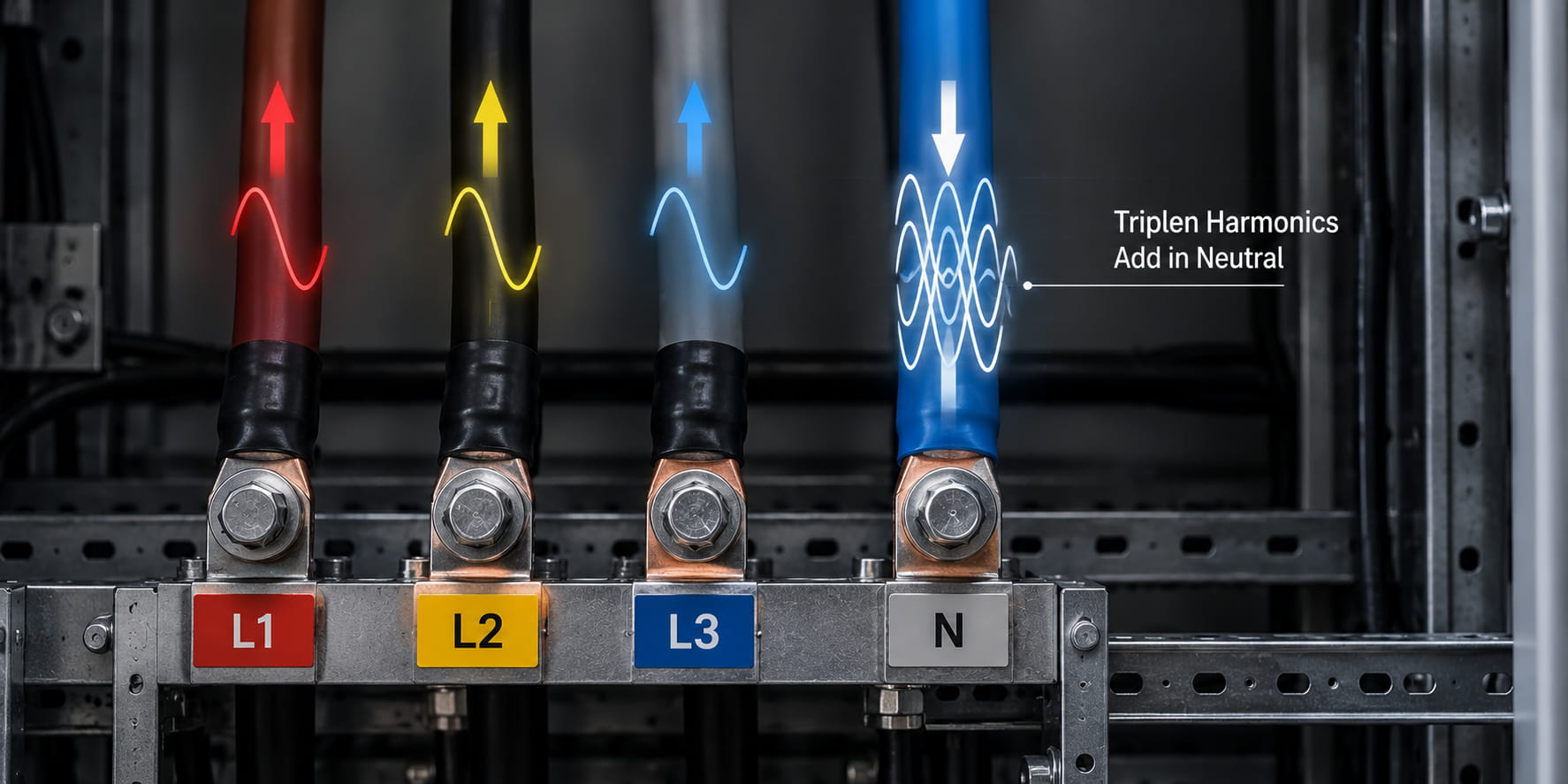
Neutral current in three-phase systems is a common power quality concern in factories, commercial buildings, and data centers. In a balanced electrical system with linear loads, the three phase currents cancel at the neutral point. However, uneven loads and harmonic distortion can cause significant current to flow through the neutral conductor.
Excessive neutral current can lead to cable overheating, energy losses, and electrical equipment failures. In some installations, neutral current may even exceed the current flowing through individual phase conductors.
Understanding what causes neutral current, how to measure it, and how to reduce it helps engineers improve electrical safety and system reliability.
In a three-phase, four-wire (3P4W) electrical system, the neutral conductor provides a return path for current when the phase loads are unbalanced.
When three identical linear loads operate on a balanced three-phase supply, their currents are separated by 120 electrical degrees. The three currents cancel, resulting in nearly zero neutral current.
However, most modern electrical systems do not operate under perfectly balanced conditions.
Single-phase equipment, uneven loading, and nonlinear electrical devices can all produce neutral current. The amount depends on both phase imbalance and harmonic distortion.
There are two main causes of high neutral current in three-phase systems: load imbalance and triplen harmonics.
Load imbalance occurs when electrical equipment draws different amounts of current from each phase.
For example, a commercial building may have:
Phase A supplying lighting and office equipment.
Phase B supplying computers and air conditioning.
Phase C supplying fewer electrical loads.
Because the currents are unequal, they cannot cancel completely. The remaining current returns through the neutral conductor.
In systems with mainly linear loads, balancing the phase loads is often the simplest way to reduce neutral current.
Harmonic distortion creates another important problem.
Many nonlinear loads generate third-order harmonics and other triplen harmonics, including the 9th and 15th orders.
Unlike fundamental currents, balanced triplen harmonic currents are in phase across all three phases. Instead of canceling, they add together in the neutral conductor.
This explains why neutral current can remain high even when the fundamental phase loads appear balanced.
Triplen harmonics are particularly important in three-phase, four-wire systems.
For example, consider three phases that each carry 20 A of third harmonic current.
Because these currents are in phase, their contribution to the neutral is:
The neutral conductor therefore carries 60 A of third harmonic current, even though each phase carries only 20 A of that harmonic.
The example assumes equal third harmonic currents with matching phase angles. Actual neutral current also depends on other harmonic orders and load imbalance.
This is why neutral current cannot always be estimated by comparing phase current magnitudes alone.
Modern buildings contain many nonlinear loads that can produce triplen harmonics.
Common sources include:
Computers and office equipment
Single-phase switch-mode power supplies
LED lighting drivers
UPS systems with single-phase inputs
Electronic control equipment
Battery chargers
Other single-phase rectifier loads
Large concentrations of these devices can increase neutral conductor loading.
Three-phase VFDs with conventional six-pulse rectifiers mainly produce non-triplen characteristic harmonics on their supply side. They are generally not the primary source of third harmonic neutral current.
Excessive neutral current increases electrical losses and places additional stress on distribution equipment.
|
Problem |
Cause |
Possible result |
|---|---|---|
|
Neutral cable overheating |
High RMS neutral current |
Insulation deterioration |
|
Transformer heating |
Harmonic and unbalanced loading |
Higher losses and temperature |
|
Voltage imbalance |
Unequal phase loading |
Poor equipment performance |
|
Electrical losses |
Increased conductor current |
Additional heat and energy loss |
|
Protection problems |
Excessive or unexpected current |
Nuisance trips or equipment stress |
A neutral conductor that carries more current than its design allows can become a serious safety concern.
For this reason, engineers should check conductor ratings, installation conditions, and harmonic loading when investigating neutral current problems.
The first step is to measure the neutral conductor using a suitable true-RMS clamp meter or power quality analyzer.
Measurements should include the three phase currents and the neutral current.
A power quality analyzer can also identify whether the neutral current mainly comes from phase imbalance or harmonic distortion.
Important measurements include:
RMS phase current
RMS neutral current
Current harmonic spectrum
Third harmonic current
Phase imbalance
Load changes during operation
Measurements should cover normal and peak operating conditions.
A high neutral current reading alone does not identify the cause. Engineers need harmonic measurements to determine whether triplen harmonics are contributing to the problem.
The correct solution depends on whether the problem comes from unbalanced loads, harmonic distortion, or both.
If the neutral current comes mainly from load imbalance, redistribute single-phase loads across the three phases.
This can reduce fundamental neutral current without installing additional filtering equipment.
However, balancing the fundamental loads does not eliminate triplen harmonic current.
When triplen harmonics are responsible, engineers should identify the nonlinear equipment producing them.
Low-harmonic power supplies, suitable filtering equipment, and changes to the electrical distribution design may reduce the problem.
The correct solution depends on the harmonic spectrum and system configuration.
A four-wire Active Harmonic Filter (AHF) can compensate for selected harmonic currents and, depending on its design, phase imbalance and neutral current.
The filter measures the electrical current and injects compensation current into the system.
For facilities with changing electronic loads, a 3P4W AHF can provide flexible harmonic compensation.
However, not every AHF supports neutral current compensation. Engineers must confirm the manufacturer's specifications and the available neutral compensation capacity.
Selecting an AHF requires more than measuring the neutral current.
Engineers should first identify how much current comes from triplen harmonics and how much comes from fundamental load imbalance.
They should then check the filter's rated compensation current, neutral current capability, and installation requirements.
For example, a building may have 120 A of measured neutral current, but this does not automatically mean it needs a 120 A AHF.
The required capacity depends on the harmonic spectrum, phase currents, target compensation, and filter design.
A complete power quality measurement provides the best basis for selecting the correct equipment.
Yes. Neutral current is normal when single-phase loads are unbalanced. However, excessive current may indicate load imbalance or harmonic distortion.
Yes. Triplen harmonics can add together in the neutral conductor, causing neutral current to exceed individual phase currents.
The third harmonic is often the most important harmonic contributor. Ninth and fifteenth harmonics can also increase neutral current.
Yes. A suitable four-wire AHF with neutral compensation capability can reduce harmonic neutral current and, where supported, current caused by phase imbalance.
Balancing linear loads can reduce fundamental neutral current. However, triplen harmonics may still produce significant neutral current even when the phase loads are balanced.
High neutral current in three-phase systems is mainly caused by uneven phase loading and triplen harmonic distortion. While load imbalance creates fundamental neutral current, third-order harmonics can add together and produce high neutral current even under balanced loading conditions.
Reducing neutral current starts with accurate electrical measurements. Load balancing can address fundamental imbalance, while suitable harmonic mitigation equipment can reduce harmonic-related neutral current.
For facilities with large numbers of nonlinear loads, a correctly selected four-wire Active Harmonic Filter can improve power quality, reduce neutral conductor loading, and support reliable electrical operation.



 IPv6 network supported

