What is the active power compensator? Active Power Compensator (APC) is an advanced power electronic device used to manage and optimize the flow of active power in electrical power systems. It helps to enhance power quality, improve voltage stability, and increase the overall efficiency of the power distribution network. APCs are particularly useful in applications where there are significant fluc...
How SVG compensation for leading reactive power? What kind of load is prone to generating leading power reactive power? Leading power factor conditions typically occur when a system has capacitive loads or a surplus of capacitive reactance over inductive reactance. Capacitive loads store energy in an electric field, unlike inductive loads that store energy in a magnetic field. When these lo...
Why Dynamic Reactive Power Compensation is Mandatory on Utility-Scale Solar PV Farms: Grid Interconnection Engineering Guide Quick Engineering Answer: Dynamic reactive power compensation is mandatory on utility-scale solar photovoltaic (PV) farms to satisfy stringent utility grid interconnection codes (such as IEEE 2800, IEEE 1547, and ENTSO-E). Intermittent cloud cover creates rapid active power ...
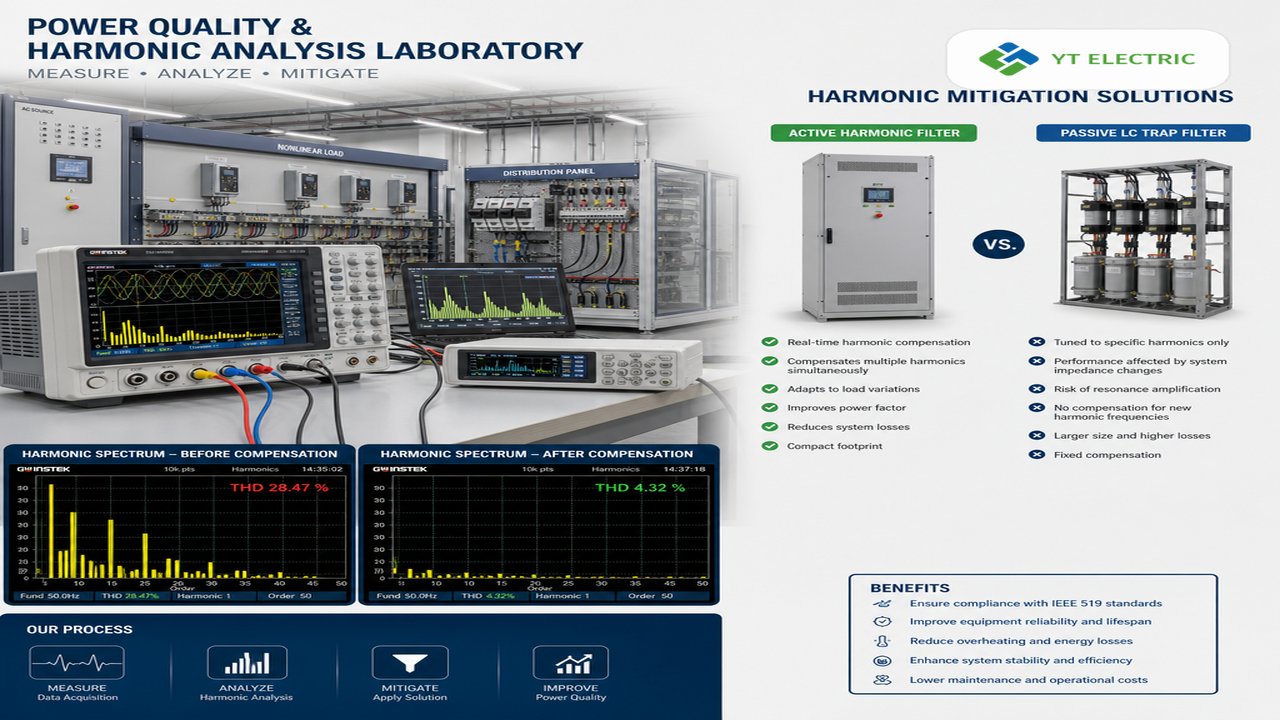
In the realm of power systems, achieving top-notch power quality is a constant pursuit. One key technology that comes to the rescue is the Active Power Filter (APF). The Active Power Filter Production Line plays a crucial role in ensuring the efficient and reliable operation of power systems. Often, we only notice power quality problems when disasters strike. System malfunctions, equ...
kVAr and Amps in power quality Reactive Power (kVAR) Reactive power, measured in kilovolt-amperes reactive (kVAR), is the component of alternating current (AC) power that does not perform any actual work but is necessary for maintaining the voltage levels required for the active (real) power to do useful work. It is associated with the energy storage in inductive and capacitive elements of the pow...
Understanding Harmonic Loss and Its Impact on Power Quality Power quality is crucial for determining the efficiency of any motor. Several key parameters of power quality include harmonics, voltage unbalance, and voltage fluctuations. In an alternating current (AC) system, voltage potential and the current through the load circuit are described in terms of frequency and amplitude. The...
How to calculate THD and PF? Total Harmonic Distortion (THD) Analysis and Power Factor Evaluation Within this discussion, we'll explore methodologies for gauging total harmonic distortion alongside computations for power factor. Total Harmonic Distortion (THD) is a metric reflecting the amalgamation of harmonic frequencies juxtaposed against the primary frequency—such as 60Hz—on...


 English
 français
 Deutsch
 español
 العربية
 中文





 IPv6 network supported

