

 English
 français
 Deutsch
 español
 العربية
 中文
中文
Active Harmonic Filter for Transformer Overheating
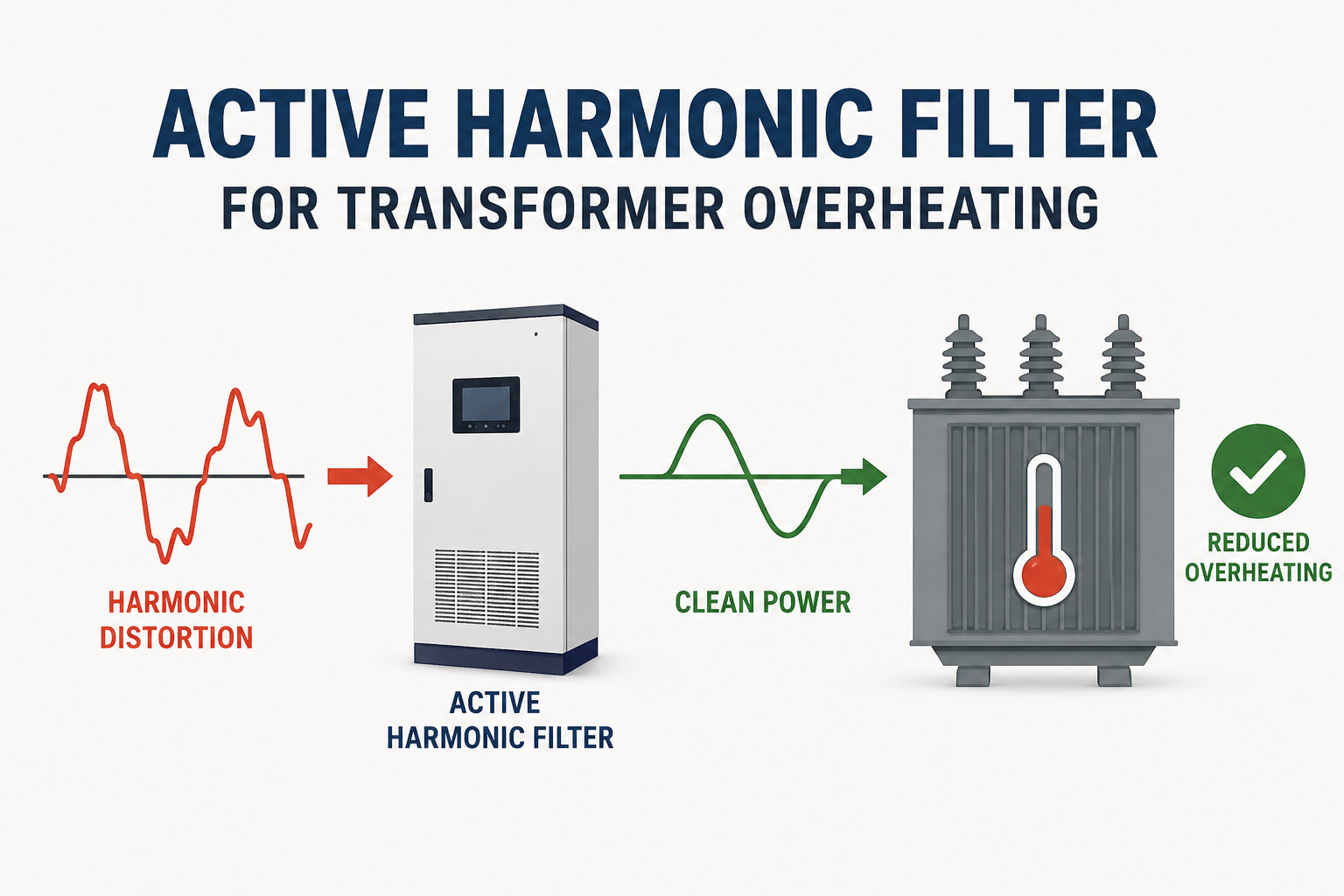
Transformer overheating is a common problem in modern electrical systems. Many sites check the transformer load first. They also check cooling, cable size, room temperature, and ventilation.
But the transformer may still run hot.
In many cases, the real cause is harmonic distortion.
An active harmonic filter helps reduce harmonic distortion in real time. It detects harmonic current and sends out a compensation current. This improves the current waveform. It also helps reduce transformer overheating and protect the electrical system.
Modern factories and buildings use many nonlinear loads. These loads include VFDs, UPS systems, rectifiers, solar inverters, EV chargers, LED lighting, and battery chargers. They are useful, but they can also create harmonic distortion.
When harmonic distortion flows through the transformer, it creates extra heat. This increases transformer losses. It can also reduce equipment life.
Transformer overheating does not always mean the transformer is too small.
A transformer can overheat for several reasons. These include overload, poor ventilation, high room temperature, poor power factor, unbalanced loads, and harmonic distortion.
Harmonic distortion is often missed. The system may look normal. The load may not look too high. But the current waveform may still be distorted.
This distorted current creates extra heat inside the transformer. It also increases stress on cables, breakers, and switchgear.
That is why transformer overheating should not be checked only by load percentage. Engineers should also check power quality.
A normal electrical system should have a clean current waveform.
Harmonic distortion changes that waveform. It happens when nonlinear loads draw current in short pulses. These pulses create harmonic current.
Harmonic current does not do useful work. It only adds heat and losses.
Inside a transformer, harmonic distortion can cause:
· higher RMS current
· higher winding temperature
· more transformer losses
· hot neutral conductors
· lower efficiency
· faster insulation aging
· shorter equipment life
· more protection trips
This is why harmonic distortion is a serious cause of transformer overheating.
A transformer may keep working for a long time under harmonic stress. But the heat slowly damages insulation. Over time, the risk of failure becomes higher.
Most harmonic distortion comes from nonlinear loads.
Linear loads draw current in a smooth way. Nonlinear loads do not. They pull current in pulses. This creates harmonic current in the electrical system.
Common nonlinear loads include:
· variable frequency drives
· UPS systems
· rectifiers
· solar inverters
· EV chargers
· battery chargers
· welding machines
· LED drivers
· server power supplies
One nonlinear load may not cause a serious issue. The risk increases when many nonlinear loads share the same transformer.
This is common in factories, data centers, commercial buildings, solar sites, water treatment plants, and charging stations.
As nonlinear loads increase, harmonic distortion also increases. When harmonic distortion increases, transformer overheating becomes more likely.
An active harmonic filter is a power quality device.
It reduces harmonic current in real time. It measures the harmonic current in the electrical system. Then it sends out an opposite current to cancel the unwanted harmonic current.
This helps clean the current waveform.
An active harmonic filter is different from a passive filter. A passive filter is fixed. It is designed for certain harmonic orders. An active harmonic filter is dynamic. It adjusts as the load changes.
This is important in modern systems. Loads often change during the day. A factory may run different machines at different times. A data center may have changing UPS and cooling loads. A charging station may have many chargers turning on and off.
An active harmonic filter follows these changes in real time.
An active harmonic filter reduces transformer overheating by reducing harmonic current.
When harmonic current is lower, the transformer carries cleaner current. This reduces extra heat and lowers transformer losses.
An active harmonic filter can help:
· reduce harmonic distortion
· lower transformer overheating risk
· reduce neutral current
· lower cable heating
· improve power quality
· improve transformer efficiency
· reduce nuisance trips
· support transformer protection
· extend equipment life
The main value is simple. The transformer works under less electrical stress.
This makes the active harmonic filter useful for sites with high THDi, hot transformers, hot cables, or repeated electrical trips.
Transformer overheating is often only one sign. Harmonic distortion can create other problems in the electrical system.
Common warning signs include:
· transformer overheating under normal load
· high THDi readings
· hot neutral cables
· repeated breaker trips
· hot switchgear
· unstable power factor
· capacitor bank failure
· UPS alarms
· VFD alarms
· transformer noise
· unexplained equipment stress
If these signs appear together, the site should check harmonic distortion.
Replacing the transformer may not solve the problem. If harmonic current is still present, the new transformer can face the same stress.
Transformer protection should not only depend on alarms and breakers.
Those devices act after the transformer is already under stress. An active harmonic filter helps reduce the stress before it causes more heat.
This gives better transformer protection.
An active harmonic filter improves power quality by reducing harmonic distortion at the source or near the affected load. This helps protect the transformer and the wider electrical system.
For industrial power systems, this is important. More sites now use power electronics. More power electronics means more nonlinear loads. More nonlinear loads means more harmonic current.
Without harmonic mitigation, transformer overheating can become a long-term problem.
An active harmonic filter should be selected based on real measurements.
Before choosing the filter size, engineers should check:
· system voltage
· transformer capacity
· load current
· THDi level
· THDv level
· main harmonic orders
· nonlinear load types
· neutral current
· transformer temperature
· power factor
· existing capacitor banks
· installation point
· future expansion plan
This is important because active harmonic filter sizing depends on harmonic current. It should not be based only on transformer size.
A correct site measurement helps avoid wrong sizing. It also helps confirm whether transformer overheating is caused by harmonic distortion, overload, poor ventilation, or another issue.
Transformer overheating is not always an overload problem.
In many modern electrical systems, transformer overheating is caused by harmonic distortion from nonlinear loads. These loads include VFDs, UPS systems, rectifiers, solar inverters, EV chargers, battery chargers, and LED lighting.
Harmonic distortion creates harmonic current. This harmonic current increases transformer losses, raises temperature, lowers efficiency, and shortens equipment life.
An active harmonic filter reduces harmonic distortion in real time. It improves power quality, lowers transformer overheating risk, and supports long-term transformer protection.



 IPv6 network supported