

 English
 français
 Deutsch
 español
 العربية
 中文
中文
Active Harmonic Filter for Welding Machines
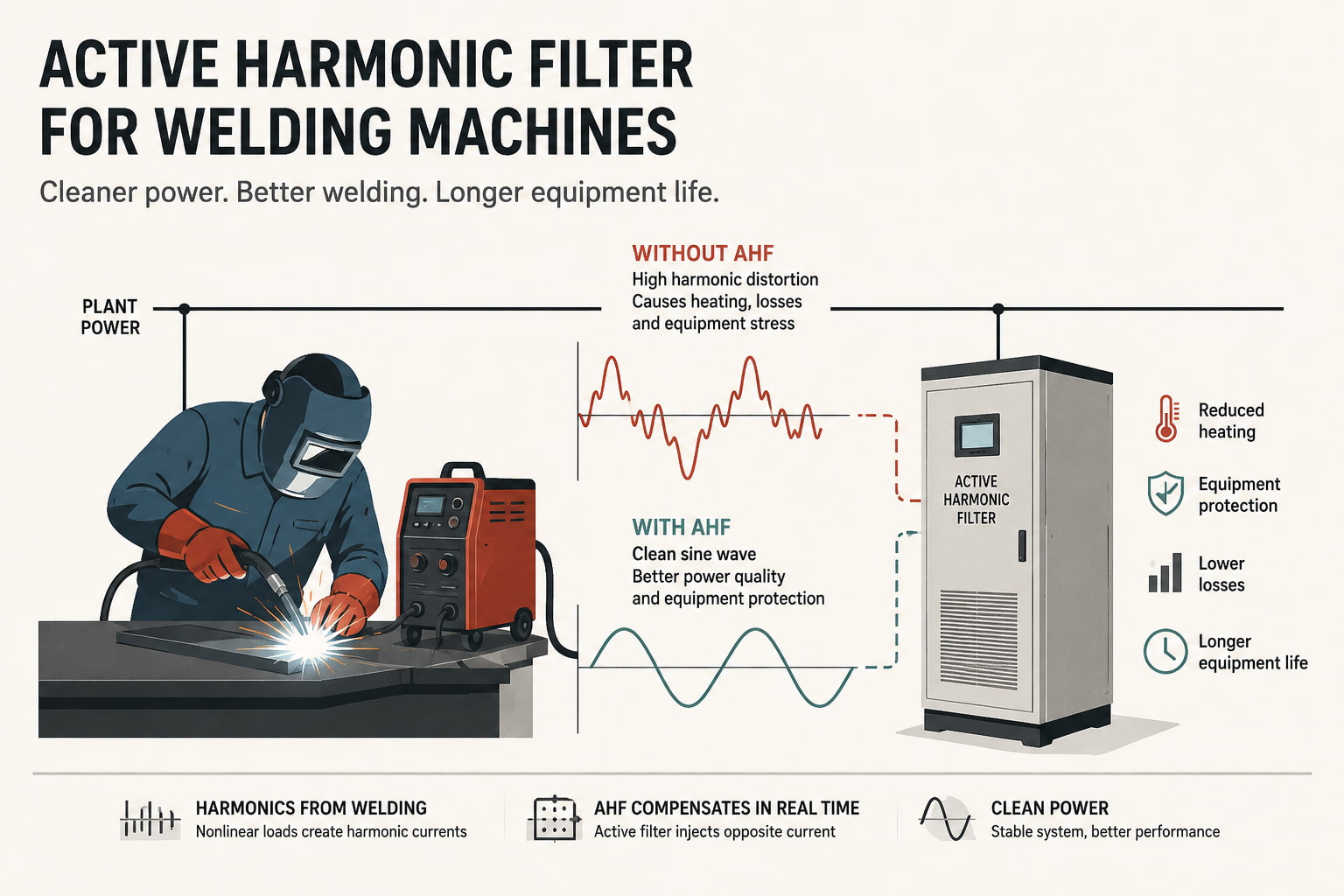
Welding machines are common in factories, workshops, steel plants, automotive production, shipyards, and metal processing sites. They are useful machines, but they can create serious power quality problems.
The main issue is welding machine harmonics.
Modern welding machines often use power electronic converters. These converters do not draw current in a clean sine wave. They draw current in pulses. This creates harmonic distortion in the electrical system.
When harmonic distortion becomes too high, the site may face overheating, nuisance tripping, unstable voltage, transformer stress, and lower equipment life. This is why an active harmonic filter for welding machines is becoming important in many industrial power systems.
An active harmonic filter helps reduce harmonic distortion in real time. It improves power quality and protects the wider electrical network from harmonic current created by welding machines.
A welding machine is usually a nonlinear load.
A linear load draws current in a smooth and predictable way. A nonlinear load does not. It pulls current in pulses. These pulses distort the current waveform and create harmonic currents.
Welding machines can create harmonics because they often include:
The welding process itself is also unstable. The load changes during arc starting, welding, stopping, and repeated operation. This makes welding machine harmonics more difficult to control than a simple fixed load.
In a factory with only one small welding machine, the problem may be limited. But in a workshop with many welding machines operating at the same time, harmonic distortion can rise quickly.
Welding machine harmonics do not stay inside the welding machine. They move through the electrical system and affect other equipment.
Common problems include:
These problems are often seen in welding workshops, steel processing plants, automotive factories, and metal fabrication sites.
The site may still operate every day, but the electrical system becomes stressed. Over time, this stress increases maintenance cost and reduces the life of transformers, switchgear, cables, and protection devices.
An active harmonic filter is a power quality device used to reduce harmonic distortion.
It monitors the current waveform in real time. When it detects harmonic current, it injects compensation current in the opposite direction. This cancels the unwanted harmonic current and improves waveform quality.
For welding machines, this is important because the load changes quickly. A fixed solution may not follow the real welding condition. An active harmonic filter adjusts continuously according to the actual harmonic distortion in the system.
This makes an active harmonic filter suitable for welding applications with changing current, unstable load patterns, and multiple machines working at different times.
An active harmonic filter for welding machines is useful because welding loads are dynamic.
A welding workshop may have different machines operating at different times. Some machines may be idle. Others may run at high current. Some may start and stop repeatedly. This makes harmonic distortion change throughout the day.
An active harmonic filter can respond to these changing conditions.
Main benefits include:
This is why AHF is often better than a fixed harmonic solution when welding loads change frequently.
Welding workshops often have concentrated electrical loads. Several machines may connect to the same distribution panel. When many welding machines operate together, total harmonic distortion can become high.
This can affect the whole workshop.
The transformer may run hotter than expected. Cables may carry extra current. Breakers may trip even when the real load does not seem too high. Capacitor banks may fail early if harmonic resonance appears.
These are not random problems. They are signs of poor power quality.
A properly sized active harmonic filter can reduce harmonic distortion and improve the electrical condition of the workshop.
Some sites consider passive harmonic filters. A passive filter uses capacitors, reactors, and tuned components to reduce specific harmonic frequencies.
A passive filter can work when the load is stable and predictable. But welding machines are often not stable. Their operating condition changes during the welding cycle.
This is where the active harmonic filter has an advantage.
A passive filter is fixed.
An active harmonic filter is dynamic.
A passive filter targets selected harmonic orders.
An active harmonic filter responds to the real waveform.
A passive filter may be less flexible when the workshop expands.
An active harmonic filter can adapt better to changing load conditions.
For welding machines, the active harmonic filter is usually the stronger long-term solution when the site has changing loads, multiple machines, or strict power quality requirements.
Transformers are often the first equipment affected by welding machine harmonics.
Harmonic current increases heating in transformer windings. It also increases losses and reduces usable capacity. The transformer may appear correctly sized, but poor power quality can make it run hotter than normal.
An active harmonic filter helps reduce this stress.
By reducing harmonic current, AHF helps:
This is important in welding-heavy factories where transformers already carry high and changing loads.
Nuisance tripping is common in welding environments.
Breakers and protection devices may trip because harmonic current increases system stress. The problem may look like overloading, but the real cause can be poor waveform quality.
When harmonic distortion is reduced, the electrical system becomes more stable. Protection devices operate under cleaner current conditions. This helps reduce unnecessary trips and improves production continuity.
For factories, this is important. A single unexpected trip can stop welding work, delay production, and create maintenance pressure.
Not every welding site needs AHF immediately. But some warning signs are clear.
A site should consider an active harmonic filter when it has:
These signs show that the electrical system is under harmonic stress.
The correct decision should be based on measurement. Engineers should check harmonic distortion, current level, voltage level, transformer loading, and the number of nonlinear loads before selecting the AHF capacity.
Before choosing an active harmonic filter for welding machines, the site should review the real electrical condition.
Important points include:
The right AHF size depends on the actual harmonic current, not only on the welding machine nameplate.
This is important because undersizing may not solve the problem. Oversizing may waste cost. Proper measurement helps select the right active harmonic filter for the real welding load.
An active harmonic filter can be used in many welding-related applications.
Fabrication workshops often use multiple welding machines, cutting machines, compressors, and motors. AHF helps control harmonic distortion and improve overall power quality.
Automotive plants use welding robots and automated production lines. These systems need stable power. AHF helps reduce electrical disturbance and supports reliable production.
Steel processing sites often use heavy welding equipment and other nonlinear loads. AHF helps reduce transformer stress and improve system stability.
Shipyards often have many welding machines working at the same time. The load changes constantly. AHF provides flexible harmonic compensation for this dynamic environment.
Heavy machinery production uses high-current welding systems. AHF helps reduce harmonic current and protect transformers, switchgear, and cables.
Welding machines create harmonics because they use power electronic converters and draw current in pulses instead of a smooth sine wave.
An active harmonic filter detects harmonic current and injects compensation current to reduce harmonic distortion in real time.
Yes. AHF is suitable for welding workshops because welding loads change quickly and often create harmonic distortion.
Yes. By reducing harmonic current, AHF can lower transformer heating, reduce losses, and improve long-term reliability.
The right AHF size should be based on measured harmonic current, voltage, load current, THDi, and the number of welding machines.
Welding machines are important industrial loads, but they can create serious harmonic distortion. When many welding machines operate together, the electrical system may face transformer overheating, cable stress, nuisance tripping, voltage instability, and reduced equipment life.
An active harmonic filter for welding machines helps solve this problem by reducing harmonic current in real time. It improves power quality, protects transformers and cables, reduces electrical stress, and supports more stable production.
Check out out various options for active harmonic filter https://www.ytelect.com/active-power-filter_c3



 IPv6 network supported