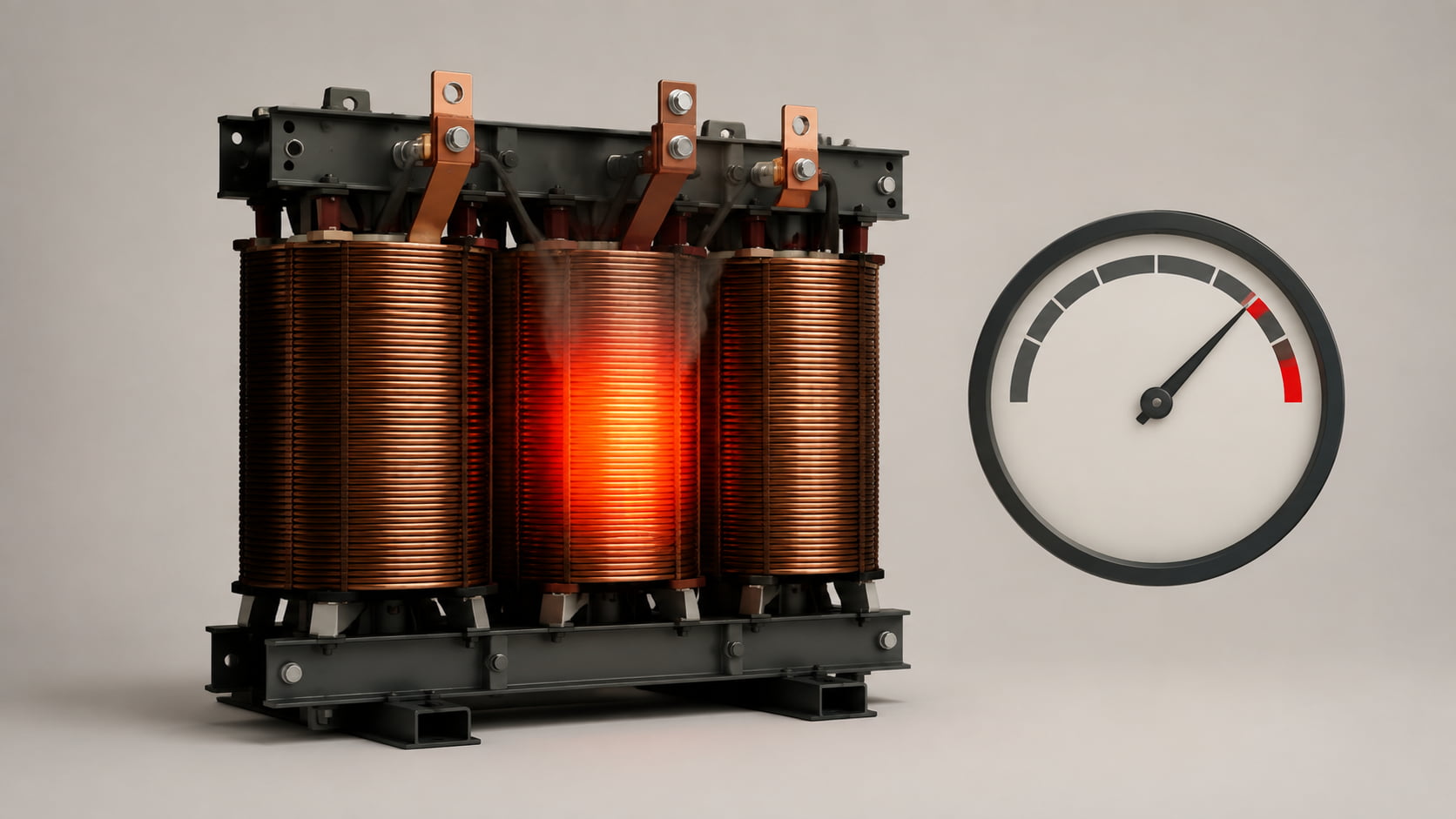
Transformer Overheating Explained: Why It Happens Below Rated Load A transformer can run unusually hot even when the connected load appears safely below its nameplate rating. Current may seem acceptable while winding or enclosure temperatures continue rising. This often happens because loading is assessed only in kilowatts or average amperes. Harmonics, imbalance, poor power factor and inad...
Even-order harmonics are current and voltage components at even multiples of the fundamental frequency — the 2nd, 4th, 6th and higher orders — that appear as asymmetric distortion in a three-phase power system. They behave differently from the familiar 3rd, 5th and 7th odd harmonics: balanced six-pulse rectifiers do not generate them, but asymmetry does. Half-controlled bridges, DC-off...
High THDi — total harmonic distortion of current — is the ratio of the RMS value of all current harmonics to the fundamental current, expressed as a percentage. It rises when nonlinear loads such as variable frequency drives (VFDs), rectifiers, UPS units and chargers draw current in pulses instead of a clean sine wave. A high reading must be explained, not simply cleared: measure the s...
Neutral conductor overheating in a three-phase four-wire system is a zero-sequence problem, so measure harmonic orders first and only then select a filter. A neutral that runs hot while the phases stay comfortably cool is rarely a coincidence. It points to zero-sequence current driven by triplen harmonics, which behaves nothing like a balanced-load calculation predicts. This article follows the or...
Capacitor bank overheating after adding VFDs is a power quality symptom, not a capacitor defect. VFD rectifiers inject harmonic current, the bank offers a low-impedance path at those frequencies, and parallel resonance between the bank and the supply can amplify that current until fuses open, contactors chatter and capacitor cans swell. A capacitor bank supplies reactive power to correct power fac...


 English
 français
 Deutsch
 español
 العربية
 中文
中文



 IPv6 network supported