

 English
 français
 Deutsch
 español
 العربية
 中文
中文
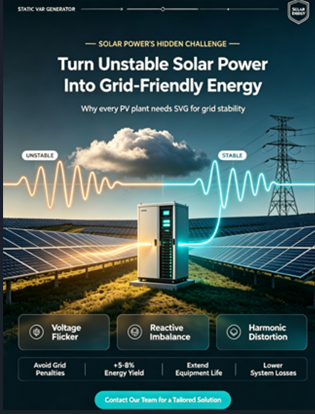
A Static Var Generator (SVG) is an active, IGBT-based power-electronics compensator that stabilises voltage, supplies or absorbs reactive power and filters harmonic current at the point of common coupling (PCC) of a solar plant. It turns unstable PV output into grid-compliant power for EPC contractors, electrical engineers, procurement teams and power-quality consultants — fast enough to follow cloud-driven irradiance changes and accurate enough to hold power factor and distortion inside code limits such as IEEE 519.
In short, an SVG solves voltage flicker, power-factor excursions and harmonic distortion in one unit, and suits dynamic disturbances that stepped capacitor banks cannot follow.
A PV plant has no rotating mass, so its output is not inherently stable. A cloud edge crossing an array can change active power by a large fraction within seconds, and the inverters swing their output to follow. At the PCC this appears as a fast, repetitive change in active and reactive power — with three measurable consequences.
Rapid active-power changes drive voltage sags and swells at the connection point. On a weak grid with a low short-circuit ratio the same power step creates a larger voltage step, and the repeated pattern becomes flicker that affects nearby customers and works the transformer tap changer. Utilities cap voltage change and flicker; exceeding the caps can trigger penalties or curtailment.
Solar inverters usually run near unity power factor, but at low irradiance or partial shading they run out of current headroom and cannot hold the reactive-power setpoint the grid code demands. The result is a power-factor excursion, higher line current and extra losses. A fixed capacitor bank switches only in steps, so it cannot follow this continuously varying demand.
Inverters switch at high frequency, so their output carries harmonic current. Where several inverters and any capacitor banks share a bus, the individual harmonic orders — typically the 5th, 7th and 11th — can add and even resonate, raising transformer and cable temperature, disturbing protection relays and pushing current THDi at the PCC beyond the utility limit. The high dv/dt of fast IGBT switching creates this distortion; the same switching stage is used to cancel it.
Poor power quality is a commercial risk, not merely a technical one. A plant that cannot hold power factor or current distortion inside its grid-code limits risks penalties, forced curtailment and slower connection approval, while inverter trips and derating cut the energy delivered.
Sizing should come from site data: a power-quality audit at the PCC records what the plant injects and absorbs.
Current transformers (CTs) belong at the PCC, on the grid side of the compensation point, with a second set useful at the SVG coupling point. CT ratio, phase orientation and arrow direction toward the load all affect the measured power factor; a reversed or mis-rated CT is a common reason an SVG appears not to work. Measure at the same reference the controller will use.
Log, over at least a full day and across irradiance conditions:
If background voltage THD is already high — present guidance treats above roughly 8% as a warning level — the SVG filtering stage can be pushed toward instability as it absorbs distortion created elsewhere. That condition, and resonance with existing capacitor banks, should be found before commissioning, not after.
An SVG is not a passive capacitor bank. It is an active compensator built around a three-level IGBT converter that measures load current and injects an equal-and-opposite current to correct reactive power, harmonics and imbalance. YT Electric modules switch their IGBTs at up to 25.6 kHz and keep power consumption below roughly 2.5%.
Responding within one grid cycle, an SVG follows cloud-driven voltage changes instead of reacting after them. It supplies capacitive and inductive reactive power continuously, so the plant holds its target power factor from dawn to dusk — and at night, when inverters are idle but the grid still needs voltage support. Applied correctly, it holds voltage fluctuation within about ±1%.
The same converter computes the harmonic content of the load current and injects the opposing current to cancel it. On typical harmonic-order distortion, reduction of 97% or better is achievable and current THDi at rated load is typically 5% or below. Where harmonics are already significant, an Active Harmonic Filter is sometimes added.
An SVG compensates each phase independently, correcting the imbalance that uneven string irradiation produces. This reduces the neutral and zero-sequence current that would otherwise circulate through the collection system and main transformer.
In a PV plant the SVG is usually connected on the low-voltage side of the main step-up transformer, at the PCC, where it corrects the whole plant's contribution. Module details are on the Static Var Generator product page.
The table compares the three compensation routes usually evaluated for a PV plant.
| Capability | Fixed capacitor bank | Hybrid TSC + SVG | Active SVG (3-level) |
|---|---|---|---|
| Response | Stepped, seconds | Fast, dynamic | Within one grid cycle |
| Reactive range | Capacitive only | Capacitive + dynamic trim | Continuous, leading and lagging |
| Power factor | Fixed steps | Adjustable | Adjustable setpoint |
| Harmonics | None; can amplify resonance | Partial | 97% or better; THDi 5% or below at rated load |
| Phase imbalance | Not addressed | Partial | Independent per-phase |
| Resonance | High with harmonics | Managed by control | Low; active coordination |
| Best fit | Stable linear loads | Retrofit over banks | PV, wind, dynamic loads |
As a starting point, SVG capacity is often taken as 10–15% of plant rated capacity, then confirmed against the measured worst-case reactive-power deficit. YT Electric low-voltage modules span roughly 10 kVAr to 100 kVAr, and plant-level cabinets extend the platform for larger builds.
Selection must also respect the device's limits:
The selection matrix maps typical conditions to a starting configuration, as a design guide.
| Condition | Primary need | Recommended configuration | Watch-outs |
|---|---|---|---|
| Small or rooftop PV, strong grid | Power-factor compliance | Wall-mounted module (10–50 kVAr) | Confirm PCC metering point |
| Utility-scale PV, moderate grid | Reactive support + harmonics | Rack or free-standing modules, 10–15% of rating | Measure harmonic orders |
| Weak grid, high flicker | Voltage and flicker control | Plant-level SVG cabinet with inverter coordination | Short-circuit ratio, voltage-step limits |
| Retrofit over capacitor banks | Dynamic compensation | Hybrid SVG + TSC bank | Resonance, switching coordination |
| Background voltage THD above 8% | Audit first | Enhanced harmonic compensation or upstream passive filter | SVG cannot correct a distorted bus alone |
How do I size an SVG for a PV plant?
Start from the measured worst-case reactive-power deficit at the PCC, not from nameplate capacity. A common working figure is 10–15% of plant rated capacity, verified against audit data.
Where should the CTs be placed, and what is checked at installation?
Install the main CT set at the PCC using the same reference the controller measures. Verify CT ratio, phase sequence and arrow direction toward the load; a mis-oriented CT gives a wrong power factor.
What maintenance does an SVG need?
An SVG is air-cooled: keep the airflow path and fans clean, hold the ambient inside the rated −20 °C to +55 °C window, check terminal torque, clear dust from the heatsink and modules, and keep firmware current. A scheduled programme is covered in this guide to SVG and AHF maintenance.
How does an SVG pay back?
The return comes from avoiding power-factor penalties and curtailment, keeping inverters online instead of tripping during voltage excursions, lower I²R losses once power factor is corrected, and reduced thermal stress that extends transformer life. Payback depends on the local tariff, so evaluate it with site-specific data.
YT Electric designs and manufactures Static Var Generators, Active Harmonic Filters and hybrid compensation systems for renewable and industrial applications. To turn your audit data into a correctly sized SVG, send your measurements and single-line diagram to sales@yt-electric.com for a technical review.



 IPv6 network supported