

 English
 français
 Deutsch
 español
 العربية
 中文
中文
Solar Inverter Harmonics in South Africa
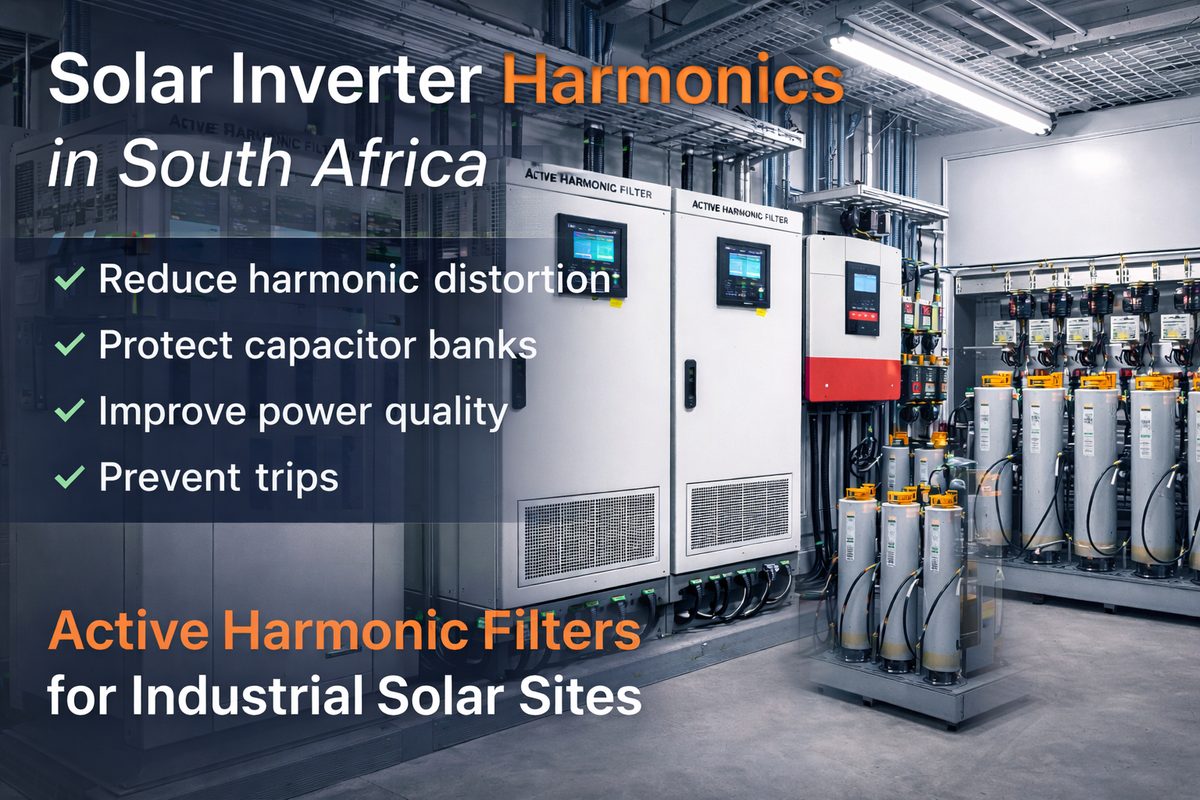 Solar inverter harmonics South Africa is now a bigger issue on industrial and commercial sites. Many facilities have added rooftop PV to reduce grid dependence and control electricity bills.
But solar inverters also add harmonic current to electrical networks. When that happens, the site may see overheating, unstable power factor, nuisance trips, and weak power supply performance. In many cases, active harmonic filters are the most cost effective way to improve power quality and protect the electricity supply.
South African sites are under pressure to keep operations stable and reduce energy cost. Solar helps with that goal. But adding solar inverters changes the electrical behavior of the system.
A solar inverter is power electronic equipment. It does not draw or inject current in the same way as a simple linear load. That is why solar inverter harmonics South Africa is becoming a more common issue in factories, warehouses, office buildings, and other industrial and commercial facilities.
If the site already has variable speed drives, UPS units, or rectifiers, the harmonic level can rise even more. This puts extra stress on cables, transformers, breakers, and capacitor banks.
Harmonic distortion does not stay only at the inverter. It moves through electrical networks and affects the wider system.
This can lead to:
Many sites first notice the symptoms, not the cause. The solar system appears to work, but power quality gets worse after installation.
A capacitor bank is built for power factor correction. It is not built for harmonic mitigation.
That is the problem.
When solar inverter harmonics South Africa projects are added to a site with an old capacitor bank, the capacitor bank may start to run hot. It may trip more often. In some cases, it fails early.
This happens because the capacitor bank is now exposed to a more distorted electrical environment. The site changed, but the compensation method did not.
Most sites show warning signs before full failure. Common signs include:
If several of these signs appear after rooftop PV is added, solar inverter harmonics may be part of the cause.
Solar inverters are not the only source of harmonic distortion. Many modern facilities also use nonlinear loads such as:
When these loads operate together, harmonic current rises faster. This is why industrial solar power quality South Africa is becoming a bigger topic. The site may have solar, drives, and capacitor banks all on the same bus. That creates more stress across the full system.
Harmonic resonance capacitor bank problems happen when a capacitor bank interacts with system impedance and amplifies certain harmonic frequencies.
This can be dangerous.
The result may be capacitor bank overheating harmonics, repeated fuse failure, unstable voltage, and shorter equipment life. A site may replace capacitor parts, but the same problem returns because the real issue is still in the network.
This is one reason solar inverter harmonics South Africa should be treated as a system issue, not just an inverter issue.
Active harmonic filters work in real time. They detect harmonic current and inject compensation current back into the network. This helps improve power quality and reduce stress on the power supply.
For sites with solar inverters and changing loads, active harmonic filters are a high quality solution. They are more flexible than fixed tuned methods and better suited to modern electrical networks.
This is why active harmonic filter South Africa projects are growing. They help reduce harmonic current, support a more stable electricity supply, and protect equipment from repeat problems.
A VSD harmonic filter South Africa solution is often needed when the site has many drives as well as rooftop solar. Drives already create harmonic distortion. When solar inverters are added, the total harmonic level can rise enough to affect the whole network.
This is common in:
In these cases, a stronger harmonic mitigation strategy is needed to keep the system stable.
Some sites do not only have harmonic problems. They also have fast reactive power changes.
A static var generator South Africa solution is useful in these cases. It responds faster than a standard capacitor bank and helps keep compensation stable under changing load conditions.
This makes it a strong option for power factor correction South Africa projects where the load profile changes often during the day.
The best answer is usually not to replace one failed part at a time. The better approach is to review the whole system and solve the real cause.
A cost effective upgrade may include:
This approach helps reduce electricity bills, improve energy savings, and support better long term performance.
Before choosing a solution, engineers should check:
Without measurement, it is difficult to make informed decisions.
Solar inverter harmonics South Africa is a growing issue in modern industrial and commercial electrical networks. As more sites add rooftop PV, the risk of harmonic distortion, capacitor bank overheating, and unstable power supply performance increases.
If the goal is to improve power quality, protect the electricity supply, reduce electricity bills, and support better energy efficiency, active harmonic filters are often the better long term solution. In many cases, AHF and SVG for solar sites is the strongest overall approach.



 IPv6 network supported