A robotic welding cell can run perfectly for hours and still expose a serious weakness in the factory power system when several lines start together. The symptom may be a hot neutral conductor, a nuisance trip, a voltage complaint from a servo drive, or a transformer that operates above its expected temperature. In many cases, the root cause is not a single defective machine. It is three-phase loa...
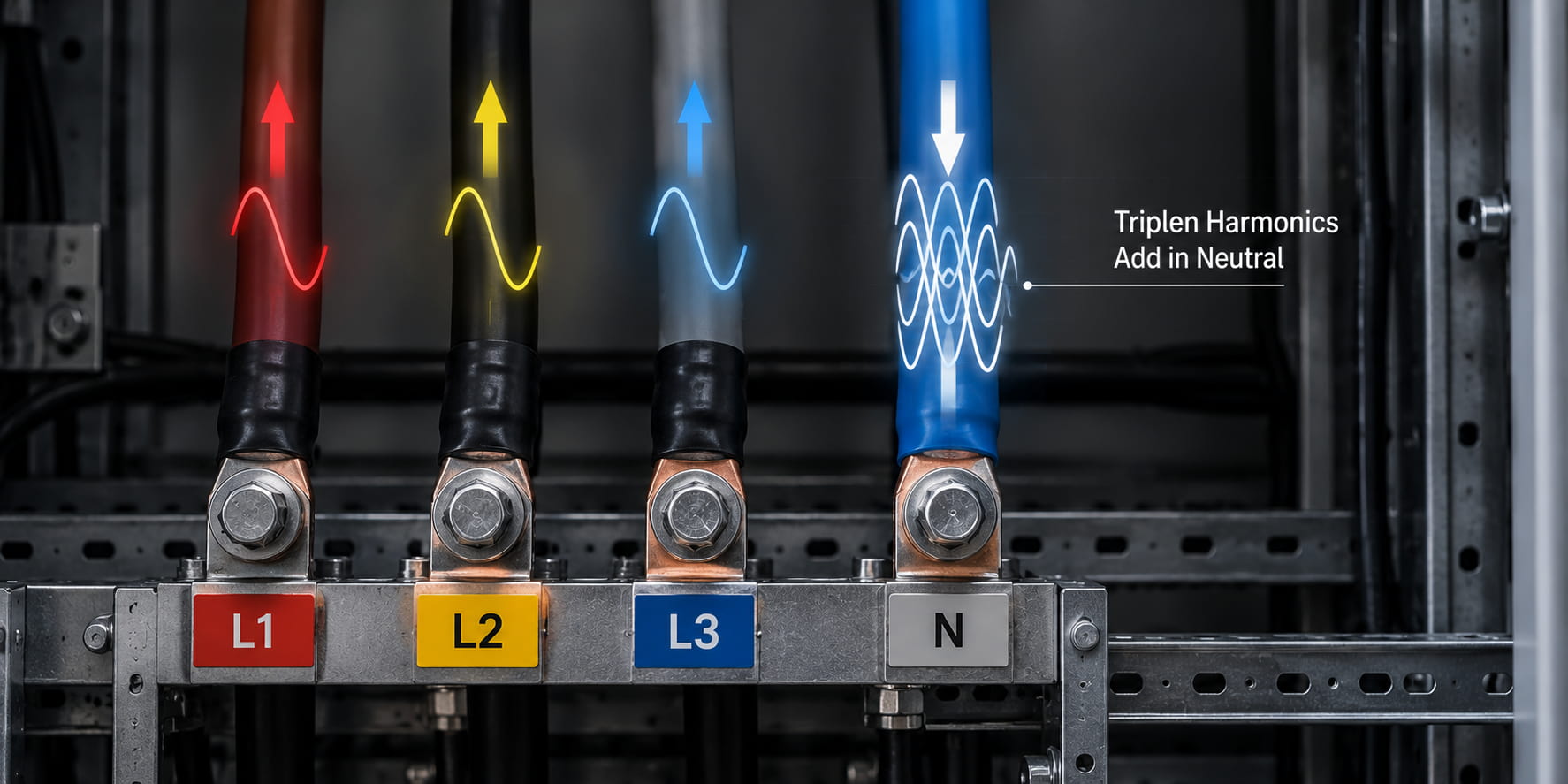
Neutral conductor overheating in a three-phase four-wire system is a zero-sequence problem, so measure harmonic orders first and only then select a filter. A neutral that runs hot while the phases stay comfortably cool is rarely a coincidence. It points to zero-sequence current driven by triplen harmonics, which behaves nothing like a balanced-load calculation predicts. This article follows the or...
Three-Phase Unbalance in Heavy-Duty EV Fleet Depots: Active Load Balancer vs SVG The rapid global electrification of commercial transportation has accelerated the deployment of megawatt-scale electric bus and heavy-duty truck charging depots. A standard fleet charging hub routinely integrates 20 to 60 high-power DC fast chargers (rated at 120 kW to 360 kW each), megawatt-hour energy storage system...
What Causes Neutral Current in Three-Phase Systems? In a theoretically balanced three-phase four-wire (3 ext{P}4 ext{W}) electrical distribution network supplying purely linear loads, phase currents are separated by 120° electrical phase angles, summing vectorially to zero at the star point (I<sub>N</sub> = I_A + I_B + I_C = 0). In modern real-world facilities—such as AI hype...


 English
 français
 Deutsch
 español
 العربية
 中文





 IPv6 network supported

