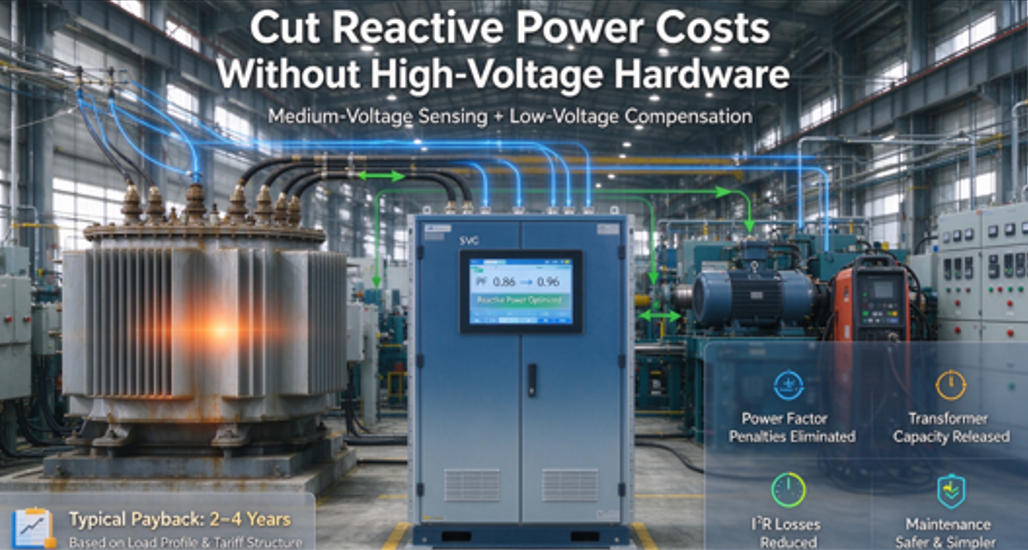
Medium-Voltage Sensing, Low-Voltage SVG Architecture Industrial plants, manufacturing complexes, and large commercial facilities frequently face a challenging power quality engineering dilemma: utility metering occurs on the medium-voltage (MV) intake bus (such as 6.6 kV, 10 kV, 13.8 kV, or 35 kV), while the vast majority of non-linear and inductive loads operate on the low-voltage (LV) 400V, 480V...
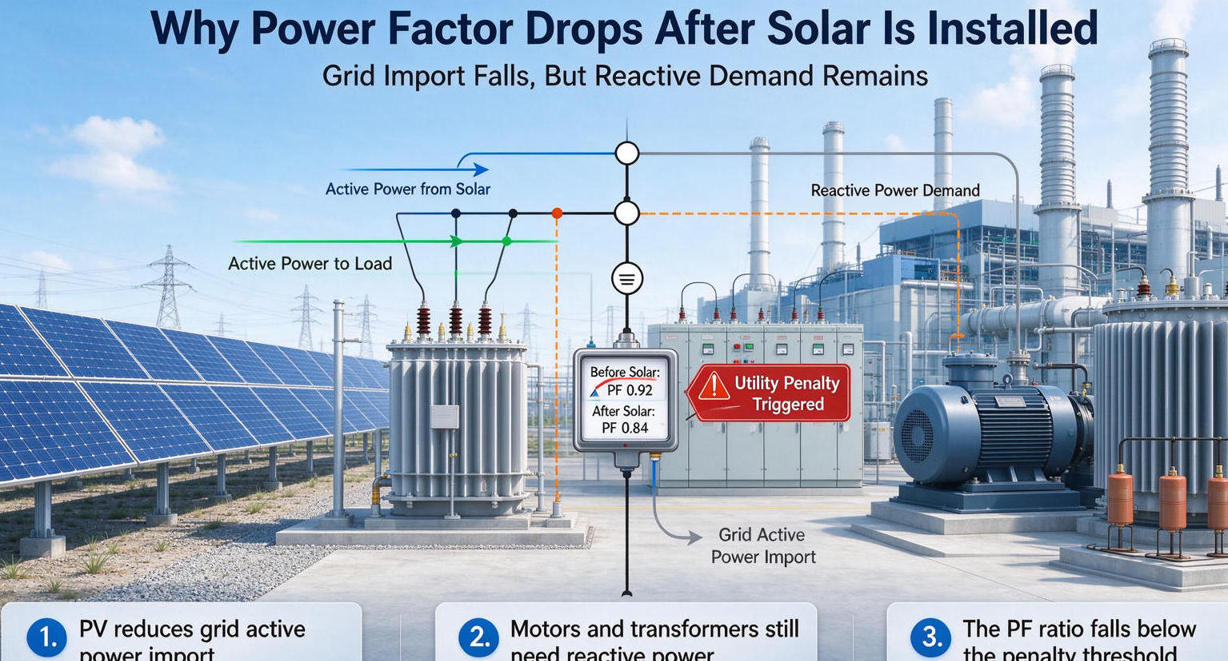
Solar Farm Power Factor Penalties: How SVG Stops Grid Fees Utility-scale and distributed solar photovoltaic (PV) plant operators worldwide face escalating monthly utility penalties for power factor (PF) non-compliance at the Point of Common Coupling (PCC). While solar farm developers engineer their systems for maximum active power generation during peak irradiance, grid codes such as IEEE 1547, IE...
BESS & Microgrid Power Quality: SVG & AHF Integration Utility-scale Battery Energy Storage Systems (BESS) and industrial renewable microgrids are fundamentally reshaping modern electrical infrastructure. However, interconnecting gigawatt-scale inverter-based resources (IBR) into weak transmission corridors and distribution grids with low Short-Circuit Ratios (SCR < 2.0) introduces unpre...
Port Crane & Shore Power Quality: Mitigating Cyclic Reactive Surges, Regenerative Braking, and Voltage Sags Modern container terminals, bulk marine ports, and automated shore-to-ship power installations operate some of the most dynamic and electrically demanding distribution networks in heavy industry. Ship-to-Shore (STS) gantry cranes, Rubber-Tired Gantry (RTG) yard cranes, and high-voltage s...
Airport baggage handling systems operate under constant time pressure. Conveyors, sorters, barcode readers, security scanners and control networks must move every bag through check-in, screening and loading without interruption. Behind this process is a dense network of motors, variable frequency drives (VFDs) and electronic controls. These loads improve automation, but they also create har...


 English
 français
 Deutsch
 español
 العربية
 中文




 IPv6 network supported

