Harmonics are extra currents and voltages at integer multiples of the supply frequency that non-linear loads draw on top of the fundamental sine wave. Their effect is costly: transformers, motors and neutral conductors overheat, relays mis-trip, and equipment life shortens even below rated load. This guide covers measurement at the point of common coupling (PCC) and how to compare the main mitigat...
Power Factor and Reactive Power: The Hidden Cost on Your Electricity Bill Your electricity bill may be higher than it needs to be — not because you use more energy, but because of how you use it. The culprit is power factor, and it's one of the most overlooked opportunities in energy management. Active, Reactive and Apparent Power To understand power factor...
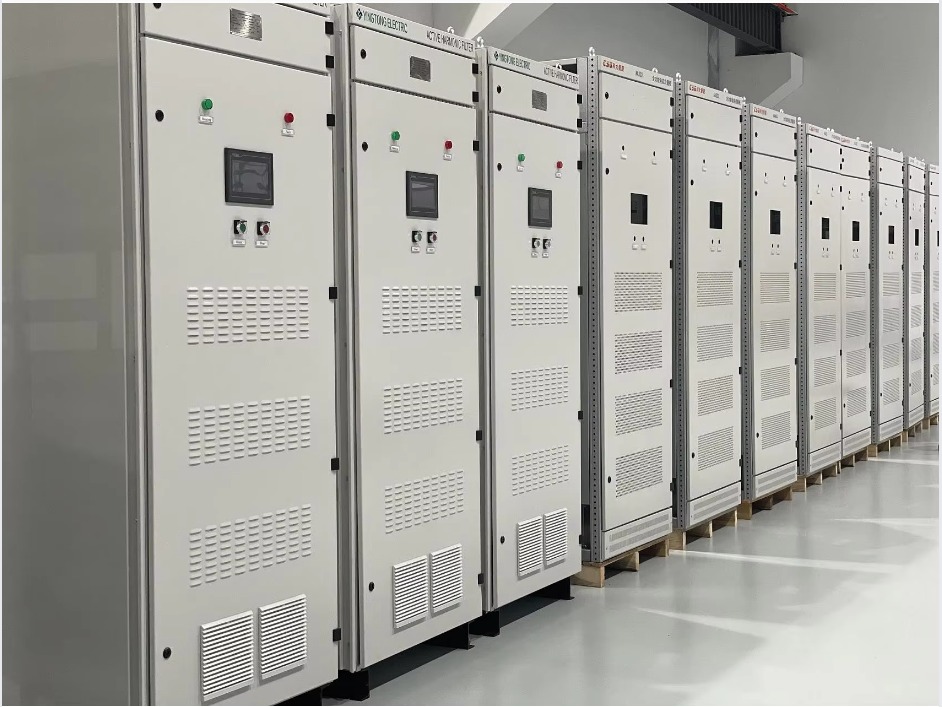
An Active Harmonic Filter (AHF) is a parallel-connected, closed-loop power-electronic device that measures load harmonic current with current transformers and injects an opposing current to cancel distortion at the point of common coupling (PCC). The engineering conclusion is blunt: an AHF is selected against the measured harmonic spectrum, load variability, site ambient temperature, and network i...
When a PV plant reaches MW scale, inverter control stops being the same thing as grid code compliance. Compliance is judged at the point of common coupling (PCC), where the utility measures voltage and current quality — not at the inverter terminals. A plant with well-behaved inverters can still fail its connection test for that reason, and a medium-voltage STATCOM is usually the device that...
Neutral conductor overheating in a three-phase four-wire system is a zero-sequence problem, so measure harmonic orders first and only then select a filter. A neutral that runs hot while the phases stay comfortably cool is rarely a coincidence. It points to zero-sequence current driven by triplen harmonics, which behaves nothing like a balanced-load calculation predicts. This article follows the or...
SVG sizing for power factor correction cannot be estimated from transformer capacity or a motor nameplate alone. Those figures describe how much load a site could connect, not how much reactive power the load actually exchanges with the supply at the point of common coupling (PCC). A Static Var Generator chosen from nameplate data will either leave the power factor short of target or spend on capa...
Capacitor bank overheating after adding VFDs is a power quality symptom, not a capacitor defect. VFD rectifiers inject harmonic current, the bank offers a low-impedance path at those frequencies, and parallel resonance between the bank and the supply can amplify that current until fuses open, contactors chatter and capacitor cans swell. A capacitor bank supplies reactive power to correct power fac...
Capacitor Banks vs. Active SVG: Which Power Factor Correction Is Right for You? When your electricity bill suddenly spikes — or your utility sends a power-factor penalty notice — a common fix is to install power factor correction (PFC). For decades, that meant one thing: capacitor banks. Today you have a second, modern option: the Static Var Generator (SVG). Both i...


 English
 français
 Deutsch
 español
 العربية
 中文






 IPv6 network supported