

 English
 français
 Deutsch
 español
 العربية
 中文
中文
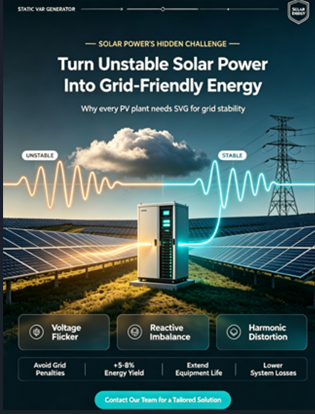
Solar energy is clean and abundant, but photovoltaic systems have a built‑in weakness – their output is inherently unstable. Clouds, temperature changes, and the day‑night cycle cause sudden power fluctuations that create serious power quality issues. These problems can damage equipment, trigger utility penalties, and even disconnect your plant from the grid. Static Var Generator solves these challenges, turning unstable solar power into reliable, grid‑friendly energy.
Unlike traditional power plants that deliver steady output, PV systems depend on irradiance. When a cloud covers half the array, output drops within seconds. When the cloud passes, power surges back. These rapid changes create three major power quality headaches.
Voltage Fluctuations and Flicker
Sudden active power changes cause voltage sags and swells at the connection point. On weak grids, these fluctuations become severe, causing flicker that annoys nearby customers and stresses transformer tap changers. Utilities impose strict limits – exceeding them leads to financial penalties or forced curtailment.
Reactive Power Imbalance
Most solar inverters operate at unity power factor by default, but during low irradiance or partial shading, they may unintentionally absorb or inject reactive power. This results in a poor overall power factor, increasing line losses and reducing transmission capacity. Many grid codes now require renewable plants to provide dynamic reactive support – something traditional capacitor banks cannot achieve.
Harmonic Distortion from Inverters
Inverters use high‑frequency switching to convert DC to AC, generating harmonics that distort the sinusoidal waveform. Harmonics cause overheating in transformers and motors, interfere with protection relays, and can trip neighboring equipment. Without mitigation, your PV plant may fail to meet IEEE 519 or local grid standards.
These issues not only threaten compliance but also reduce your energy yield and shorten equipment life. The cost of poor power quality can reach millions over a project’s lifetime.
Static Var Generator is not a passive capacitor bank. It is an active power‑electronics device that senses grid conditions in real time and responds in milliseconds. For solar farms, SVG delivers instant compensation for every transient event.
Millisecond Response to Irradiance Changes
When a cloud causes voltage to sag, SVG detects it within one cycle and injects the exact reactive power needed to hold voltage steady. When the sun returns and voltage swells, it absorbs reactive power to prevent overvoltage. This keeps voltage fluctuation within ±1%, well within grid requirements.
Full‑Range Reactive Power Support
Unlike fixed capacitors that only provide capacitive compensation, SVG supplies both capacitive and inductive reactive power continuously. This allows your plant to meet utility power factor requirements at all times – from dawn to dusk, and even at night when inverters are idle but SVG can still support grid voltage.
Active Harmonic Filtering
SVG includes built‑in harmonic suppression. It monitors the current waveform and injects opposite‑phase harmonic currents to cancel distortion. Total harmonic distortion can be reduced below 3%, protecting downstream equipment and ensuring compliance with strict grid codes.
Three‑Phase Balancing
Unbalanced loads or uneven irradiation across strings cause phase current imbalances. SVG independently compensates each phase, reducing neutral currents and improving overall system efficiency.
Installing SVG delivers measurable returns beyond compliance:
Avoid Penalties and Curtailment – Meet grid code requirements consistently, eliminating fines and ensuring you sell every kilowatt‑hour generated.
Increase Energy Yield – Stabilized voltage reduces inverter trips and derating. Many projects report a 5‑8% increase in annual generation simply because inverters stay online longer.
Extend Equipment Life – Reduced harmonics and voltage stress lower operating temperatures of transformers and switchgear, extending their lifespan by years.
Lower System Losses – Improved power factor reduces current through cables, cutting I²R losses and boosting plant efficiency.
Future‑Proof Your Plant – As grid requirements tighten, SVG with modular design allows capacity upgrades without full replacement.
While SVG is powerful, it cannot work miracles if background voltage distortion is already high. In solar farms, harmonics from multiple inverters can interact and create resonance. If voltage total harmonic distortion at the connection point exceeds 8% under normal operation, the SVG may experience control instability. Its filtering algorithms can overload, leading to overheating or nuisance tripping.
Always conduct a thorough power quality audit before sizing SVG. If existing distortion is high, consider installing a passive harmonic filter upstream or choosing an SVG with enhanced harmonic compensation. Also ensure control parameters are tuned to your collection system’s impedance. Proper planning avoids costly retrofits and ensures reliable performance from day one.
Q: Why does a solar farm need SVG when inverters already have reactive power control?
A: Many inverters have built‑in reactive control, but they are limited by their current rating. At full active power output, they have little margin for reactive power. Moreover, inverters respond slowly (hundreds of milliseconds) and cannot handle rapid voltage fluctuations from passing clouds. SVG operates independently and instantly, providing both leading and lagging reactive power without affecting your active generation – so you never sacrifice energy yield for grid support.
Q: How do I choose the right SVG capacity for my solar project?
A: Required capacity depends on the maximum reactive power deficit under worst‑case conditions – typically at low irradiance or during grid voltage deviations. A common rule is to size SVG at 10‑15% of plant rated capacity, but this varies based on grid strength and local codes. We recommend a dynamic simulation using site irradiance data and grid impedance. Our team provides tailored analysis to balance cost and performance.
Q: Can SVG work with existing capacitor banks or filters?
A: Yes. SVG integrates with existing compensation equipment. A hybrid solution – fixed capacitors for steady‑state compensation plus SVG for dynamic correction – often offers the best economics. However, avoid resonance between capacitors and system inductance. Our SVG includes anti‑resonance control algorithms that coordinate with passive elements. We always conduct a site survey and harmonic study before finalizing the configuration.
Power quality is no longer a secondary concern – it is a key determinant of profitability and reliability for photovoltaic projects. Solar irradiance will never be steady, but your plant’s performance can be. Static Var Generator offers the speed, precision, and flexibility to tackle voltage fluctuations, reactive imbalances, and harmonics in one integrated solution. It helps you comply with grid codes, maximize energy output, and protect long‑term assets.
As solar capacity grows, grids demand higher power quality standards. Investing in SVG today future‑proofs your project against stricter regulations and challenging grid conditions.
Ready to stabilize your solar power and boost your bottom line? Our team specializes in SVG for renewable energy. Contact us sales@yt-electric.com for a consultation and see how much you can gain from cleaner, more reliable power.



 IPv6 network supported