Why Poor Power Quality Prevents Industrial Growth: The Hidden CapEx, OpEx, and Downtime Costs Quick Engineering Answer: Poor power quality—specifically harmonic distortion (THDi > 15%), voltage sags (< 0.9 p.u.), and phase unbalance (> 2%)—directly bottlenecks industrial growth by inflating operating expenditures (OpEx) by 4% to 12% in wasted energy losses, consuming up to 30%...
Clean Power Solutions for Modern Office Towers The power networks in today’s skyscrapers and large office buildings face increasingly complex challenges. From nonlinear loads like elevators, LED lighting, and IT systems to harmonic pollution affecting the power supply's quality, maintaining optimal power quality is critical. This blog explores how the YTPQC Active Harmonic Filters effectivel...
IEEE 519 Harmonic Distortion Limits: Guide to Compliance The IEEE 519-2022 standard, called Harmonic Control in Electric Power Systems, sets rules for designing electrical systems to reduce harmonic distortion. What Does the Standard Do? IEEE 519-2022 helps engineers manage harmonics in power systems. It covers both linear loads (like motors and regular light bulbs) and nonlinear loads...
Power Quality: Why It Matters and How YT Electric Provides Solutions What Is Power Quality, and Why Should We Care? In 2001, a Silicon Valley manufacturing company lost over $3 million in a single day due to a power outage that halted production.¹ Today, nearly 20% of the world’s electricity is wasted due to inefficiencies in power transmission and distributio...
Minimizing Harmonic Distortion in Microinverter Systems ACTIVE POWER FILTER SOLUTIONS Microinverters—each mounted under a single photovoltaic (PV) module—offer significant advantages for residential solar installations. However, like all inverter-based systems, they introduce harmonic distortion due to high-frequency switching. This article explores the origins, impacts, ...
Grid Interconnection Compliance for Waste-to-Energy Plants: Overcoming Interharmonics, Voltage Flicker, and Dynamic Reactive Demands Quick Engineering Answer: Connecting Waste-to-Energy (WtE) and biomass generation assets to the transmission grid requires satisfying rigorous Point of Common Coupling (PCC) power quality standards (IEEE 519-2022, IEC 61000-3-6, and EN 50549). Flue gas treatment driv...
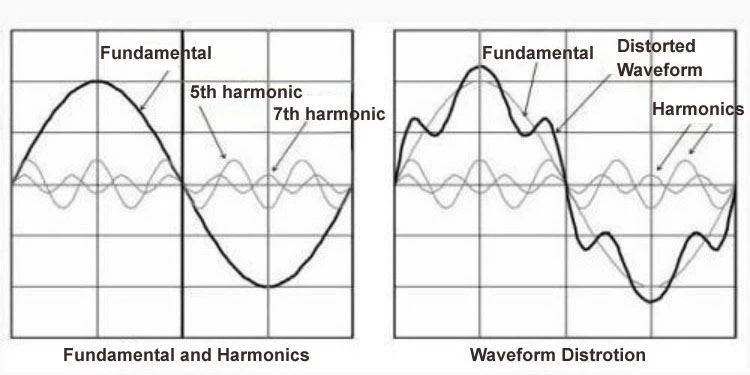
1. Why Do SVGs Generate Harmonics? Unlike ideal components, the real-world power electronic switches (IGBTs) in an SVG do not switch sinusoidally. They use Pulse Width Modulation (PWM) to synthesize a sinusoidal output current. This switching action is the primary source of harmonics. PWM Switching Frequency Harmonics: The output voltage of the SVG's H-Bridge inverters is a series of high-fre...
Using Medium Voltage SVG in the metallurgical industry is not an "option," but a "necessity" concerning economic efficiency, production stability, and social responsibility. We can use a simple analogy to understand this: The power grid of a metallurgical plant is like a main water pipe supplying all equipment. High-power impact loads like electric arc furnaces and rolling mills are like gian...


 English
 français
 Deutsch
 español
 العربية
 中文




 IPv6 network supported