Even-Order Harmonics: Why Standard APFs Miss Them & How Full-Spectrum Active Filters Stop DC Magnetization Quick Answer: Standard Active Power Filters (APF/AHF) miss even-order harmonics (2nd, 4th, 6th) because their internal Discrete Fourier Transform (DFT) algorithms assume half-wave waveform symmetry ($f(t) = -f(t + T/2)$) to optimize digital signal processor (DSP) cycle throughput, activel...
Why Active Harmonic Filter Is a Game-Changer for Steel Plants with Smelting Furnaces Steel plants are among the most electrically demanding facilities in the world. Arc furnaces, induction furnaces, rolling mills, large motors, cranes, and variable frequency drives all operate on the same network. This mix creates a complex and rapidly changing power quality environment. Harmonic distortion is one...
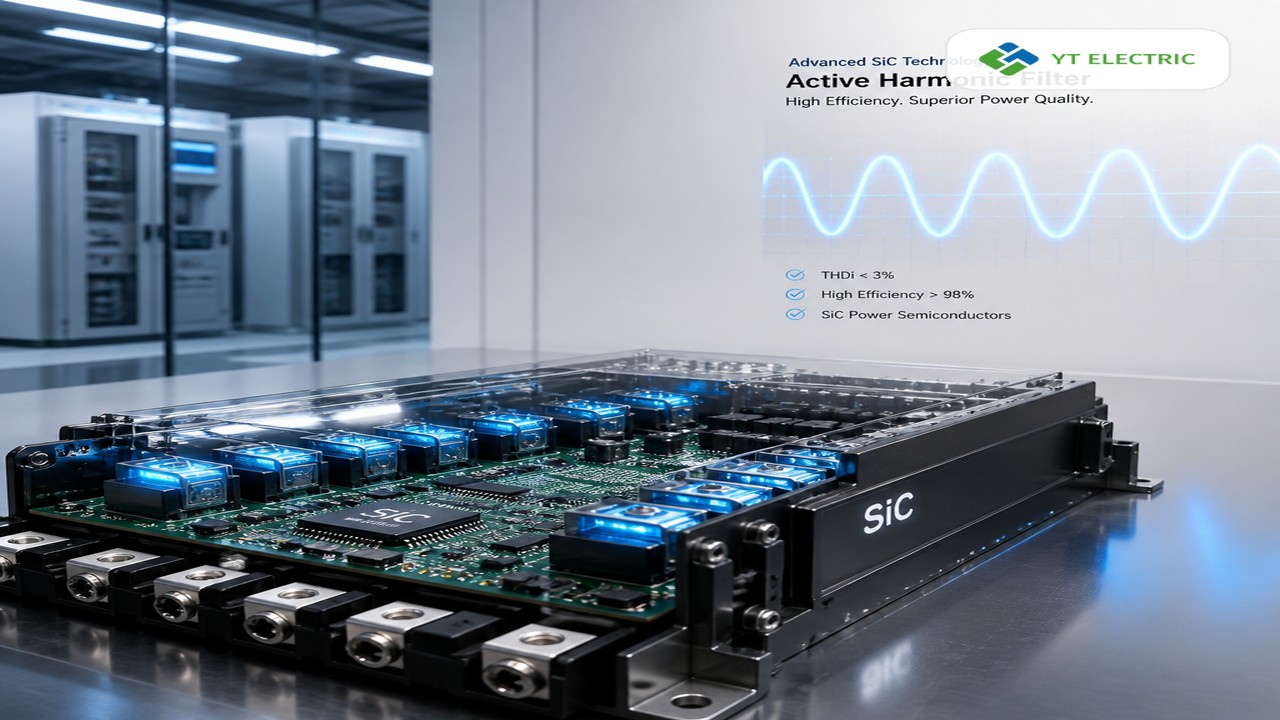
Silicon Carbide (SiC) Active Harmonic Filter Efficiency Benchmark: Why Sub-1% Loss Architecture Changes Industrial Power Quality Economics Quick Engineering Answer: Transitioning from traditional silicon IGBTs to wide-bandgap Silicon Carbide (SiC) MOSFET power architectures in Active Harmonic Filters (AHF) elevates power electronics efficiency to an unprecedented industry benchmark. Based on high-...
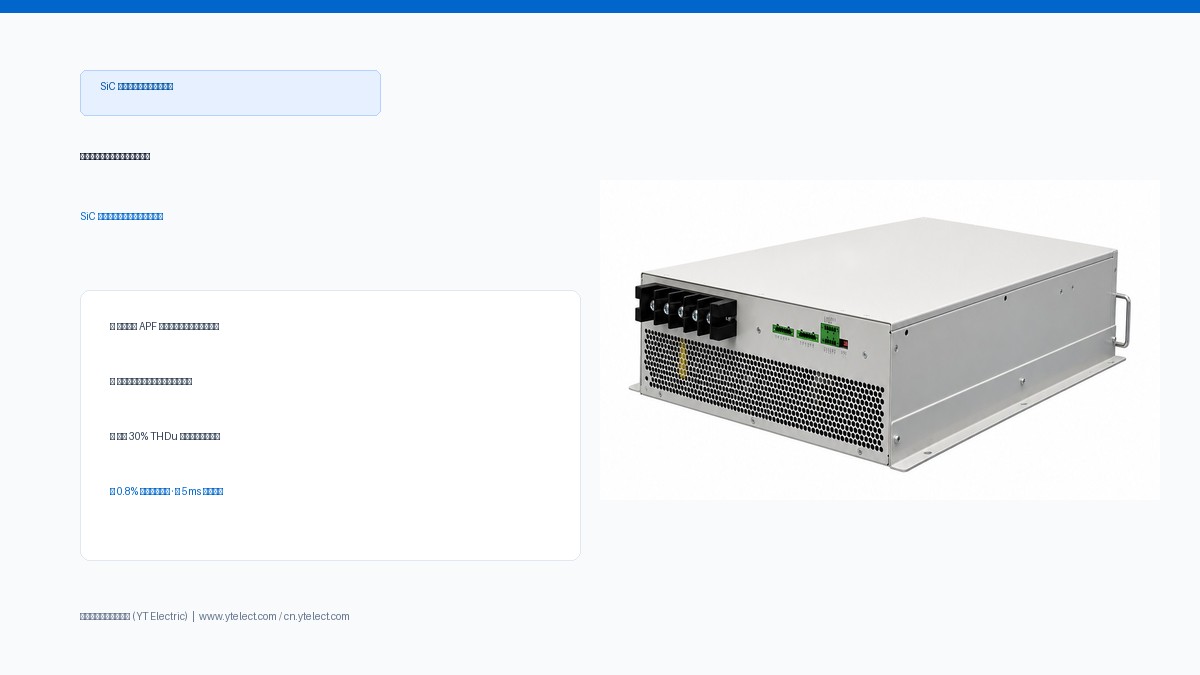
Quick Answer: Powered by 3rd-generation Silicon Carbide (SiC MOSFET) topology, YT Electric introduces its next-generation modular Active Power Filters (APF / AHF) and Static Var Generators (SVG). The new SiC platform achieves an overall system conversion efficiency of ≥ 99.0% (tested up to 99.4%) and suppresses operating average losses down to 0.8%—over 60% lower than legacy silicon IGBT ...
In continuous 24/7 industrial manufacturing and mission-critical power infrastructures, the operating electrical losses and heat dissipation of active power quality equipment represent a substantial, ongoing component of Total Cost of Ownership (TCO). YT Electric's next-generation Silicon Carbide (SiC) active filter and static var generator modules establish a sub-1% loss benchmark (0.8% average o...
In advanced semiconductor wafer fabs, medical imaging suites, precision CNC manufacturing, and mission-critical data centers, conventional Active Harmonic Filters (APFs) often introduce unwanted high-frequency switching ripple and distortion while mitigating grid harmonics. YT Electric's 3rd-generation Silicon Carbide (SiC) power quality platform leverages an ultra-high 80kHz switching frequency c...
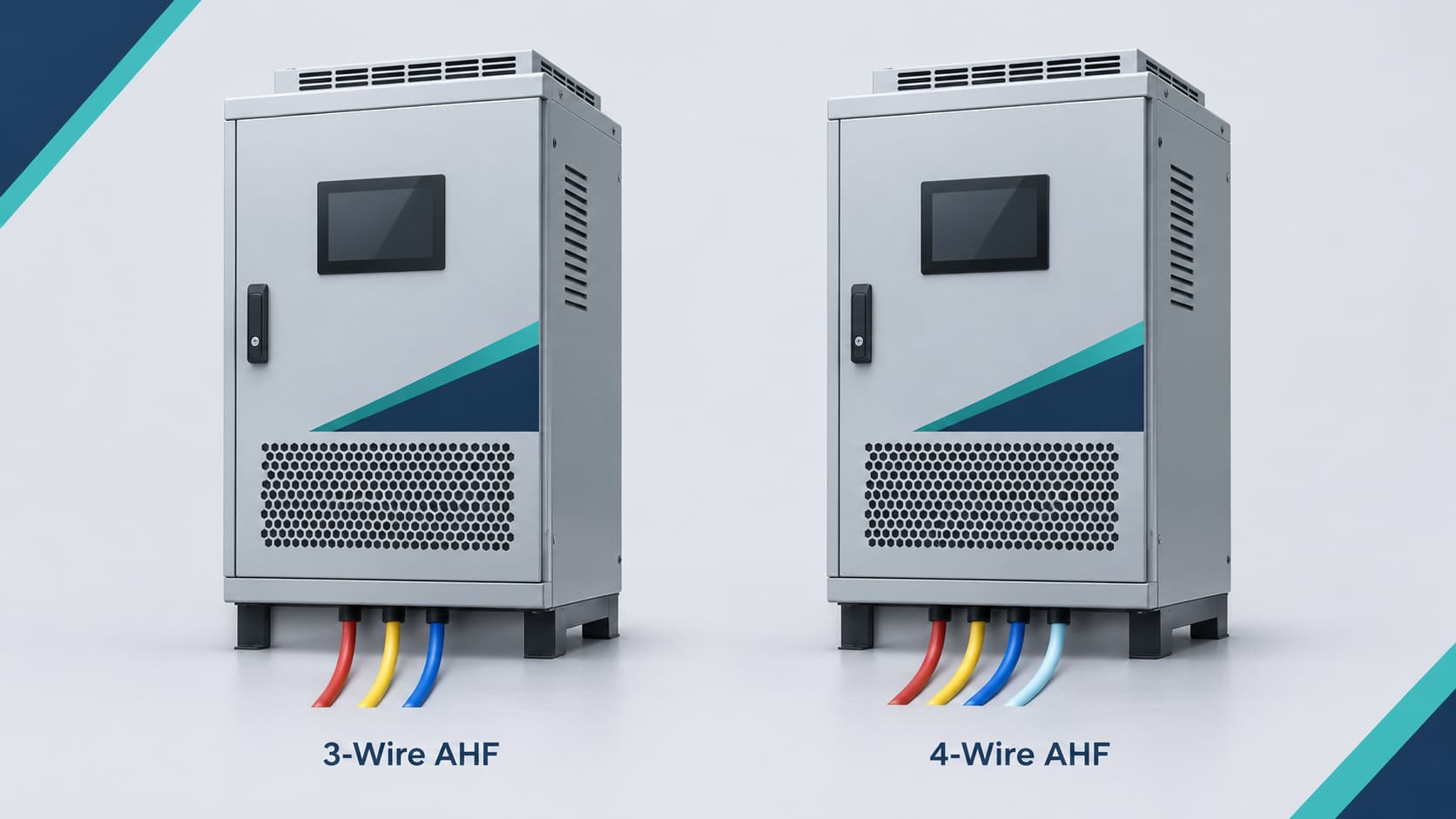
Direct Answer: 3-Wire vs. 4-Wire AHF Selection The core difference between 3-wire and 4-wire Active Harmonic Filters (AHFs) lies in neutral path compensation: 3-wire AHFs mitigate 3-phase balanced harmonics (5th, 7th, 11th, 13th) in 3P3W industrial grids, whereas 4-wire AHFs utilize a dedicated 4th inverter bridge leg or split-DC bus to neutralize heavy zero-sequence triplen harmonics (3rd, 9th, 1...
Quick Answer Core Takeaway: Induction melting furnaces and high-power thyristor rectifiers inject severe mixed even-order (2nd, 4th, 6th...) and odd-order (3rd, 5th, 7th...) harmonics into industrial grids due to asymmetrical firing angles and half-wave conduction. Conventional Silicon IGBT Active Power Filters (APFs), constrained by switching carrier limits (<20kHz) and narrow-band control alg...


 English
 français
 Deutsch
 español
 العربية
 中文





 IPv6 network supported