Even-order harmonics are current and voltage components at even multiples of the fundamental frequency — the 2nd, 4th, 6th and higher orders — that appear as asymmetric distortion in a three-phase power system. They behave differently from the familiar 3rd, 5th and 7th odd harmonics: balanced six-pulse rectifiers do not generate them, but asymmetry does. Half-controlled bridges, DC-off...
When Power Quality Equipment Must Also Be Quiet A Static Var Generator is normally evaluated by reactive power capacity, response time, power factor control and harmonic compensation. In many installations, the equipment room adds another requirement: the solution must also control noise, dust exposure and maintenance demands. YT Electric’s Fanless Static Var Generator uses natural he...
High THDi — total harmonic distortion of current — is the ratio of the RMS value of all current harmonics to the fundamental current, expressed as a percentage. It rises when nonlinear loads such as variable frequency drives (VFDs), rectifiers, UPS units and chargers draw current in pulses instead of a clean sine wave. A high reading must be explained, not simply cleared: measure the s...
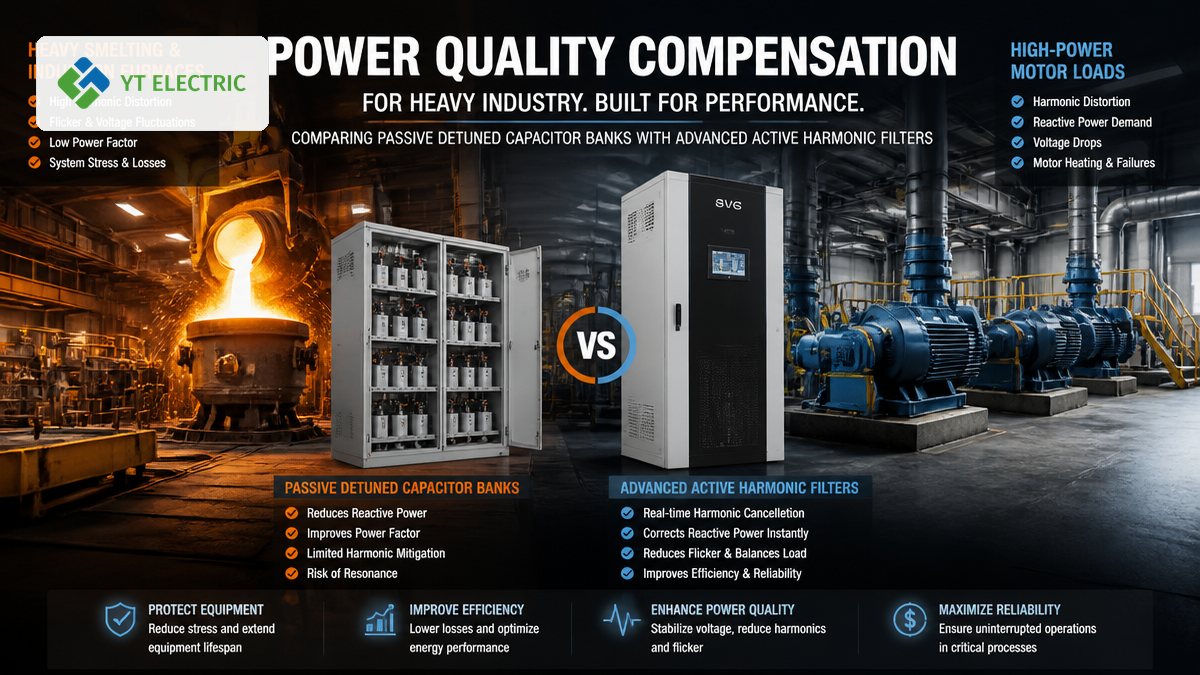
Poor power quality rarely appears as its own line on an electricity bill, but it can raise the charges a facility already pays by increasing current, losses and power-factor or demand penalties. When a bill climbs the tariff is blamed first — yet low power factor, harmonic distortion and voltage imbalance make a plant draw more current than the useful work it produces requires. This article ...
Harmonics are extra currents and voltages at integer multiples of the supply frequency that non-linear loads draw on top of the fundamental sine wave. Their effect is costly: transformers, motors and neutral conductors overheat, relays mis-trip, and equipment life shortens even below rated load. This guide covers measurement at the point of common coupling (PCC) and how to compare the main mitigat...
Power Factor and Reactive Power: The Hidden Cost on Your Electricity Bill Your electricity bill may be higher than it needs to be — not because you use more energy, but because of how you use it. The culprit is power factor, and it's one of the most overlooked opportunities in energy management. Active, Reactive and Apparent Power To understand power factor...


 English
 français
 Deutsch
 español
 العربية
 中文




 IPv6 network supported

