

 English
 français
 Deutsch
 español
 العربية
 中文

Solar Farms Are Paying Hidden Power Factor Penalties
Here Is How SVG Stops the Bleeding
Solar projects are built to generate active power and reduce electricity purchases from the grid. But as soon as PV production rises and grid import falls, a hidden problem appears: the facility’s reactive power demand does not disappear. The load still needs reactive power, but the active power drawn from the utility is now much smaller. The result is a lower power factor at the point of common coupling, and in many regions, that means automatic utility penalties.
This is not a solar panel problem. It is a reactive power compensation problem. Static Var Generator solves it dynamically, and the cost savings can be measured in avoided penalties, released transformer capacity, and reduced line losses.
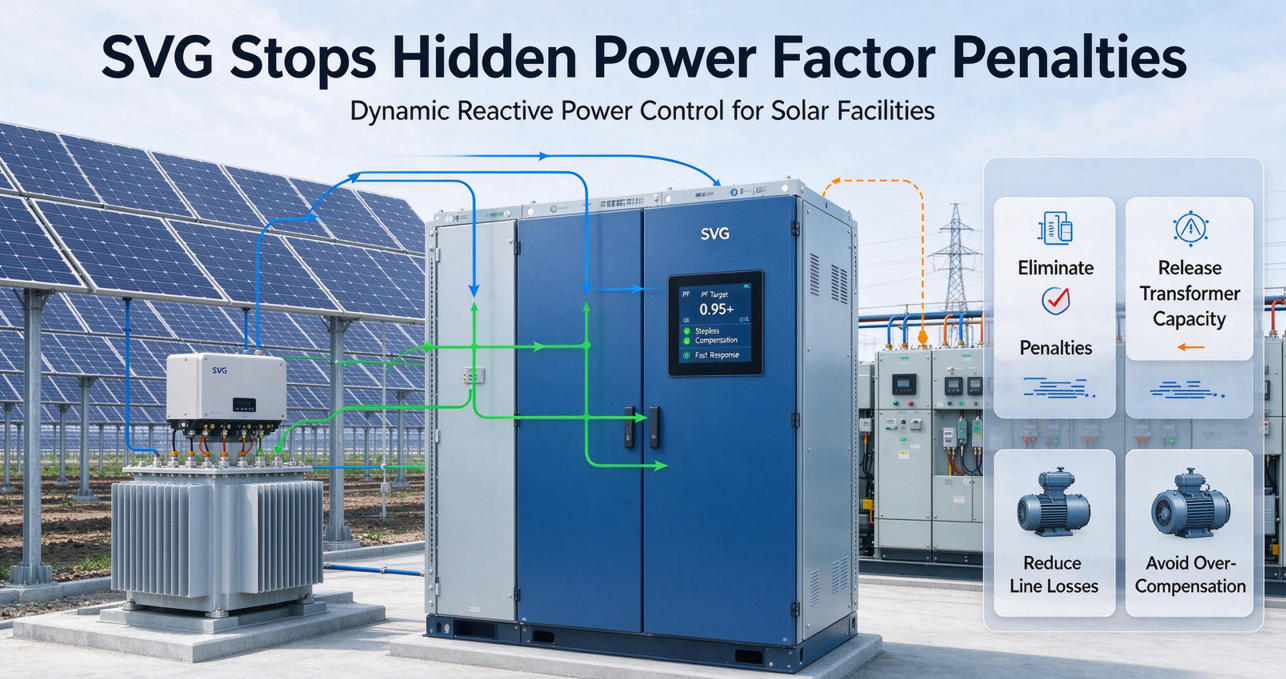
Power factor is the ratio of active power to apparent power. When a facility imports most of its active power from the grid, the reactive power drawn from the grid is proportionally smaller, and the power factor may look acceptable. But when solar generation covers a large share of active power demand, grid import drops sharply. The reactive power required by motors, transformers, and other inductive loads remains roughly the same. The utility meter therefore sees a small active power import and a relatively large reactive power import. The calculated power factor falls.
If the facility’s existing capacitor banks are fixed or stepped, they may not track this new operating condition. They may over-compensate at night or under-compensate during high PV output. The utility then applies power factor penalties, and the solar project that was supposed to save money starts generating unexpected charges.
SVG continuously monitors voltage, current, and power factor at the grid connection point. When PV output rises and grid active power import falls, SVG detects the changing reactive power balance and injects or absorbs reactive power in milliseconds. It maintains the target power factor regardless of whether the facility is importing active power, exporting active power, or operating at near-zero grid import.
Unlike fixed capacitor banks, SVG provides stepless compensation. It does not create resonance with system harmonics, and it does not degrade over time. It also stabilizes voltage and reduces harmonic distortion, which helps solar inverters and sensitive loads operate more reliably.
Eliminated Power Factor Penalties
Utilities often charge penalties when power factor falls below 0.90 or 0.95. SVG keeps power factor consistently above the threshold, removing these charges from the monthly bill.
Released Transformer Capacity
Reactive power consumes transformer capacity without producing useful work. By correcting power factor, SVG frees capacity for active power and can defer or avoid transformer upgrades.
Reduced Line Losses
Lower reactive current means lower I²R losses in cables and transformers. The savings appear as reduced energy consumption and lower cooling demand.
Avoided Over-Compensation Waste
Fixed capacitor banks often remain connected when PV output is high, causing leading power factor and additional penalties. SVG avoids both under-compensation and over-compensation.
Lower Maintenance Cost
Capacitor banks require periodic replacement due to aging and bulging. SVG has no moving parts and no capacitor aging problem, reducing maintenance and replacement costs over the project life.
Q: Why does the power factor penalty appear only after solar is installed?
A: Before solar, the facility imported both active and reactive power from the grid in a ratio that may have met the utility threshold. After solar, active power import falls, but reactive power demand remains. The ratio therefore drops, and the meter records a lower power factor. The problem is not the solar system itself, but the lack of dynamic reactive compensation at the connection point.
Q: How much can a customer save by replacing fixed capacitors with SVG?
A: Savings depend on the tariff, penalty structure, load profile, and current power factor. Typical savings include eliminated monthly penalties, reduced transformer losses, and avoided capacity charges. For a facility that repeatedly falls below the penalty threshold during high PV output, the penalty elimination alone often provides a payback period of a few years. Additional savings from released capacity and lower losses shorten the payback further.
Q: Can SVG work with the existing solar inverters and capacitor banks?
A: Yes. SVG can operate alongside solar inverters and existing compensation equipment. However, fixed capacitor banks should be reviewed carefully because they may cause over-compensation during high PV output. In many retrofits, the capacitor bank is decommissioned or reduced, and SVG takes over dynamic compensation. A power quality audit should confirm the harmonic spectrum, transformer impedance, and reactive power demand before finalizing the design.
Solar generation reduces grid active power purchases, but it does not reduce the facility’s need for reactive power. Without dynamic compensation, power factor falls and penalties appear. SVG provides the fast, stepless reactive power support needed to keep power factor stable across day and night, cloudy and clear conditions. The result is lower utility bills, released transformer capacity, reduced losses, and a solar project that delivers the savings it was designed for.
If your solar site has started receiving power factor penalties, please contact us sales@yt-electric.com the issue is not your PV panels.



 IPv6 network supported